


A Guide to India's New Salary Rules in 2025
60-Second Summary
India's new Labour Codes (effective 21 November 2025) have fundamentally changed how your salary is built. Here's what's happening at a glance:
- Basic Pay must now be minimum 50% of your total CTC (was typically 30–35%)
- PF is calculated on this bigger base → your deduction goes up
- Take-home may drop by ₹1,000–3,000/month for mid-level earners
- But your retirement corpus and gratuity grow significantly
- Fixed-term/contract workers get gratuity after just 1 year (was 5 years)
- F&F settlement must happen within 2 working days of exit
Less cash now. Much more security later.
Let's start with the most important fact: your salary structure has legally changed.
Not because your company decided to. Not because you negotiated differently. It's because India just rewrote its labour laws ,the first major overhaul since the 1940s ,and the new rules took effect on 21 November 2025.
If you've opened your payslip recently and noticed your take-home is slightly lower than it used to be, or if HR sent you a new 'revised CTC breakdown', this article explains everything. No jargon. No legalese. Just a straight explanation of what changed, why it changed, and what it means for your actual wallet.
Let's go top-down. The most important thing first.
The One Rule That Changes Everything: The 50% Basic Pay Mandate
Under the new Code on Wages, 2019, your Basic Pay + Dearness Allowance (DA) must now equal at least 50% of your total Cost to Company (CTC). Full stop.
So what? This means if you earn ₹10 lakh a year, at least ₹5 lakh of that must now be classified as Basic Pay ,not hidden in allowances.
Why does this matter? Because Provident Fund (PF) and Gratuity are both calculated as a percentage of your Basic Pay. A bigger basic means bigger deductions, and bigger retirement savings.
Why Basic Pay Must Now Be 50% of Your CTC
For decades, Indian companies kept Basic Pay low ,often just 25–35% of CTC ,and stuffed the rest into allowances like HRA, Special Allowance, Travel Reimbursement, etc. The result? Lower PF deductions, lower gratuity liabilities, and a fatter monthly take-home.
This was legal. It was also the standard playbook across startups, MNCs, and everything in between. But it meant workers were building far less retirement wealth than they should have been.
The new rule shuts that door. The excess allowances over 50% get reclassified as 'wages' for statutory calculations. The loophole is gone.
The Old Game That Companies Were Playing
For decades, Indian companies kept Basic Pay low ,often just 25–35% of CTC ,and stuffed the rest into allowances like HRA, Special Allowance, Travel Reimbursement, etc. The result? Lower PF deductions, lower gratuity liabilities, and a fatter monthly take-home.
This was legal. It was also the standard playbook across startups, MNCs, and everything in between. But it meant workers were building far less retirement wealth than they should have been.
The new rule shuts that door. The excess allowances over 50% get reclassified as 'wages' for statutory calculations. The loophole is gone.
How Companies Structured Salaries Before the New Rule
Take Priya, a marketing manager in Bengaluru earning ₹12 lakh per annum (LPA). Here's how her salary looked before and after the change:
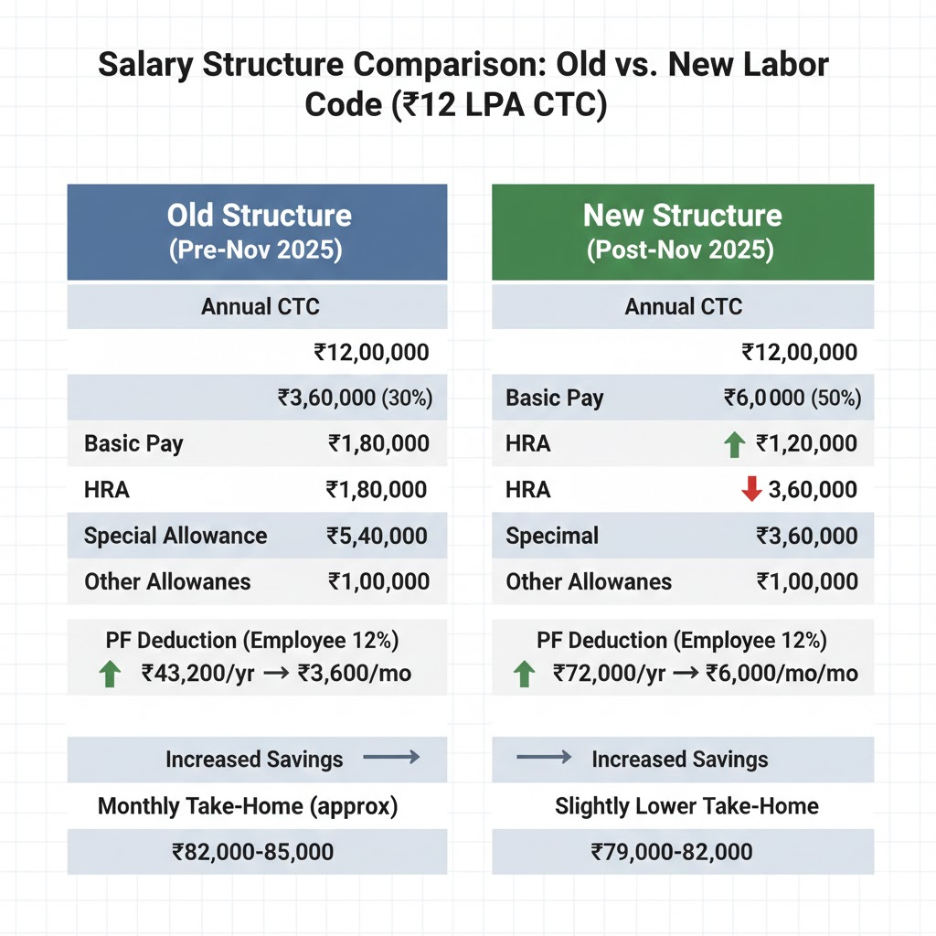
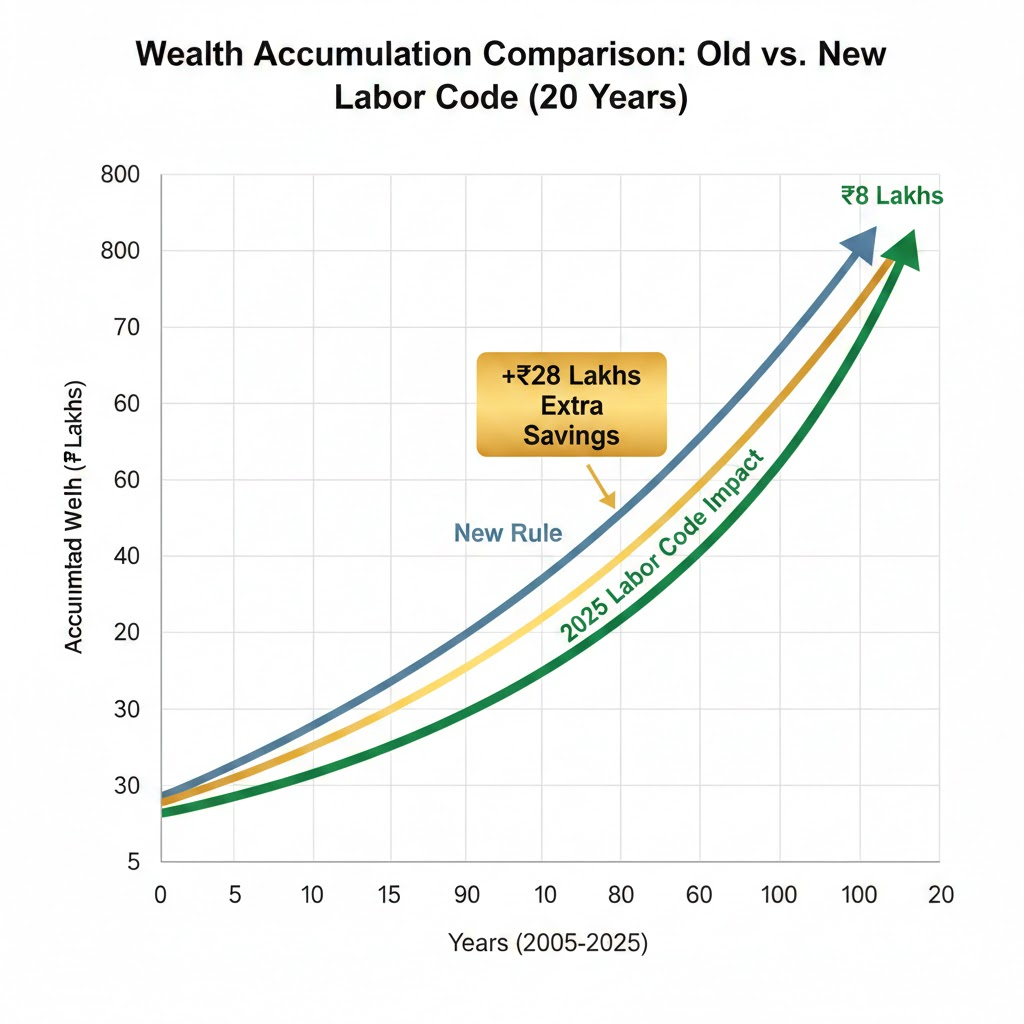
Priya's take-home drops by about ₹2,400 per month. That's real money out of her immediate pocket. But her annual PF contribution (employer + employee combined) increases by ₹57,600 per year. Compounded over 20 years at 8%, that's a difference of over ₹28 lakhs in retirement savings.
That is the trade-off the government is forcing everyone to make: less cash now, dramatically more security later.
Why the Government Introduced the 50% Wage Rule
This is the question that's confusing a lot of people right now, and it's worth explaining carefully because it feels unfair at first glance.
Your CTC has not changed. Your employer hasn't reduced your salary. What has changed is the distribution ,how that same total amount is split between basic pay and allowances.
Think of it like a glass of water with a partition down the middle. The total water (your CTC) is the same. The government has just mandated that at least half must be on the left side of the partition (basic pay). Previously, you might have had only 30% on the left. Shifting 20% over means the calculations for PF and gratuity are now based on a bigger number ,which increases your deductions.
You are not poorer. You are just saving more compulsorily than you were before.
The Numbers Behind the Drop
Your CTC | Old Basic (30%) | New Basic (50%) | Monthly Take-Home Change |
₹6 LPA | ₹1,80,000 | ₹3,00,000 | ↓ ~₹800/month |
₹10 LPA | ₹3,00,000 | ₹5,00,000 | ↓ ~₹1,500/month |
₹15 LPA | ₹4,50,000 | ₹7,50,000 | ↓ ~₹2,000/month |
₹24 LPA | ₹7,20,000 | ₹12,00,000 | ↓ ~₹3,200/month |
(Above figures are approximate and assume PF capped at ₹15,000 basic for higher earners. Your actual impact depends on your employer's PF policy.)
📄 Time to File Your ITR with the New Salary Structure?
The new salary rules change how your taxable income is calculated. Make sure your Income Tax Return reflects your restructured CTC, higher PF, and applicable deductions correctly.
Real Example: How the New Salary Structure Changes Your Payslip
The second big change hits contract and fixed-term workers especially hard ,in a good way.
Previously, you needed five continuous years of service to be eligible for gratuity. If you left a job after four years and eleven months, you got nothing. This rule trapped millions of workers in roles just to hit the five-year mark, or simply denied them a benefit they'd genuinely earned.
Under the new Labour Codes, if you're on a fixed-term employment contract, you are now eligible for pro-rata gratuity after completing just one year of service. One year.
Worker Type | Old Rule | New Rule (2025) |
Permanent Employee | Gratuity after 5 years | Gratuity after 5 years (unchanged) |
Fixed-Term / Contract | Gratuity after 5 years | Gratuity after 1 year |
Gig / Platform Worker | Not eligible | Now covered under Social Security Code |
And because gratuity is calculated on last drawn wages ,which, under the 50% rule, is now a much higher base ,the actual gratuity amount will be substantially larger than before even for permanent employees.
Formula reminder: Gratuity = (Last Drawn Wages × 15 × Years of Service) / 26
With a higher wage base in the numerator, the final payout grows ,automatically, legally, without negotiation.
📋 Have a gratuity or full & final settlement dispute?
Our employment law experts can help you calculate what you're owed and enforce your rights under the new Labour Codes.
ESI, PF, and Social Security: What's New
1. Employee State Insurance (ESI)
ESI registration is now mandatory for all eligible employees. The contribution applies when your Basic Salary + DA + Retaining Allowance is ₹21,000 or less per month. If you fall in this range, ESI gives you access to medical care, sickness benefits, maternity benefits, and disability coverage.
- Employee contribution: 0.75% of wages
- Employer contribution: 3.25% of wages
- Coverage expanded: now pan-India ,voluntary for <10 employees, mandatory even for 1 employee in hazardous process units
2. Provident Fund (PF)
- Contribution: 12% of Basic Wages from both employee and employer
- With the 50% rule, your effective PF savings are now significantly higher
- For salaries where basic exceeds ₹15,000, PF can be contributed on actual basic (not capped)
Tax Implications: The Silver Lining
Here's something many people miss in the panic about lower take-home: higher PF contributions mean higher tax deductions.
Employee PF contributions (12% of basic) are deductible under Section 80C of the Income Tax Act ,up to ₹1.5 lakh per year. If your PF contribution has increased due to the 50% rule, you may now be utilizing your 80C limit more efficiently, reducing your taxable income.
This means the take-home reduction might not be as bad after taxes as the gross numbers suggest.
The 48-Hour Exit Rule: Your Company Has to Pay You Faster
One of the most practically useful changes for employees is about Full & Final (F&F) settlement timelines.
If you've ever left a job, you know the pain: you resign in March, your last day is April 30, and your final settlement cheque arrives sometime in June ,if you're lucky. Chasing HR for your own money after leaving a company is a deeply unpleasant experience.
Note: Statutory payments like gratuity may still follow a slightly different timeline (often 30 days) depending on state rules ,but the overall direction is clear: faster, more transparent, legally enforceable.
Under the new Industrial Relations Code, companies are now legally required to complete your F&F settlement within two working days if you resign, are dismissed, or are retrenched. Not 30 days. Not 45. Two working days.
This applies to: final month's salary, pending leaves, notice pay adjustments, and other outstanding dues.
If your employer isn't following the 48-hour rule, you have legal options. See: What to Do If Your Employer Doesn't Pay Your Salary
⚖ Employer violating the 48-hour F&F rule? Our legal team can file a dispute and help recover your dues quickly.
What Should You Do Right Now?
Here's the practical action list ,for both employees and employers.
If You Are an Employee
- Review your new payslip: Check that Basic Pay is at least 50% of your gross CTC. If it's not, your employer is non-compliant.
- Recalculate your 80C: Your PF contribution may have increased. You might be saving more tax automatically ,adjust your investment plan accordingly.
- Check your ITR: With a restructured salary, your taxable income components change. File your next ITR with these new figures in mind.
- Know your F&F rights: If you're planning to resign, document your exit date and demand F&F within 2 working days. Do it in writing.
- Get an appointment letter: Mandatory under the new codes. If your employer hasn't issued one, ask for it ,it protects you legally.
Related reading: Top Legal Compliance Requirements for Businesses in India
If You Are an Employer or HR Professional
- Restructure all CTC models immediately ,basic must be ≥50% of total compensation.
- Update payroll software to reflect new wage definitions and ESI/PF calculations.
- Issue appointment letters to every employee ,mandatory now, not optional.
- Review F&F processes ,update to complete within 2 working days of separation.
- Get a compliance audit ,non-compliance now triggers penalties, inspections, and legal disputes.
🏢 Employer? Get Your Compliance Audit Done.
Our legal and CA team will audit your payroll structure, identify non-compliance risk, and help you restructure CTC correctly before the penalties hit.
Quick Reference: 2025 Salary Rules vs. Old Rules
Feature | Before Nov 2025 | After Nov 2025 |
Basic Pay | 30–40% of CTC (typical) | Minimum 50% of CTC (mandatory) |
PF Base | Calculated on lower basic | Calculated on higher 50% basic |
Gratuity for Contract Workers | 5 years of service required | 1 year of service required |
Gratuity Amount | Lower (smaller wage base) | Higher (larger wage base) |
F&F Settlement | 30–90 days (typical) | 2 working days (legally mandated) |
Take-Home Pay | Higher | Slightly lower |
Retirement Corpus | Slower growth | Significantly faster growth |
Gig Worker Coverage | Not covered | Social security recognized |
Appointment Letters | Optional in many firms | Mandatory for all workers |
How Digilawyer Can Help You Navigate the New Salary Laws
The rules have changed. Here's how we help you turn that to your advantage.
- Salary Restructuring Review: Ensure your employer is compliant ,and you're getting every benefit you're entitled to.
- Tax Optimization: Recalibrate your 80C, HRA, and investment declarations to recover the take-home difference.
- ITR Filing: File your Income Tax Return accurately with the restructured salary ,with expert CA support.
- F&F Dispute Resolution: If your employer is dragging their feet on settlement, our legal team steps in fast.
- ESI Registration & PF Compliance: For employers needing end-to-end compliance support.
Frequently Asked Questions (FAQs)
Why has my take-home salary dropped even though my CTC is the same?
Because the 50% Basic Pay rule requires a larger portion of your salary to be classified as 'wages' for statutory purposes. This increases your PF deduction ,the money isn't gone, it's in your PF account growing for retirement.
Does my employer have to increase my salary to comply with the 50% rule?
No. The 50% rule is about redistributing your existing CTC ,not about increasing it. Your employer restructures the split between Basic Pay and allowances. Your total package stays the same.
I'm on a 1-year contract. Am I really eligible for gratuity now?
Yes. Fixed-term employees are now eligible for pro-rata gratuity after completing one year of continuous service. This is one of the most significant wins for India's modern workforce in the new Labour Codes.
Is the 48-hour F&F rule enforceable? What if my company ignores it?
Yes, it is legally enforceable under the Industrial Relations Code, 2020. If your employer does not settle your dues within two working days, you have the right to file an employment dispute. Digilawyer's legal team specializes in exactly these cases.
See also: What to Do If Your Employer Doesn't Pay Your Salary
What happens if my Basic Pay is still only 30% of CTC after November 2025?
Your employer is in violation of the Code on Wages, 2019. This can lead to compliance audits, financial penalties, and legal disputes. As an employee, you also have grounds to raise a grievance ,your statutory benefits (PF, gratuity) are being under-calculated.
Do gig workers like delivery partners get any real benefits now?
Yes, for the first time. The Social Security Code recognizes gig and platform workers. Aggregators must contribute 1–2% of their annual turnover to a social welfare fund. Benefits are linked to an Aadhaar-based UAN that is portable across states.
How does the new salary structure affect my income tax?
Higher PF contributions increase your Section 80C deductions, potentially reducing your taxable income. However, the restructuring of allowances (reduced HRA, for instance) may affect your HRA exemption claims. We strongly recommend a CA consultation to recalibrate your tax plan.
Will these rules apply to small companies and MSMEs too?
Yes. The Labour Codes apply across establishments regardless of size, though some thresholds (like mandatory safety committees requiring 500+ workers) are size-linked. All MSME workers are covered under the Social Security Code, 2020.
Related: Common Consumer Complaints in India ,Know Your Rights at Work
I received an income tax notice recently. Could this salary restructuring be related?
Possibly. Any mismatch in Form 26AS, AIS, or your ITR due to changed salary components can trigger a notice. A CA can help you reconcile and respond accurately.
See: Income Tax Notice to Salaried Employees ,What It Means and What To Do


- The One Rule That Changes Everything: The 50% Basic Pay Mandate
- Why Basic Pay Must Now Be 50% of Your CTC
- The Old Game That Companies Were Playing
- How Companies Structured Salaries Before the New Rule
- Why the Government Introduced the 50% Wage Rule
- The Numbers Behind the Drop
- Real Example: How the New Salary Structure Changes Your Payslip
- ESI, PF, and Social Security: What's New
- 1. Employee State Insurance (ESI)
- 2. Provident Fund (PF)
- Tax Implications: The Silver Lining
- The 48-Hour Exit Rule: Your Company Has to Pay You Faster
- What Should You Do Right Now?
- If You Are an Employee
- If You Are an Employer or HR Professional
- Quick Reference: 2025 Salary Rules vs. Old Rules
- How Digilawyer Can Help You Navigate the New Salary Laws
- Frequently Asked Questions (FAQs)


Full and Final Settlement in India: Rules & Timeline (2026)
A simple guide to understanding full and final settlement in India, including timelines, rules, and what to do if your employer delays payment.
How to Apply for a Bonafide Certificate: Online & Offline Application Process
Know how to apply for a bonafide certificate online or offline, the documents needed, format, who’s eligible, and why this official proof of affiliation matters.
What to Do If Employer Doesn’t Pay Salary - Actions & Legal Remedies
Unpaid salary in India? Learn legal remedies under Labour Law, Payment of Wages Act, Labour Court process, Samadhan portal & recovery steps quickly. Act now.
DigiLawyer, A 80, A Block, Sector 2, Noida, Uttar Pradesh 201301
Phone: +918178704343
justice@digilawyer.ai





Disclaimer: DigiLawyer is not a law firm, a substitute for a lawyer or law firm, a chartered accountancy firm, or a company secretary firm. We act solely as an intermediary between users and registered professionals, and also offer AI-powered legal assistance, consultation, and document drafting tools to improve access to legal support. Use of our website, services, or AI tools is at the sole risk of the user and does not create any lawyer-client or professional relationship. All consultations and interactions facilitated through our platform are strictly between the user and independent professionals. DigiLawyer is not liable for any actions, decisions, or outcomes arising from the use of our platform, AI tools, or reliance on any advice, consultation, or content provided by us or third-party professionals.
Use of our products and services is subject to our Privacy Policy & Terms of Service

