


New UGC Rules 2026, What Changed, Why It Matters, and What You Should Do?
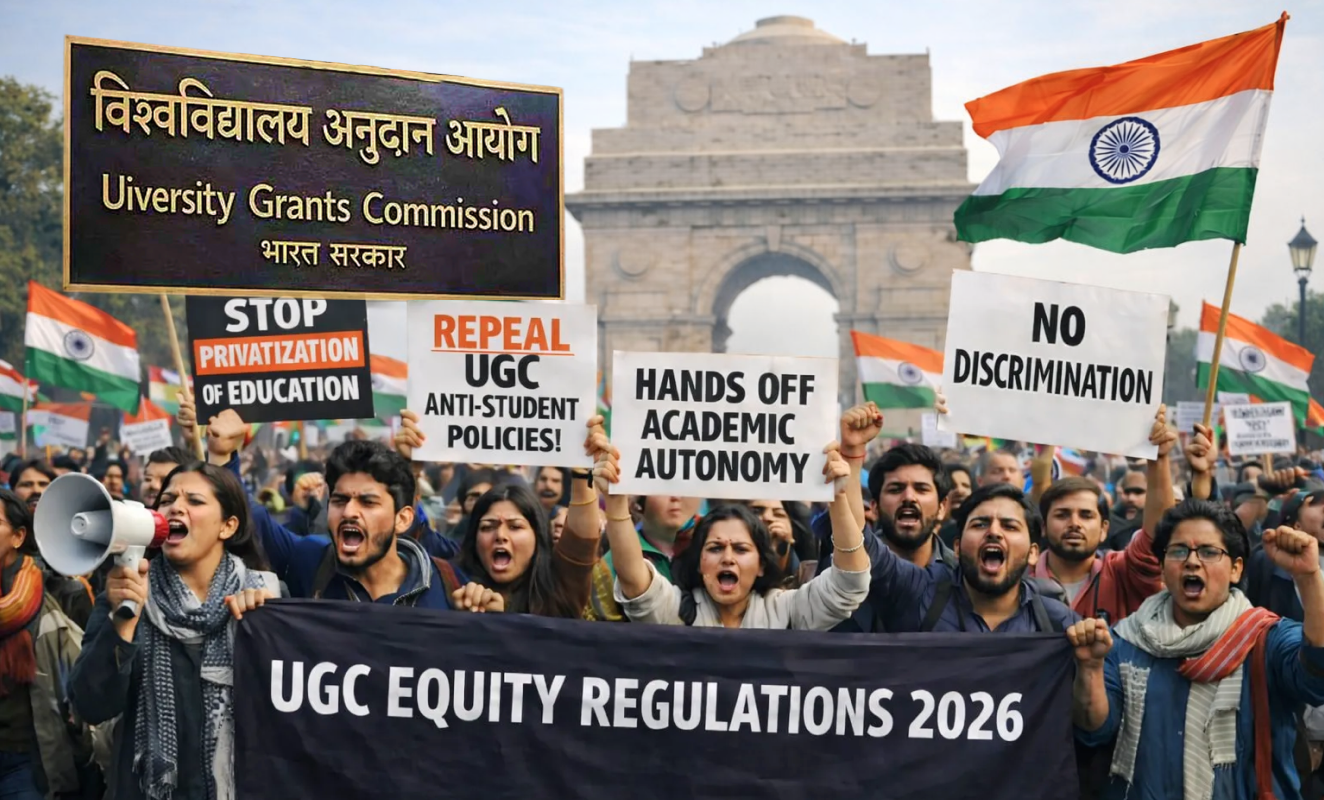
The situation is currently this: On January 15, 2026, the University Grants Commission notified the Promotion of Equity in Higher Educational Institutions Regulations, 2026, creating mandatory grievance mechanisms across every UGC-recognized institution in India.
Within 72 hours, three separate Public Interest Litigations were filed in the Supreme Court challenging the constitutional validity of this UGC equity bill.
Right?
If you’re a student, a faculty member, a parent, or a college admin, this affects you. This article explains the rules simply, shows what can go wrong, and gives actionable steps (a checklist) colleges should follow today. We’ll also answer common questions at the end.
60-Second Summary: What You Need to Know Right Now
- The Law: Every university must establish an Equity Oversight Committee (EOC) to handle discrimination complaints within 24 hours.
- The Penalty: Non-compliance = Loss of NAAC accreditation, Colleges that fail will lose their UGC funding, their status, and could even face criminal charges.
- The Controversy: The regulation defines caste discrimination narrowly (covering only SC, ST, OBC, and EWS), removes penalties for false accusations that existed in the 2025 draft, and creates a presumption-of-guilt framework that critics argue violates Article 21.
- The Stakes: 1,043 universities, 42,343 colleges, and approximately 4.13 crore students are now operating under this framework.
- The Question: Is this finally justice for students, or just a new way for the government to crush colleges?
What the UGC Regulations Require?
Every institution must create an Equal Opportunity Centre (EOC). This is the official intake and support office.
- Each EOC must have an Equity Committee that includes the head of the institution, faculty, student reps, and civil society voices , with mandatory seats for SC, ST, OBC, women and PwD representatives.
- Multiple ways to complain: online form, email, helpline (24×7). Complaints can be confidential.
- Fast timelines (why this matters below): committee meets quickly, reports within a few weeks, and decisions are expected fast.
- Serious penalties if colleges don’t comply: suspension of programmes, loss of funding, even de-recognition.
What Changed Between 2025 and 2026 UGC Equity Bill?
The 2025 Draft had a clause. A small one. Actually, it was Clause 8(g), and it stated:
Any person found to have made a false or malicious complaint shall be liable to disciplinary action as per the institution's code of conduct.
”That clause is gone.
↕️ In contrast, the 2026 notification sets strict timelines and mandatory escalation for discrimination complaints but provides no safeguards for the accused. A single complaint can trigger institutional action within 24 hours, followed by an Equity Committee inquiry. If the accused is seen as non-cooperative, the matter can be escalated to the District Magistrate or the National Commission for Scheduled Castes, without any clear consequences for false or malicious complaints.
This is the core of the Supreme Court challenge.
How the UGC Equity Regulations Work Now
1. The Equity Oversight Committee (EOC)
Every institution must now establish an EOC chaired by a senior faculty member from SC/ST/OBC/Minority communities. The committee has sweeping powers:
- Receive complaints of caste-based discrimination
- Initiate suo motu investigations
- Recommend disciplinary action against faculty, students, or administrators
- Coordinate with the National Commission for SCs/STs
Fine. But here's the issue: The EOC is not bound by the Indian Evidence Act. It operates under administrative discretion. Which means the evidentiary standards that apply in courts, like the requirement to prove guilt beyond reasonable doubt do not apply here.
2. The 24-Hour Response Mandate
Regulation 5(a) requires colleges and universities to acknowledge a complaint within 24 hours and start an inquiry within 72 hours.
To put this in perspective, even police investigations under the IPC get up to 15 days just to file a chargesheet. The UGC has compressed what is normally a long legal process into a 3-day administrative exercise.
The key concern is this: Can institutions really investigate complaints fairly and carefully in such a short time or will they assume guilt just to avoid punishment?
3. Regulation 3(c): The "Specific Groups" Limitation
This is where the law gets legally fragile.
⮞ Regulation 3(c) defines “caste-based discrimination” only as actions against students from SC, ST, OBC, and EWS communities.
⮞ What’s missing? The rule does not cover discrimination faced by general category students, forward castes, or minority groups outside these categories.
⮞ This gap has sparked strong reactions on Reddit and Twitter. Critics argue that if a general category student is abused, excluded, or treated unfairly because of their caste, this regulation gives them no protection at all.
⮞ Supporters point out that laws like the SC/ST (Prevention of Atrocities) Act, 1989 are also group-specific, but that law is meant to address long-standing historical oppression.
⮞ The problem, critics say, is that the UGC regulation is presented as an “equity” rule, not a law for historical correction. By protecting some caste groups but not others, they argue it may violate Article 14 of the Constitution, which guarantees equal treatment under the law.
👉 Also Read : New Rental Laws in India You Should Know in 2026
Where the UGC Rules Fall Short on Due Process?
Let’s be clear about what critics are actually saying.
The concern is not that false caste-discrimination complaints are common. Data from the National Commission for Scheduled Castes shows that out of 1,247 complaints filed in educational institutions in 2023–24, only about 9% were found to be unsubstantiated. In other words, false complaints are the exception, not the norm.
The real issue is constitutional.
⚖️ Article 21 of the Indian Constitution protects the right to life and personal liberty, which the Supreme Court has consistently interpreted to include the right to reputation. In Kiran Bedi v. Committee of Inquiry (1989), the Court clearly held that reputation is an essential part of this right.
👉 What actually happens is this: A faculty member is accused; the accusation is logged; an investigation is initiated; the faculty member's reputation is damaged in the academic community; and even if the accusation is later proven false, there is no corrective mechanism, no public exoneration, and no consequence for the complainant.
This was the fear. And it is why the Rohith Vemula case still haunts this debate.
This concern is not hypothetical. The Rohith Vemula case continues to shape this debate. In 2016, a Dalit PhD scholar at the University of Hyderabad died by suicide after institutional action following allegations of caste-based harassment. The university cited due process; students pointed to institutional failure. The episode exposed a hard truth: when systems lack transparency and accountability, both marginalized students and the accused can suffer lasting harm.
So the law must protect both. Right?
What Happens If Institutions Fail? The 4 Major Penalties
The UGC does not take non-compliance lightly. Under Regulation 10, institutions that fail to implement these regulations face:
⚠️ Withdrawal of NAAC Accreditation: This effectively destroys an institution's credibility and student enrollment prospects.
⚠️ Debarment from UGC Funding: Universities lose access to research grants, infrastructure funding, and faculty development schemes.
⚠️ Loss of Autonomous Status: Institutions operating under autonomy lose that privilege and revert to affiliate status, crippling their academic flexibility.
⚠️ Criminal Proceedings under the SC/ST (Prevention of Atrocities) Act: If caste-based discrimination is proven and the institution is found complicit, criminal liability attaches to the administration.
For contrast, when the UGC introduced the Academic Integrity Regulations in 2018, non-compliance resulted in warnings and conditional funding suspensions. This time, the penalties are existential.
The Supreme Court Challenge: What's Being Argued?
Three PILs have been filed as of late January 2026. The petitioners argue:
❗ Article 14 Violation (Equality): By limiting protection to specific caste groups, the regulation denies equal protection to others who may face caste-based bias.
❗ Article 21 Violation (Reputation): By removing safeguards against false accusations, the regulation denies the accused the right to reputation and fair process.
❗ Vagueness of "Discrimination": The regulation does not define what constitutes caste-based discrimination with precision, leaving institutions vulnerable to subjective interpretations.
The Attorney General's response, as reported by The Hindu on January 22, 2026, is that the regulation is remedial, not punitive, and is designed to address historical injustices. The government has cited the Payal Tadvi case- where a Scheduled Tribe medical student died by suicide in 2019 after sustained caste-based harassment by her seniors- as evidence that existing mechanisms have failed.
⚖️ So we have a legal standoff: Constitutional protections for the accused versus institutional accountability for systemic discrimination.
What to Do If You Face Discrimination or Harassment?
Harassment in an educational institution is not something a student has to “manage quietly.” Under UGC regulations, there is a defined, enforceable process to ensure accountability and relief.
Here’s how it typically unfolds.
1. Preliminary Review by UGC or the University
Once a complaint is submitted, it is first examined to check:
- Whether it falls under UGC jurisdiction
- Whether it meets the basic maintainability requirements
If the complaint qualifies, it is formally admitted for inquiry.
2. Notice Issued to the Institution or Respondent
After admission:
- A formal written notice is issued
- The institution or individual is asked to submit a response within a fixed timeline
At this stage, the matter becomes an official record, not an informal grievance.
3. Inquiry Committee Is Constituted
An inquiry committee is then formed, which may include:
- Academic members
- Legal or regulatory experts (in some cases)
Both parties can be asked to submit:
- Written explanations
- Documents or affidavits
- Supporting evidence
This ensures the inquiry is neutral, structured, and evidence-based.
4. Hearing and Investigation
The committee conducts hearings:
- Online or offline
- With recorded statements from both sides
Evidence such as:
- Emails or messages
- Admission or fee records
- Institutional communications
is examined to establish facts.
This is where strong documentation matters most.
5. Findings and Recommendations
After completing the inquiry, the committee submits a final report.
If the complaint is found valid, recommendations may include:
- Corrective action by the institution
- Penalties or disciplinary measures
- Compensation or relief for the student
- Regulatory action against the institution
6. Action Taken by UGC
Based on the findings, UGC may:
- Issue binding directions or warnings
- Impose fines or penalties
- Suspend admissions or specific courses
- Withdraw UGC recognition or approvals
- Direct fee refunds or other student relief
These actions are legally enforceable, not advisory.
7. Right to Appeal or Take Further Legal Action
If either party is dissatisfied:
- A review can be sought before UGC
- A write petition may be filed before the High Court
- Legal notices, affidavits, or formal complaints may be required
This ensures access to judicial remedies beyond regulatory action.
Is the General Category Actually Excluded? The Legal Interpretation
Here's what the regulation says: Caste-based discrimination is defined under Regulation 3(c) as acts targeting SC, ST, OBC, and EWS individuals.
Here's what the regulation does not say: That general category students are prohibited from filing complaints.
The UGC has clarified in its FAQs (published January 18, 2026) that:
Any student facing harassment may approach the EOC, which has the discretion to address grievances falling under the broader mandate of promoting equity.
”But this is administrative guidance, not statutory language. So if a general category student files a complaint and the EOC rejects it citing Regulation 3(c), what is the legal remedy? File a writ petition? Approach the National Human Rights Commission?
The law is silent.
For contrast, the Sexual Harassment of Women at Workplace Act, 2013, applies universally to all women, regardless of caste, religion, or class. It does not create tiered protections. But the UGC regulation does. And that is why constitutional lawyers are watching this case closely.
DigiLawyer's Take: Equity vs. Equality
The truth is, the UGC Equity Regulations mean very different things to different people.
👨🏻🎓 For a Dalit student who has faced exclusion, insults, or unfair treatment because of caste, this regulation can be a real source of protection. It clearly tells institutions that discrimination will not be tolerated and that complaints must be taken seriously.
🧑🏫 For a faculty member accused of discrimination, the same regulation can feel overwhelming. The timelines are short, the process is strict, and even a false accusation can cause lasting damage, with little clarity on how reputations are restored.
Wherever you stand in this debate student, parent, faculty member, or institution DigiLawyer is here for you. We help you understand your rights, your risks, and your next legal step, clearly and responsibly.
College Compliance Checklist (Quick Actionable Checklist)
- Formally publish EOC contact details on college website and noticeboards.
- Constitute Equity Committee with required representation.
- Implement a 24×7 helpline or shared helpline number.
- Create a confidential intake form and evidence intake protocol.
- Prepare a timeline tracker for complaints and outcomes.
- Train committee members on natural justice, bias, and evidence handling.
- Draft interim protection measures (e.g., no-contact orders, class reassignment).
- Maintain a secure digital record of complaints and actions.
- Prepare ready responses for UGC audits and public communication.
- Set a policy for appeal to the Ombudsperson and publish it.


- What the UGC Regulations Require?
- What Changed Between 2025 and 2026 UGC Equity Bill?
- How the UGC Equity Regulations Work Now
- 1. The Equity Oversight Committee (EOC)
- 2. The 24-Hour Response Mandate
- 3. Regulation 3(c): The "Specific Groups" Limitation
- Where the UGC Rules Fall Short on Due Process?
- What Happens If Institutions Fail? The 4 Major Penalties
- The Supreme Court Challenge: What's Being Argued?
- What to Do If You Face Discrimination or Harassment?
- 1. Preliminary Review by UGC or the University
- 2. Notice Issued to the Institution or Respondent
- 3. Inquiry Committee Is Constituted
- 4. Hearing and Investigation
- 5. Findings and Recommendations
- 6. Action Taken by UGC
- 7. Right to Appeal or Take Further Legal Action
- Is the General Category Actually Excluded? The Legal Interpretation
- DigiLawyer's Take: Equity vs. Equality
- College Compliance Checklist (Quick Actionable Checklist)


DigiLawyer, A 80, A Block, Sector 2, Noida, Uttar Pradesh 201301
Phone: +918178704343
justice@digilawyer.ai





Disclaimer: DigiLawyer is not a law firm, a substitute for a lawyer or law firm, a chartered accountancy firm, or a company secretary firm. We act solely as an intermediary between users and registered professionals, and also offer AI-powered legal assistance, consultation, and document drafting tools to improve access to legal support. Use of our website, services, or AI tools is at the sole risk of the user and does not create any lawyer-client or professional relationship. All consultations and interactions facilitated through our platform are strictly between the user and independent professionals. DigiLawyer is not liable for any actions, decisions, or outcomes arising from the use of our platform, AI tools, or reliance on any advice, consultation, or content provided by us or third-party professionals.
Use of our products and services is subject to our Privacy Policy & Terms of Service

