


Rent vs Lease Agreement in India: Key Legal Differences Explained
60 Second Summary
- Rent agreements offer flexibility; leases provide stability.
- Rent can usually be revised periodically; lease rent is fixed unless an escalation clause applies.
- Leases require higher stamp duty and mandatory registration (if over 11 months).
- Leases create stronger tenant rights and are more enforceable in court.
For landlords, the choice depends on whether they prefer flexibility or predictable long-term income. For tenants, it depends on mobility versus long-term security. Platforms like DigiLawyer simplify drafting, stamping, e-signing, and registration, making the entire process digital and hassle-free.
The Indian rental landscape has shifted to a strictly regulated digital ecosystem. Whether you are a student in Bangalore or a business owner in Mumbai, knowing the difference between a lease and a rental agreement isn't just about flexibility. In a real estate agreement, understanding the distinction between lease and rent is crucial because it dictates your long-term flexibility.
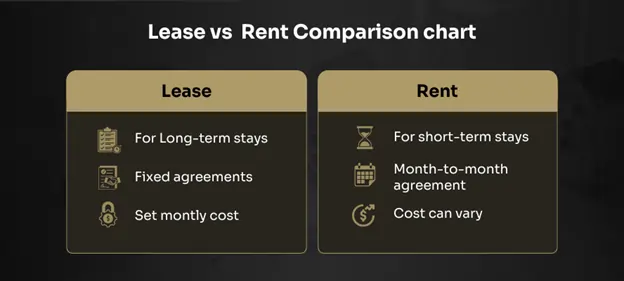
A Lease Agreement: Locks you into a fixed term (usually 1 year or more). It provides long-term stability but offers very little room to move or change terms early.
A Rental Agreement: Usually operates on a month-to-month basis or a typical 11-month term.
This blog will help you understand the distinction between the two agreements, explain your rights, and explain how DigiLawyer can help you draft and register both effortlessly to avoid any penalties.
Key Differences Between a Rent Agreement and a Lease Agreement
While both are legal contracts, it is best to compare the difference between a rent agreement and a lease agreement side by side to help property owners and tenants choose the right contract.
Feature | Rental Agreement | Lease Agreement |
Duration | Short-term (typically 30 days or month-to-month). | Long-term (usually 6 months, 1 year, or more). |
Stability | Low terms can change frequently with notice. | High terms are locked in for the entire period. |
Rent Increases | The landlord can raise rent at the end of each month. | Rent remains the same until the lease expires. |
Flexibility | High- tenant can leave with short notice (30 days). | Low- breaking the contract often results in penalties. |
Renewal | Automatically renews every month unless terminated. | Expires on a specific date, requires a new contract. |
Maintenance | Usually handled by the landlord for short stays. | Responsibilities are often shared or detailed in depth. |
Best For | Students, travelers, and temporary workers. | Families, long-term residents, and businesses. |
👉 Note: Before executing a rent agreement especially for long-term arrangements, it’s advisable to verify the property ownership and documents to avoid future disputes.
What Is a Rental Agreement? (Legal Meaning, Features & Validity)
A Rental Agreement is a short-term contract that governs the occupancy of a property. It automatically renews at the end of every 30-day period unless either the landlord or the tenant provides written notice to change or end it.
You can think of it as a subscription: Flexible, Easy to cancel, but subject to price changes.
A Rental Agreement comprises:
- Essential Components
- Property & Parties: Precise identification of the premises and the legal names of all occupants.
- Financial Terms: The exact rent amount, defined payment schedules, and late fee penalties.
- Security Deposit: The total sum held in escrow and the specific conditions for its refund.
- Maintenance: A clear division of labor regarding structural repairs (Landlord) versus daily upkeep (Tenant).
- House Rules: Explicit clauses regarding pet policies, subletting restrictions, and guest limits.
2. Legal Validity and Execution
- Authentication: The document should be printed on Stamp Paper of the appropriate value as determined by local state or municipal laws.
- Execution: It must be signed by both the lessor (landlord) and the lessee (tenant) in the presence of at least two independent witnesses.
- Mandatory Registration: Under the Registration Act, any agreement with a tenure exceeding 11 months must be formally registered at the local Sub-Registrar’s Office.
What is a Lease Agreement?
A Lease Agreement is a formal, long-term contract that prioritizes fixed-term security. A lease is a robust legal instrument designed to freeze the terms of the relationship for a year or more.
➤ The Anatomy of a Comprehensive Lease Agreement
Fixed Tenure: Defines the Start Date and End Date. Neither party can end the agreement early without specific legal cause.
Escalation Clause: For leases exceeding 12 months, this specifies a pre-agreed rent increase (e.g., a 5% or 10% hike) after the first year.
Lock-in Period: A specific window (e.g., the first 6 months) during which neither the landlord nor the tenant can terminate the contract, ensuring initial stability.
Detailed Inventory: A Schedule of Fixtures listing all furniture and fittings, often accompanied by a move-in condition report.
Maintenance & Structural Integrity: Clearly distinguishes between Tenantable Repairs and Capital Repairs.
➤ Legal Execution & Enforceability
The legality of a lease depends on how it is executed. Following these steps is non-negotiable for high-stakes properties:
Stamping: The lease must be drafted on Non-Judicial Stamp Paper. The value of the stamp duty is often calculated as a percentage of the total annual rent plus the security deposit.
Mandatory Registration: Under the Registration Act, any lease with a term of 12 months or more must be registered at the Sub-Registrar’s Office.
Consequence: An unregistered long-term lease cannot be used as evidence in court to prove the terms of the lease or the duration of the tenancy
Attestation: The document must be signed by the Landlord and Tenant, with at least two witnesses providing their signatures and identification details
Rent vs Lease Agreement in India: Which One Should You Choose?
When deciding on lease vs rent for a property arrangement, the choice of agreement often comes down to the level of control the owner wishes to retain versus the security the occupant requires.
1. Choose Lease Agreement if:
- Best for those seeking financial predictability and a locked-in long-term relationship.
- Stability: Ideal for families with school-going children or individuals who want to settle into a community. It provides security of tenure, meaning the landlord cannot arbitrarily ask you to leave before the term ends.
- Target Demographics: Most suitable for long-term residents and corporate employees on multi-year assignments.
- Price Protection: A lease is your best shield against market volatility. A lease freezes the rent for the entire duration (usually 12–36 months), helping with long-term financial planning.
- Large Commercial Operations: Essential for retail stores, warehouses, or large offices. These businesses require legal protection of a registered lease deed.
- Investment for Tenants: Because the term is long, tenants feel more comfortable investing in semi-permanent improvements (like better wardrobes or water purifiers), knowing they will stay long enough to enjoy the benefits.
2. Choose Rent Agreement if:
Best for long-term stability and creating a sense of home.
- Stable, Long-Term Tenants: If your goal is to sign a family or a long-term corporate lease where the occupants are likely to stay for multiple years.
- Predictable Income: These agreements are designed for those who value a consistent, unchanging rental yield over several years.
- Strict Notice Periods: Choose this if you are comfortable with more rigid legal protections. Rent agreements often carry stricter notice periods and provide the tenant with more right of possession, making it harder for a landlord to terminate the contract without specific legal grounds.
How Long Are Rent and Lease Agreements in India?
While Rent Agreement and Lease Agreement are often used interchangeably in casual conversation, the law distinguishes them primarily by their tenure and the legal rights they create.
Feature | Rent Agreement (Short-Term) | Lease Agreement (Long-Term) |
Typical Duration | Generally, 11 Months. | Usually 12 Months to 99 Years. |
Legal Minimum | No legal minimum; can be for a few months. | No legal minimum, but usually starts at 1 year. |
Legal Maximum | Often capped at 11 months to avoid registration. | Theoretically unlimited(e.g., 99-year leases). |
Registration | Not Compulsory (if 11 months or less). | Compulsory under the Registration Act, 1908. |
Stamp Duty | Minimal/Nominal. | Higher (calculated on total lease value). |
Tenant Rights | Limited- emphasizes occupancy. | Strong- creates an interest in the property. |
Key Takeaway
- Use a Rent Agreement if you want to avoid the bureaucratic hassle of the Sub-Registrar's office and want to review the relationship annually.
- Use a Lease Agreement if you are looking for long-term security (like a 3-year term) and are prepared to pay the associated registration and stamp duty costs.
Skip the Vendor Queues. Get E-Stamps without any hassle.
Benefits of Rent and Lease Agreements for Landlords and Tenants
1. From the Owner’s (Landlord's) Perspective
Feature | Rent Agreement (Short-Term/11-Mo) | Lease Agreement (Long-Term/Registered) |
Asset Control | High: Easier to reclaim property; occupants don't gain permanent tenancy rights. | Moderate: Property is committed for a long duration; it is harder to evict before the term ends. |
Rental Yield | Flexible: You can adjust rent to match market inflation every 11 months. | Fixed: Provides a guaranteed, predictable income stream for several years. |
Administrative | Low Effort: Avoids the time-consuming process of formal registration at the Sub-Registrar. | High Effort: Requires formal registration, but ensures the tenant is legally vetted and committed. |
Vacancy Risk | Higher: Frequent turnover means more time spent finding and vetting new tenants. | Lower: Secure, long-term occupancy reduces marketing costs and rent-free gaps. |
2. From the Tenant’s Perspective
Feature | Rent Agreement (Short-Term/11-Mo) | Lease Agreement (Long-Term/Registered) |
Mobility | The Exit Benefit: Perfect for professionals or students who may need to move for work on short notice. | The Stay Benefit: Provides deep security; the landlord cannot ask you to leave without major cause. |
Financials | Lower Upfront Cost: Minimal stamp duty and usually no registration fees. | Price Lock: Protection against rent hikes. You know exactly what you’ll pay for the next 3–5 years. |
Legal Status | Limited: Offers basic protection but lacks the interest in property that a registered lease provides. | Strong: A registered lease is a powerful shield in court; it is a public record and fully enforceable. |
How DigiLawyer Helps Simplify Rental Documentation?
With DigiLawyer as your trusted partner, rental documentation becomes simple, secure, and hassle-free. Whether it’s a residential flat, commercial property, PG, or co-living space, you can draft and register a legally compliant agreement online from the comfort of your home.
Here's how DigiLawyer helps property owners and landlords:
Customized Agreement Drafting - Drafts customized agreements for your property
Legal Vetting - Create legally vetted documents to ensure compliance with Indian laws, prevent illegal possession, and reduce the risk of disputes
Manages the complete process, including e-stamping, e-signing, and registration.
Tenant Verification & Compliance - Assists with tenant verification and legal compliance
Start creating your lease agreement today, digitally stamped and registered in minutes, without stepping out of your home.
FAQ'S
What is the major difference between Lease and Rent Agreement?
The primary distinction lies in tenure and legal interest.
- Rent Agreement: Typically, a short-term contract (usually 11 months). It is a licensing of the space where the landlord retains high control. It is often not registered to save on costs.
- Lease Agreement: A long-term commitment (usually 12 months to 99 years). It creates a transfer of interest,giving the tenant stronger legal rights. In India, any lease over 11 months must be registered at the Sub-Registrar's office
Which type of agreement is required for a commercial property?
For commercial properties (offices, shops, warehouses), a Commercial Rent Agreement is almost always required.
- Why? Businesses usually invest heavily in interiors and infrastructure. They need long-term security (3, 5, or 9 years) that only a registered lease provides.
- GST: Lease on GST is 18% if the landlord’s turnover exceeds ₹20 Lakhs or if the tenant is a registered entity.
How do I make a lease agreement for residential property?
Follow these formal steps to ensure the document is legally binding:
- Drafting: Include all essential clauses (Rent, Security Deposit, Maintenance, and Termination).
- Stamp Duty: Print the agreement on non-judicial stamp paper. The value depends on your state’s laws and the total rent for the lease term.
- Execution: Both parties must sign every page in the presence of two witnesses.
- Registration: Visit the local Sub-Registrar’s office with the landlord, tenant, and witnesses to pay the registration fees and get the document biometrically verified
Duration or term for a typical lease agreement?
- Residential: Generally 11 months (to avoid registration) or 1 to 3 years (if registered).
- Commercial: Typically 3, 5, or 9 years, often with a Renewal Clause and a pre-agreed rent escalation (e.g., 5% increase every year or 15% every 3 years).
Is it possible to change the rent amount during the term of agreement?
- In a Lease: No. The rent is locked in for the duration. The landlord cannot increase it unless an Escalation Clause was specifically written into the contract (e.g., Rent increases by 10% after 12 months).
- In a Rent Agreement: In a month-to-month or short-term setup, the landlord can change the rent by giving a 30-day written notice, unless the agreement says otherwise.
Can an agreement be terminated before expiry?
Yes, an agreement can be terminated early, but it depends on the Termination Clause:
- Notice Period: Most agreements allow termination if one party gives 1 to 3 months' notice.
- Lock-in Period: If the contract has a Lock-in (e.g., 6 months), and the tenant leaves early, they may be liable to pay the rent for the remainder of that period or forfeit their security deposit.
- Breach of Terms: If the tenant fails to pay rent or uses the property for illegal activities, the landlord can terminate the agreement immediately.


- Key Differences Between a Rent Agreement and a Lease Agreement
- What Is a Rental Agreement? (Legal Meaning, Features & Validity)
- A Rental Agreement comprises:
- What is a Lease Agreement?
- ➤ The Anatomy of a Comprehensive Lease Agreement
- ➤ Legal Execution & Enforceability
- The legality of a lease depends on how it is executed. Following these steps is non-negotiable for high-stakes properties:
- Rent vs Lease Agreement in India: Which One Should You Choose?
- 1. Choose Lease Agreement if:
- 2. Choose Rent Agreement if:
- How Long Are Rent and Lease Agreements in India?
- Key Takeaway
- Benefits of Rent and Lease Agreements for Landlords and Tenants
- 1. From the Owner’s (Landlord's) Perspective
- 2. From the Tenant’s Perspective
- How DigiLawyer Helps Simplify Rental Documentation?
- FAQ'S


Why Police Verification Is Required for Rent Agreement: Why Landlords Should Do It?
Police verification for tenants helps landlords confirm tenant identity, prevent fraud, and reduce legal risks. This guide explains the process, required documents, applicable legal rules, and how to complete tenant verification easily in India.
What are the Documents Required for Residential and Commercial Rent Agreement
Discover rent agreement documents required in India. Complete checklist for residential & commercial tenants and landlords with legal guidance and document tips.
Why 11-Month Rent Agreements Are Common in India?
Signing a rent agreement? Understand 11-month agreements in India with legal rules, registration, stamp duty, key clauses, validity & tips to avoid disputes.
How to Create a Rent Agreement Online in India
Create a legally valid rental agreement in India for tenants and owners. Learn stamp duty, registration rules, key clauses, documents, & avoid common mistakes.
Rent Agreement Vs Leave & License in India | Key Differences Explained
Don't sign the wrong paper. We break down the rent agreement vs leave and license agreement so you know exactly who holds the rights. Learn the key differences and draft your agreement online today.
All You Need to Know About Society Conveyance Deed
Secure your housing society's legal ownership with a Society Conveyance Deed. Learn its importance, process, and required documents in this essential guide!
DigiLawyer, A 80, A Block, Sector 2, Noida, Uttar Pradesh 201301
Phone: +918178704343
justice@digilawyer.ai





Disclaimer: DigiLawyer is not a law firm, a substitute for a lawyer or law firm, a chartered accountancy firm, or a company secretary firm. We act solely as an intermediary between users and registered professionals, and also offer AI-powered legal assistance, consultation, and document drafting tools to improve access to legal support. Use of our website, services, or AI tools is at the sole risk of the user and does not create any lawyer-client or professional relationship. All consultations and interactions facilitated through our platform are strictly between the user and independent professionals. DigiLawyer is not liable for any actions, decisions, or outcomes arising from the use of our platform, AI tools, or reliance on any advice, consultation, or content provided by us or third-party professionals.
Use of our products and services is subject to our Privacy Policy & Terms of Service

