


Full and Final Settlement in India: Rules & Timeline (2026)

60-Second Summary
- Full and Final (F&F) settlement is the final payment made to an employee after exiting, covering salary, leave encashment, bonus, and gratuity after deductions.
- Under the Code on Wages, 2019, employers must clear wages within 2 working days of the employee’s last working day.
- Common issues include delays, unfair deductions, partial payments, and lack of transparency in settlement breakdowns.
- Employees should first send formal reminders and keep written records of all communication.
- If ignored, sending a legal notice is a strong step that often leads to faster resolution without court action.
- Further remedies include filing a complaint with the Labour Commissioner or approaching the labour court.
- Proper documentation like offer letters, salary slips, and bank statements is crucial for recovery.
With the new Full and Final (F&F) settlement rules expected to be followed in 2026, employees now have stronger rights regarding timely salary and dues after resignation. Despite this, many still face delays in receiving their final settlement, unexplained deductions, or no response from employers.
With the latest labour law updates in India, employers are now required to clear dues within strict timelines, but many still don’t comply. If you’re unsure about your new F&F settlement rules or are waiting for your pending salary, this guide will help you understand updated rules 2026, timelines, and the exact steps you can take to recover your dues.
What is Full and Final Settlement?
A Full and Final Settlement is the final, comprehensive settlement between the employer and employee when the employment ends. It includes paying pending salary, bonus, gratuity, and unused leave encashment, while deducting any amount that the employee owes to the company.
F&F Settlement Under the New Labour Codes 2026
One of the most important update in the new labour codes is regarding Full and Final settlement timelines. The new labour codes came into force on November 21, 2025, it consolidates the 29 older laws into four codes. One of the key changes is in how quickly employers must settle employee dues after exit.
Section 17(2) of the Code on Wages, 2019, now requires all wages to be paid within two days of the employee’s exit, regardless of the reason for separation, whether it is resignation, termination, or retirement. The old industry practice of 30 to 45 days is no longer valid considered valid under the new rules.
How is it important for employees-
- Payroll systems must process final wages within 48 hours of the employee's last working day.
- Department clearance (IT, Finance, Admin) must occur at the same time, not sequentially.
- Exit formalities must start prior to the employee's final working day, rather than after it.
Timeline for Settlement Under the New Rules
- Wages (salary, leave encashment, bonus)- Within 2 working days
- Gratuity- Within 30 days
- EPF transfer or withdrawal – Per EPFO timelines, which is typically 15-20 days.
👉 Also Read: New Salary Structure Under New Rules 2026
Key Components of Full and Final Settlement
When an employee exits an organization, the full and final (F&F) settlement ensures that all pending financial dues are properly calculated and cleared. Understanding these components can help employees verify the settlement and identify any errors or missing payments.
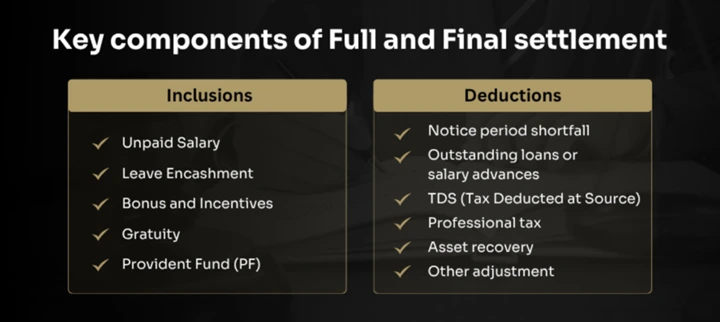
Inclusions in F&F Settlement
Unpaid Salary: This includes the salary for the number of days worked in the final working month. It may also cover any pending salary from previous months that has not yet been disbursed.
Leave Encashment: Employees may receive compensation for unused earned or paid leaves, depending on the company’s leave policy. This amount is calculated based on the balance of eligible leave days at the time of exit.
Bonus and Incentives: Any performance-linked bonus, commission, or incentive that the employee is entitled to should be included, subject to company policies and eligibility criteria.
Gratuity: Employees who have completed a minimum of five years of continuous service are entitled to gratuity under applicable laws. This is a significant long-term benefit paid by the employer.
Provident Fund (PF): The provident fund amount is maintained separately and is not directly paid as part of the F&F settlement. Employees can withdraw or transfer the amount through the EPFO portal after their exit is processed.
Deductions in F&F Settlement
Notice period shortfall: If the employee does not serve the full notice period, the employer may deduct salary for the unserved days. This is typically calculated on a per-day basis using the employee’s monthly salary.
Outstanding loans or salary advances: Any pending loans, advances, or financial assistance taken from the company during employment are adjusted against the final settlement amount.
TDS (Tax Deducted at Source): TDS is deducted as per applicable income tax slabs based on the employee’s total earnings, including final settlement payouts.
Professional tax: In certain states, professional tax is applicable and may be deducted as per state-specific rules.
Asset recovery: If company assets such as laptops, ID cards, or other equipment are not returned or damaged, the employer may recover the associated cost from the final dues.
Other adjustments: Any additional dues arising from company policies or contractual obligations may also be included. It is important to carefully review the final settlement statement.
What to Do if Your Employer Delays F&F Payment
Under the updated Full and Final (F&F) settlement rules 2026, if your employer delays or doesn’t pay your full and final settlement, these are the legal remedies you could take to recover the salary:
- Send Formal Reminders: Send at least three formal reminder emails to HR and senior management with a 48-hour gap and keep all the written records of communication. Clearly mention the laws related to pending F&F dues and ask for a clear timeline as per the updated F&F guidelines by which all the dues will be cleared.
- Issue a legal Notice: If your employer doesn’t respond or refuses to pay compensation, send a legal notice for recovery of salary and F&F settlement. The notice should clearly mention the pending amount, a deadline for payment, and possible legal consequences. You may also claim additional damages where applicable, but the primary focus should be recovery of dues.
- File a complaint: You can also approach the local labour commissioner or file a suit in the Labour Court to mediate. In the complaint, include all the proof you have against your employer. It will help your case.
- Escalate on Social Media: As a last resort, you may raise the issue publicly on platforms like LinkedIn. However, stick strictly to facts and avoid defamatory statements, as this can have legal consequences.
👉For Brief Steps Read: What to Do If Employer is Not Paying Your Salary
Documents Needed to Take Legal Action for Unpaid Salary in India
Keep these documents with you handy, as they will serve as proof against your employer.
- Appointment Letter and annexure
- Resignation acceptance email
- Last 6-month salary slips
- Proof of asset return
- ‘No dues’ clearance certificate
- Appraisal mails
- Bank statement
- Corresponding mail with the company
- Form- 16
Common Challenges Employees Face in Full and Final Settlement
Even under the updated Full and Final (F&F) settlement rules, employees still face several challenges in receiving their dues on time and in full. Some of the most common issues include:
1. Delays Despite Timelines Under New Rules
Although the updated labour codes require faster settlement of dues, employees still face delays in receiving their final payment. Despite clear timelines, employers often fail to process F&F settlements within the expected period.
2. Unclear Deductions Without Explanation
Employees often face deductions that are either unclear or not legally justified, such as:
- Notice period recovery without adjusting earned leave
- Charges for training without prior agreement
- Deductions for performance-related issues
- Excess deductions beyond permissible limits
3. Lack of Transparency in Settlement Process:
Employees often struggle with:
- No detailed F&F settlement settlement breakdown
- Delayed or ignored follow-ups from HR
- No clarity on timelines or deductions
This lack of transparency can make it difficult to verify if the settlement is accurate.
4. Withholding Relieving or Experience Letters:
While not strictly mandated by law, some employers use relieving or experience letters as leverage to delay or deny F&F payments. This practice is considered unfair and can be challenged if it impacts the employee’s career opportunities.
5. Mismatch in Salary Components:
Mistakes in calculating salary components can lead to incorrect settlement amounts, such as:
- Bonus or incentive miscalculations
- Incorrect leave encashment
- Gratuity computation errors
- Omitted allowances or benefits
6. Disputes Over Notice Period Terms:
Confusion around notice period buyout, recovery, or adjustment against leave balance often leads to disputes during F&F calculation.
f you’re facing this issue, consider consulting a legal expert to resolve it effectively.
Consequences for Employers Who Fail to Pay Under New Full & Final (F&F) Settlement Rules 2026
Failure to comply with the new rules can lead to serious legal and financial consequences:
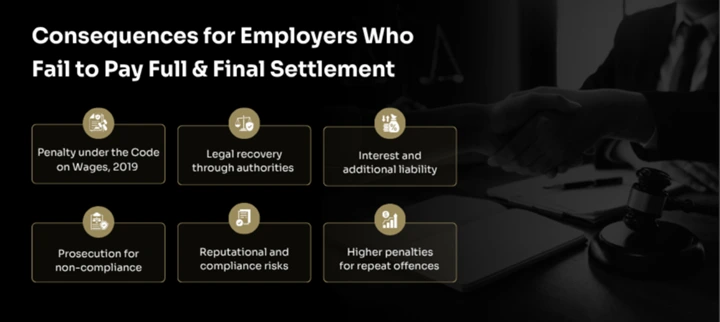
⚠️ Penalty under the Code on Wages, 2019: Non-payment or delayed payment of dues (including F&F) can attract a fine of up to ₹50,000 for the first offence. Repeated violations can lead to fines up to ₹1,00,000 and even imprisonment.
⚠️ Legal recovery through authorities: Employees can file claims for recovery of unpaid dues, and authorities can order the employer to pay the amount along with penalties.
⚠️ Interest and additional liability: Delayed F&F settlement may attract interest, increasing the overall financial burden on the employer.
⚠️ Prosecution for non-compliance: If employer fail to comply with order issued by labour authorities, they may face legal prosecution under applicable labour laws.
⚠️ Reputational and compliance risks: Non-payment cases can lead to government scrutiny, damage employer reputation, and impact future hiring and business credibility.
⚠️ Higher penalties for repeat offences: If the employer repeatedly fails to clear F&F dues, stricter punishment may include imprisonment of up to 3 months along with fines.
How DigiLawyer Helps with Employment Issues & Salary Disputes
DigiLawyer offers end-to-end legal support for employees facing workplace disputes, especially issues like unpaid salary, wrongful termination, or delayed full & final settlement.
Get quick legal consultation from experts who assess your employment issue and explain your rights under Indian labour laws.
Receive a professionally drafted non-payment of salary notice that clearly demands your dues within a legal timeframe.
Strengthen your case with proper documentation guidance like salary slips, contracts, and written communication.
Push employers to act faster, as a legal notice signals serious intent and often leads to quicker settlements.
Get support in escalating the matter to the Labour Commissioner or legal forums if the employer ignores the notice.
Access end-to-end assistance from notice drafting to dispute resolution without handling complex legal steps alone.
Save time and cost with a fully online process, faster turnaround, and affordable fixed-fee legal services.
FAQ's
Can an employer hold an F&F settlement due to poor performance?
No, performance issues are not a valid reason to delay or deny F&F settlement. All earned wages must still be paid as per law.
Is F&F settlement different for contract employees?
Yes, contract employees’ settlements depend on their agreement terms, but wage payment timelines still apply under labour laws.
Can I negotiate my F&F amount after my resignation?
You can negotiate components like notice period buyout or deductions, but statutory payments like salary and gratuity cannot be reduced unfairly.
What happens if my company shuts down before paying F&F?
You can file a claim with labour authorities or courts, and dues may be recovered from company assets during liquidation.
Is email communication valid proof in F&F disputes?
Yes, emails, offer letters, and salary slips are considered valid evidence in legal proceedings.
Can an employer delay F&F until I return company assets?
They can withhold a portion related to asset recovery but cannot delay the entire settlement unreasonably.
Do startups have different F&F rules in India?
No, all companies including startups must comply with the Code on Wages and other applicable laws.
Can I claim compensation for mental stress due to delayed payment?
In some cases, courts may allow additional compensation or interest if the delay is excessive and unjustified.
What if my employer pays only part of the F&F amount?
You can demand a detailed breakdown and take legal action for the remaining unpaid dues.
Can I file a case without legal notice?
Yes, but sending a legal notice first is recommended as it often resolves the issue faster and strengthens your case.
Is there a time limit to claim unpaid F&F dues?
Yes, generally claims should be filed within 3 years, but acting early improves your chances of recovery.
Will filing a complaint affect my future employment?
No, exercising your legal rights does not legally impact future employment, especially if handled professionally.


- What is Full and Final Settlement?
- F&F Settlement Under the New Labour Codes 2026
- Timeline for Settlement Under the New Rules
- Key Components of Full and Final Settlement
- Inclusions in F&F Settlement
- Deductions in F&F Settlement
- What to Do if Your Employer Delays F&F Payment
- Documents Needed to Take Legal Action for Unpaid Salary in India
- Common Challenges Employees Face in Full and Final Settlement
- 1. Delays Despite Timelines Under New Rules
- 2. Unclear Deductions Without Explanation
- 3. Lack of Transparency in Settlement Process:
- 4. Withholding Relieving or Experience Letters:
- 5. Mismatch in Salary Components:
- 6. Disputes Over Notice Period Terms:
- Consequences for Employers Who Fail to Pay Under New Full & Final (F&F) Settlement Rules 2026
- How DigiLawyer Helps with Employment Issues & Salary Disputes
- FAQ's

A Guide to India's New Salary Rules in 2025
Is your take-home salary dropping in 2025? New Labour Codes enforce 50% basic pay, higher PF deduction, 1-year gratuity and 48-hour F&F settlement. Check impact now.
How to Apply for a Bonafide Certificate: Online & Offline Application Process
Know how to apply for a bonafide certificate online or offline, the documents needed, format, who’s eligible, and why this official proof of affiliation matters.
What to Do If Employer Doesn’t Pay Salary - Actions & Legal Remedies
Unpaid salary in India? Learn legal remedies under Labour Law, Payment of Wages Act, Labour Court process, Samadhan portal & recovery steps quickly. Act now.
DigiLawyer, A 80, A Block, Sector 2, Noida, Uttar Pradesh 201301
Phone: +918178704343
justice@digilawyer.ai





Disclaimer: DigiLawyer is not a law firm, a substitute for a lawyer or law firm, a chartered accountancy firm, or a company secretary firm. We act solely as an intermediary between users and registered professionals, and also offer AI-powered legal assistance, consultation, and document drafting tools to improve access to legal support. Use of our website, services, or AI tools is at the sole risk of the user and does not create any lawyer-client or professional relationship. All consultations and interactions facilitated through our platform are strictly between the user and independent professionals. DigiLawyer is not liable for any actions, decisions, or outcomes arising from the use of our platform, AI tools, or reliance on any advice, consultation, or content provided by us or third-party professionals.
Use of our products and services is subject to our Privacy Policy & Terms of Service

