


Sale Deed
Starting at
₹1
₹100


₹1
₹100
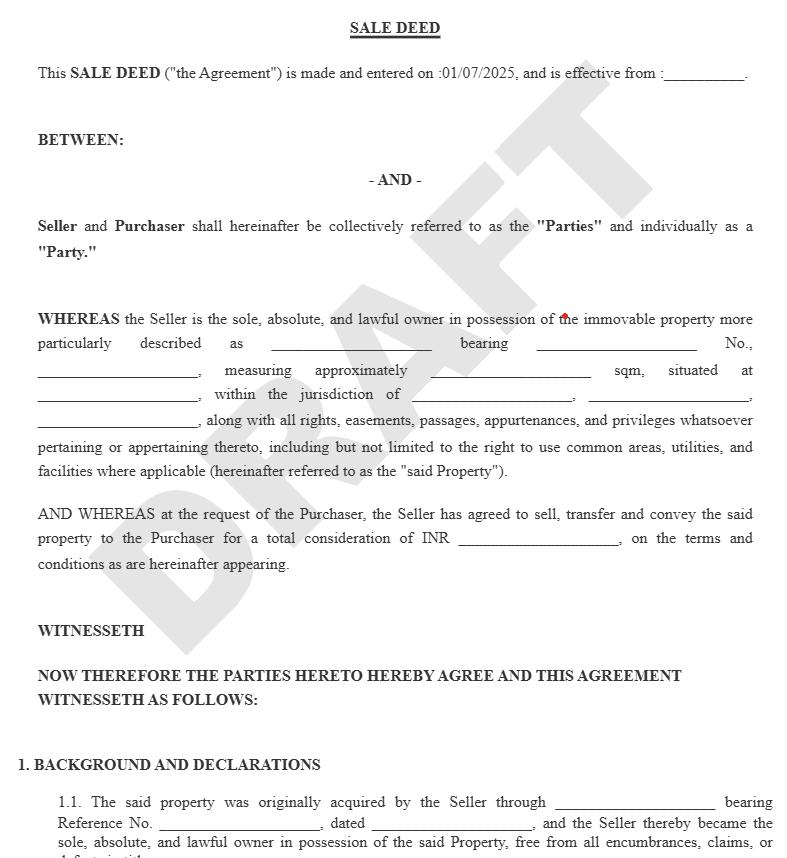
What is Sale Deed?
A sale deed or property deed is a legal document between a seller and a buyer that transfers ownership of an immovable property like land, building or a flat. It serves as a formal record of ownership and one of the most crucial documents when it comes to property transactions. DigiLawyer can also help you get the property documents verified as well.
How DigiLawyer can Draft Your Sale Deed?
A property sale deed is one of the most critical legal documents in any property transaction. It proves ownership, protects your rights, and ensures the legal validity of the property transfer. DigiLawyer makes this process simple, secure, and affordable. Here’s why you should choose DigiLawyer
Simple and Fast- We will draft your sale deed quickly and clearly, saving you from dealing with confusing legal terms or complicated paperwork. We have experts that know how to properly draft the deed and what important details to mention.
Tailored to your deal- We will create a deed that fits your exact situation, whether it’s for a home, commercial property, or land. It includes all important clauses such as possession date, seller warranties, and indemnity protections.
Legally Sound- Your sale deed is drafted according to the relevant laws, minimizing the risk of future disputes or legal issues.
Affordable cost- You will get a professionally drafted deed at a fraction of cost, and in less time compared to the traditional legal services.
Online Procedure- Our complete procedure is online, and you can e- sign the documents as well.
Expert Guidance- If you have questions or want extra guidance, we offer access to legal experts and trusted professionals.
Secure and reliable- Your information stays confidential and secure throughout the drafting process.
Benefits of Drafting a Property Deed
It’s important to know the benefit of getting a sale deed drafted and how it legally establishes the transfer of ownership
Legal proof of ownership- It acts as the legal documents proving that the buyer is the rightful owner of the property.
Prevents Fraud- It ensures the seller has the legal right of the property and can prevent any claim or fraud on the property.
Create a public record- Once the sale deed is registered. It becomes an official land record, which offers public notice of the buyer’s ownership and allows any third party to verify it.
Offers Protection- It safeguards the interest of both buyers and sellers and offers protection for them. Buyer is protected from any future claim, and the seller is protected from any future liability after the property is sold.
Legal Requirement- Registration of a sale deed is a legal requirement, as it serves as a record in the local revenue authorities, and it’s an essential document required by banks and financial institutions when you apply for a housing loan.
How to Draft Sale Deed Online and Offline
DigiLawyer-This is the ideal choice for anyone seeking a hassle-free, timely, and affordable sale deed process.
Online
Offline
- Enter Your Details: Fill in your contact information along with basic details.
- Consultation: Our team connects with you to understand your requirements and clarify any queries.
- Share Documents: Securely share the necessary ownership documents to get started.
- Process Begins: Once documents are verified, we initiate your sale deed drafting and registration process within 24 hours.
- Visit Offices: Parties are required to visit legal consultants, and registration offices in person to initiate the process.
- Manual Consultations: Discussions with lawyers take place physically, often requiring follow-ups to finalize clauses and terms.
- Document Collection & Submission: Property documents, identity proofs, and supporting paperwork must be arranged, photocopied, and submitted.
- Drafting & Revisions: The sale deed is prepared manually and may go through multiple revisions, depending on accuracy and completeness.
- Stamp Duty & Registration: Stamp duty is paid through designated centers, followed by scheduling and attending an appointment at the sub-registrar’s office for execution and registration.
- Time & Coordination: The process can take several days or longer, depending on availability, coordination between parties, and administrative timelines.
Documents Required For Sale Deed Registration
Specific requirements may vary according to case, but we are providing the general documents needed
- Sale Agreement (If executed earlier)
- ID Proof of Buyer and Seller
- Address Proof of Buyer and Seller
- PAN Card of Buyer and Seller
- Passport size photographs
- Original Title deed of the property
- Previous sale deed (Chain of Documents)
- Encumbrance Certificate (EC)
- Khata Certificate & Extract (if applicable)
- Latest Tax Receipts (Property Tax)
- Power of Attorney (if applicable)
- NOC from Society or Builder (if applicable)
- Stamp Duty and Registration Fee Receipt
- Bank Loan Documents (if under mortgage)
Eligibility For Sale Deed Registration
Eligibility for a sale deed in India
- Legal compliance- Both the buyer and seller need to be legally able to make a contract. This means that they must be at least 18 years old, mentally capable of understanding the contract, and not be disqualified by any law from contracting.
- Voluntary consent- Both the seller and buyer must agree to contract feely on their own will. They should not be misled or tricked.
- Authority to transfer- The seller must have the legal right to sell the property. This means they must own it and have clear legal rights to transfer it.
- Valid Consideration- There must be a fair price for a party that both parties agree on.
- Representation- If someone is acting for the buyer or seller (like using a Power of Attorney), that person must have proper legal authority to sign the contract. For companies or trusts, the person is signing.
- Witness Requirements-The people witnessing the signing of the contract must be mentally capable and at least 18 years old. They confirm that the buyer and seller signed the contract.
Elements of a Sale Deed
We have made a checklist for all the details to include in sale deed, and what to check before buying a property
- Parties Involved-Names, addresses, and details of both the buyer and the seller.
- Property Details- A detailed description of the property, including its location, area, boundaries, and survey numbers.
- Sale Price- The agreed-upon amount for which the property is being sold.
- Payment Details- How and when will the payment was made.
- Encumbrance Clause-The seller confirms that the property isn’t tied up with any debts, loans, or legal problems.
- Possession Clause-This explains when the buyer will actually get the keys and take control of the property.
- Indemnity Clause-The seller promises to cover any losses for the buyer if there are issues with the property’s ownership.
- Witnesses-The names and signatures of at least two people who saw the buyer and seller sign the agreement.
- Signatures-Both the buyer and seller need to sign the agreement to make it official.
- Stamp Duty and Registration Fees-This shows the taxes and fees that were paid to make the sale legal.
- Dispute Resolution Clause-This tells how any disagreements between the buyer and seller will be settled, like through mediation, arbitration, or going to court.
- Legal Heirs Clause- If either the buyer or seller passes away, their rights and responsibilities in the agreement will pass on to their family members or legal heirs.
Know the Law
The Transfer of Property Act, 1882 is an Indian law that governs how property can be legally transferred from one person to another. It applies to both movable and immovable property and ensures that transfers are done lawfully, with the consent of the owner.
The Act covers various forms of transfers, including the sale of property, where ownership is passed for a price through a sale deed; gifts, which are voluntary transfers without payment; leases, which allow temporary possession for rent; mortgages, where property is pledged as security for a loan; and exchanges, where properties are swapped between parties. The law ensures that the person transferring the property actually owns it and that both parties’ rights and obligations are clearly defined. In essence, the Act provides a legal framework to make property transfers safe, fair, and enforceable.



DigiLawyer, A 80, A Block, Sector 2, Noida, Uttar Pradesh 201301
Phone: +918178704343
justice@digilawyer.ai




Disclaimer: DigiLawyer is not a law firm, a substitute for a lawyer or law firm, a chartered accountancy firm, or a company secretary firm. We act solely as an intermediary between users and registered professionals, and also offer AI-powered legal assistance, consultation, and document drafting tools to improve access to legal support. Use of our website, services, or AI tools is at the sole risk of the user and does not create any lawyer-client or professional relationship. All consultations and interactions facilitated through our platform are strictly between the user and independent professionals. DigiLawyer is not liable for any actions, decisions, or outcomes arising from the use of our platform, AI tools, or reliance on any advice, consultation, or content provided by us or third-party professionals.
Use of our products and services is subject to our Privacy Policy & Terms of Service

