


Free Trademark Search in India
Find available trademarks for your business in 1 click. Free, accurate results from the Trademark Database.
95%+
Application Success Rate
10,000+
Trademarks Filed
3X Faster
Filing Process
Rs. 10 Cr+
Saved in Rejections
200+
IP Experts and Lawyers
Choose the Right Plan for Your Trademark
Starting at
₹499
₹799
Flat ₹300
WHAT YOU GET
Starting at
₹3499
₹6999
Flat ₹3500
WHAT YOU GET
Why Choose DigiLawyer



How the Trademark Search Process Works
Check Trademark Availability Before Filing
Our free trademark search tool pulls results directly from the IP India trademark database, many times users see IP india search is not working because website is usally facing a lot of traffic and the portal is not ready to bare it. You type in the name or phrase you want to check, and the tool scans the database for existing marks that are identical or similar to yours. Results show you the applicant name, filing date, trademark class, and current status so you know exactly what you are dealing with. The tool is free to use. No waiting. Just type your brand name and see what comes back.What is Trademark Search?
A trademark search is a one of the vert first steps before filing for trademark registration. It checks whether a similar mark already exists in the trademark database. By conducting a proper trademark search, you avoid conflicts, rejections, and costly legal battles down the line. It is the single most important thing you can do before launching your brand.
At DigiLawyer, our free trademark search tool scans the entire IP India trademark database in seconds. You get clear, accurate results so you can make informed decisions about your brand name, logo, or tagline.
Why Check Trademark Availability Before Registering Your Brand
Searching before you file is one of the most important things you can do for your brand. Here is why it matters:
1. It prevents application rejections
The trademark examiner at IP India will check for conflicting marks during examination. If a similar mark already exists in your class, your application can be refused. Doing the search yourself before filing gives you the chance to catch and fix these issues in advance.
2. It saves you from legal trouble
If you launch and build a brand on a name that someone else already owns, you could face infringement claims. That means rebranding costs, legal fees, and reputational damage. A search takes minutes. A rebrand after the fact costs far more.
3. It protects your investment
Every rupee you spend on packaging, marketing, social media, and product development is tied to your brand name. If that name is not protected or is already taken, that investment is at risk. Checking early protects everything downstream.
4. It helps you choose a stronger mark
A search also tells you what is already crowded in your space. That helps you pick a name that is not just available but genuinely distinctive, which makes it easier to register and harder for others to challenge later.
Check your trademark availability before filing and proceed with trademark registration to protect your brand.
Types of Trademarks
Not everything that identifies your brand is the same. Trademarks come in different forms, and understanding which type fits your brand can help you file correctly.
1. Word Marks
A word mark protects the text itself, regardless of how it is styled or presented. This is the broadest form of protection. If your brand name is distinctive, a word mark gives you rights over that name in any font, color, or design.
2. Device Marks (Logo Marks)
A device mark protects a specific logo, illustration, or graphical element. This covers the visual design rather than the word itself. If your logo has a unique symbol or illustration, this is what you register.
3. Composite Marks
These combine both a word and a logo in a single registration. This protects the specific combination as it appears, which is useful when your brand identity includes a fixed pairing of text and graphic.
4. Shape Marks
In some cases, the distinctive shape of a product or its packaging can be trademarked. The shape of the Coca-Cola bottle is a well-known example. These are harder to register and require proof that the shape has acquired distinctiveness in the market.
5. Sound Marks
A unique sound that identifies your brand, like a jingle or audio logo, can also be registered as a trademark in India. The sound must be distinctive and capable of being represented graphically.
6. Collective Marks
These are used by associations or groups to indicate that the goods or services come from members of that group. Geographic indications are a common example.
Trademark Search by Classes
India uses the NICE Classification system, which divides all goods and services into 45 classes. Classes 1 to 34 cover physical goods. Classes 35 to 45 cover services. When you apply for a trademark, you must choose the class or classes that cover your specific business activity.
This matters because trademark rights are class-specific. The same name can be registered by two different businesses if they operate in different classes and there is no likelihood of confusion. For example, a company selling coffee and another selling software might both be able to use the same word in their respective classes, depending on how distinctive the mark is.
Some of the most commonly used trademark classes in India include:
• Class 25 for clothing, footwear, and headgear
• Class 30 for coffee, tea, cereals, and food products
• Class 35 for advertising, business management, and retail services
• Class 36 for financial and insurance services
• Class 42 for software, technology, and IT services
• Class 44 for healthcare, medical, and beauty services
When you use the DigiLawyer trademark search tool, you can search within specific classes to get more targeted results. Our IP experts can also help you identify the right class for your business if you are not sure where your goods or services fall.
Things to Consider Before Conducting a Trademark Search
Running a search is straightforward, but knowing what to look for makes the results far more useful. Here are some things to keep in mind before you start:
Search for variations, not just exact matches
If you are checking availability for the name "Zorix", also search for "Zorex", "Zoricks", and phonetically similar combinations. The trademark examiner considers marks that sound alike, look alike, or convey the same meaning, not just identical spellings.This will help you understand about the brand search availability
Check across relevant classes
Your trademark protection only applies in the classes you register under. Search within the specific class or classes that cover your business. A clean result in Class 42 means nothing if your product falls under Class 5.
Look at all statuses, not just registered marks
A trademark that is pending examination or under opposition is still a potential conflict. Do not ignore applications just because they have not been fully approved yet.
Check for device marks separately
If you have a logo, the word search will not catch conflicting device marks. Consider running a separate search or consulting an IP expert who can review logo similarity.
Consider industry context
Two identical names in completely different industries may not conflict. But if your business operates in a related space, even a similar name can create problems. Think about how a consumer might confuse the two.
Do not rely on just one search method
The IP India public search is comprehensive but works best when you know what you are looking for. DigiLawyer's tool streamlines this process and surfaces results more clearly, but for high-stakes decisions, pairing it with a consultation from an IP expert is always a good idea.
TM Symbol vs Registered Symbol
These two symbols are often seen next to brand names, but they mean very different things. Using the wrong one, or using either one without understanding what it means, can create legal complications.
TM (Trademark Symbol)
The TM symbol can be used by anyone who is claiming rights to a name, logo, or phrase as a trademark. You do not need to have a registered trademark to use TM. You can start using it as soon as you file your trademark application with IP India. It signals that you are claiming this mark as your brand identifier, even while registration is still in process.
R (Registered Trademark Symbol)
The R in a circle can only be used after your trademark has been officially registered by IP India and you have received your registration certificate. Using the R symbol before registration is complete is a legal offence under the Trade Marks Act, 1999. It misrepresents the status of your mark and can have consequences if challenged.In practical terms: use TM from the day you file. Switch to the R symbol only after you receive your registration certificate, which typically takes 18 to 24 months from the date of filing.
In practical terms: use TM from the day you file. Switch to the R symbol only after you receive your registration certificate, which typically takes 18 to 24 months from the date of filing.
Claim Your Trademark Before Others Do
If your trademark is available, take the next step and register it before someone else claims it.DigiLawyer Trademark Search vs IP India Public Search
- Can become slow or difficult to navigate due to heavy public traffic
- Government portal experience can feel outdated and cluttered
- No support for confusion or next steps
- Designed primarily as a public registry portal
- Search-only platform with no legal assistance
- No consultation or expert review available
- Built to display trademark database records

- Smooth and responsive experience even during searches
- Built for faster trademark discovery and usability
- Guidance available if similar marks appear
- Better experience for first-time founders
- Assistance with objections, opposition, and filing
- Human support when your trademark faces challenges
- Built to help you make filing decisions
How Can DigiLawyer Help After Trademark Search
The search is just the beginning. Once you know your mark is available, there are several things that need to happen to protect it properly.
Trademark Registration: Our team files your application with IP India, handles the class selection, and prepares your documentation. We file within 6 to 8 hours of your consultation. Once filed, you can start using the TM symbol on your brand.
Responding to Examination Objections: Even after a clean search, the examiner may raise objections. Our lawyers draft and file the response on your behalf, drawing on our experience handling similar objections across hundreds of applications.
Trademark Renewal: A trademark registration in India is valid for 10 years. After that, it needs to be renewed. We track your renewal dates and handle the process so your protection never lapses.
Trademark Watch: After registration, someone else might file a mark that is similar to yours. We offer watch services that monitor new filings and alert you to potential conflicts so you can oppose them early if needed. Also our tool can be used to get real time updates on your brand name search, you will get the right results at zero cost.
Trademark Assignment and Licensing: If you want to sell your trademark, transfer it to another entity, or license it for use, our team handles the legal documentation and filing for these transactions.
Our User Reviews Speak for Themselves
Enterprise, Grade Security and Compliance

ISO 27001

SOC 2 Type II
GDPR Compliant
PCI DSS

HIPAA Compliant
Become a DigiLawyer Partner
Partner with DigiLawyer and offer trademark registration services to your clients. Earn on every referral with zero setup cost. Register and get started in under 10 minutes.Frequently Asked Questions
What is a trademark and why should I register one?
A trademark is any word, name, logo, tagline, or symbol that identifies your brand and distinguishes it from others. Registering it gives you exclusive legal rights to use that mark in your industry across India.
Protect your brand with our trademark registration service and get end-to-end assistance for filing and approval.
Can my trademark application be rejected?
Yes, the examiner can raise objections if your mark is too similar to an existing one or is descriptive. DigiLawyer has a 95% success rate because our experts review risks before filing. If an objection is raised, our lawyers respond on your behalf.
How long does trademark registration take in India?
With DigiLawyer, your application is filed within 6 to 8 hours of your consultation. You can start using the TM symbol the same day your application is filed. Full registration typically takes 18 to 24 months, but your rights are protected from the date of filing.
Book a quick IP lawyer consultation and get started today.
What happens after I file my trademark application?
After filing, your application is examined by IP India. You receive acknowledgment immediately and can use the TM symbol from this point. If no objections are raised, your mark is published in the Trademark Journal and registered if no opposition is received.
What is a trademark class and how do I choose the right one?
India follows the NICE Classification system with 45 classes. You must file under the class that covers your business activity. Our IP experts identify and confirm the right class during your consultation.
Can I trademark a logo or tagline, or only a name?
You can trademark a brand name, logo, tagline, combination of letters, sounds, colors, or any distinctive identifier. DigiLawyer handles all types of applications and advises on likely objections before you file.
Related Blogs
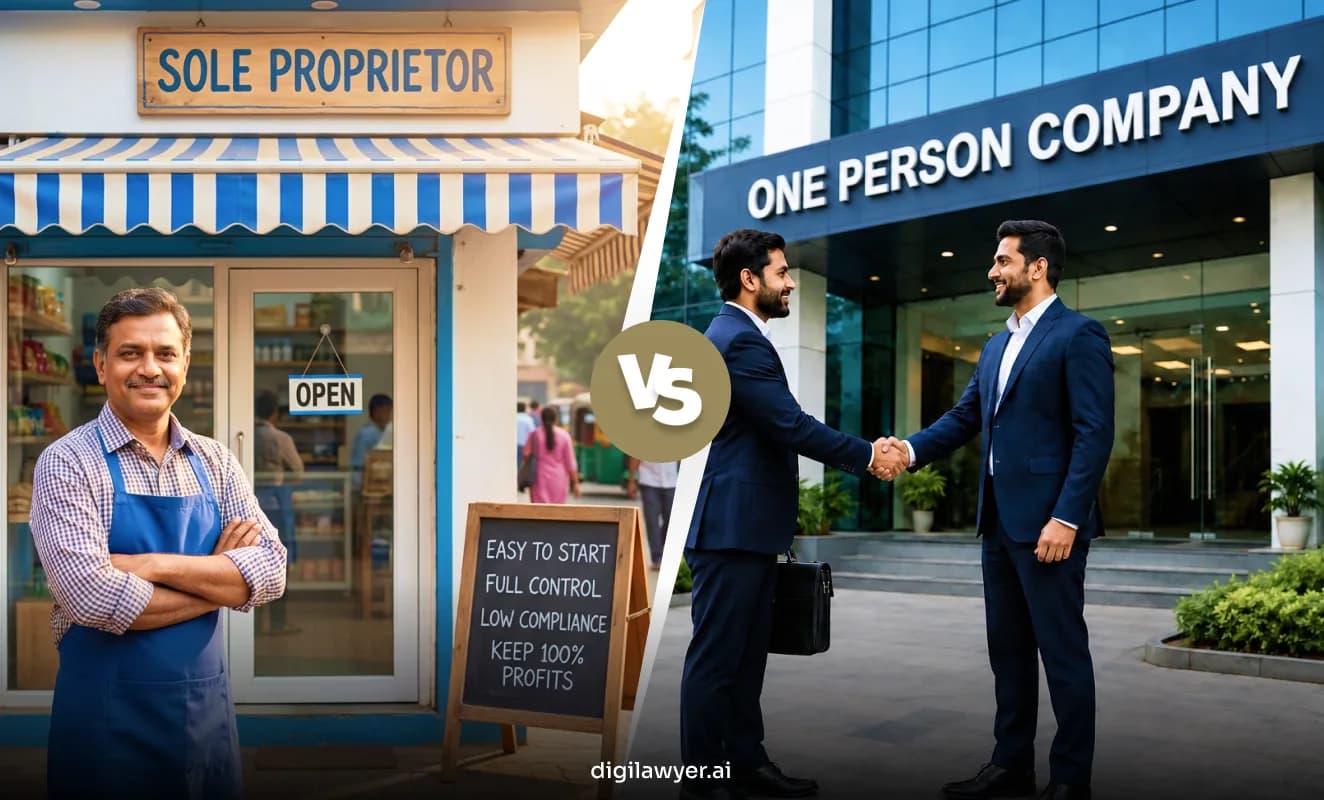
Sole Proprietorship Vs One Person Company: Which One Should You Choose in 2026?
Learn key differences between sole proprietorship and OPC in structure, liability, compliance, and which option fits your business in 2026.
Difference Between LLP and Partnership Firm
Learn how LLP and Partnership Firms differ in liability, compliance, and benefits to choose the right business structure.
Check MCA Company Name Availability in India - Guide for Startups
Guide for startups to check business name on MCA portal , reserve via SPICe+/RUN, verify trademarks, get ROC approval, and register a company in India.
Top Legal Compliance Requirements for Businesses in India to Avoid Penalties
Starting a business in India? Learn the essential legal compliance steps to avoid penalties and build a trustworthy brand. From GST and taxation to labor laws and intellectual property, our guide helps you navigate the regulations with ease.Related Services





DigiLawyer, A 80, A Block, Sector 2, Noida, Uttar Pradesh 201301
Phone: +918178704343
justice@digilawyer.ai





Disclaimer: DigiLawyer is not a law firm, a substitute for a lawyer or law firm, a chartered accountancy firm, or a company secretary firm. We act solely as an intermediary between users and registered professionals, and also offer AI-powered legal assistance, consultation, and document drafting tools to improve access to legal support. Use of our website, services, or AI tools is at the sole risk of the user and does not create any lawyer-client or professional relationship. All consultations and interactions facilitated through our platform are strictly between the user and independent professionals. DigiLawyer is not liable for any actions, decisions, or outcomes arising from the use of our platform, AI tools, or reliance on any advice, consultation, or content provided by us or third-party professionals.
Use of our products and services is subject to our Privacy Policy & Terms of Service

