


How to File Income Tax Return Without Form-16
File ITR without Form 16 using salary slips, AIS & Form 26AS. Verify TDS, claim deductions, choose correct ITR form, e-verify & stay compliant with Income Tax rules.
File Your ITR Without Form 16 — Fast & Stress-Free
- You can file your Income Tax Return even without Form 16. Simply use your salary slips, AIS, and Form 26AS from the Income Tax portal to calculate total income, verify TDS, and claim eligible deductions. Choose the correct ITR form, enter the details manually, and e-verify within 30 days.
- Form 16 may not be issued if you changed jobs, work as a freelancer, or earn below the exemption limit—but filing ITR is still crucial for refunds, loans, visas, and compliance.
- If TDS was deducted but not reflected, you have legal remedies. Platforms like DigiLawyer can help you reconcile records and file accurately without risking tax notices.
Income Tax Return (ITR) is a formal process where individuals, businesses and other entities report their total earnings, the taxes they've already paid (TDS), and any tax-saving investments made during a specific financial year. The obligation to file ITR depends upon the income level.
Form-16 is a TDS (Tax Deduction Service) certificate under section 203 of the Income Tax Act of 1961 that indicates income, deductions, and exemptions issued by the employer of a company. For most salaried professionals it is an essential document required to file ITRs, but what if your employer fails to provide form-16 or you’ve switched jobs mid-year?
ITR filing is still possible even if someone does not have form 16. Through this blog, know how to file tax without form 16, the necessary documents involved, and how DigiLawyer can assist you in the process.
👉 Read more about Which ITR Form Should You Choose
Why is it Important to File ITR?
Filing an ITR is mandatory for salaried individuals, even if you don't owe any extra tax, filing an ITR is incredibly useful and often mandatory:
- Legal Compliance: If your gross income exceeds the basic exemption limit (currently ₹3 lakh under the New Tax Regime).
- Tax Refunds: Only way to reclaim excess tax (TDS) deducted by your employer or bank.
- Loan Approvals: Essential proof of income for Home, Car, or Personal loan applications.
- Visa Entry: Required by many embassies (US, UK, Schengen) to verify financial stability.
- Carry Forward Losses: Necessary to offset current stock market or business losses against future profits.
What are the Cases in which Form-16 is Not Issued?
An employee may not receive Form 16 if their salary is below the basic exemption limit, and no TDS (Tax Deducted at Source) was deducted. However, there are several other situations where Form 16 may not be issued.
- If a company goes bankrupt or shuts down suddenly, the HR or payroll department may no longer function. In such cases, employees may not receive Form 16.
- Some small businesses pay workers as a stipend or professional fee instead of a regular salary. In these cases, they may not issue Form 16.
Note: If TDS was deducted on non-salary payments, the employer (or payer) should issue Form 16A, which is used for TDS on non-salary income.
- Many employers issue Form 16 only once a year (usually by June after the financial year ends). If you leave a company in mid of a financial year, you may need to contact the HR or payroll department and request a form 16, or a salary certificate showing your earnings and TDS details.
- If you work as a freelancer or consultant, you will not receive Form 16 because it is issued only for salary income. Instead, you may receive Form 16A if TDS was deducted.
- If you are working directly for a foreign company that does not have a registered entity in India and does not have a TAN (Tax Deduction and Collection Account Number), they cannot deduct TDS under Indian tax laws. In such cases, Form 16 will not be issued. You may need to calculate and pay advance tax yourself, if applicable.
Step-by-Step Guide to File ITR Without Form16
Any salaried employee can file their Income Tax Return (ITR) without Form 16. You just need to collect the same information your employer would have included in Form 16 and use it to file your return.
Step 1 Gather Your Alternate Income Proof
- Monthly Salary Slips: Total the Gross Salary, Allowances, and Deductions for a financial year.
- AIS (Annual Information Statement): This is your most critical document. It captures interest from savings accounts, dividends, and even small stock market gains that you might have forgotten.
- Form 26AS (likely labeled Form 168 in 2026): Download this from the Income Tax portal. It shows all tax (TDS) deposited by your employer under your PAN.
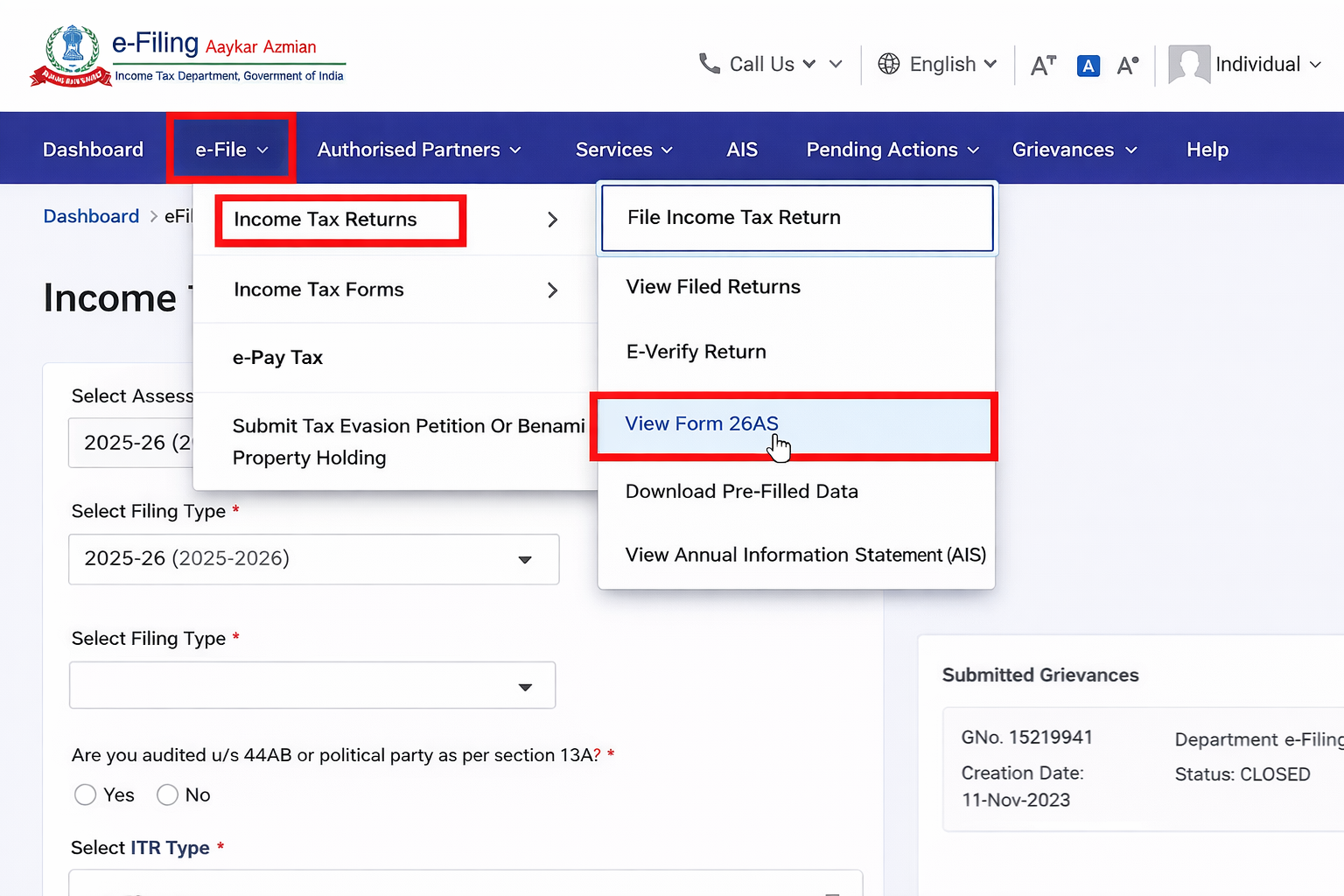
Step 2: Calculate Your Gross Taxable Income
- Total Salary: Sum up Basic salary HRA (after exemption, if applicable), Special allowances, Bonus or incentives and leave encashment (if taxable) from your payslip.
- Add Other Income: Include bank interest (from AIS) and any rental or freelance income.
- Standard Deduction: Subtract the standard deduction (as applicable for the year) or professional tax (if applicable) from total gross salary.
Step 3: Claim Tax-Saving Deductions
After calculating your total income, the next step is to reduce your taxable income by claiming eligible deductions. Deductions help lower the amount of income on which you pay tax.
This includes: Premiums, Health Insurance Premiums or Home loan interests
Step 4: File and E-Verify
1.Log in to the Income Tax e-Filing Portal.
2. Select the correct assessment year.
3. Choose the correct form:
ITR-1 (Sahaj)- For salaried individuals with simple income
ITR-2 -If you have capital gains, multiple properties, etc.
4. Enter your calculated figures manually.
5. Verify TDS from Form 26AS.
6. E-Verify: Use Aadhaar OTP or Net Banking to verify within 30 days. Without verification, your ITR is invalid.
Documents Required to File ITR without Form 16
If you don't have Form 16, you can file a perfectly accurate return by gathering the following alternative documents.
1.Salary Slips
Collect all salary slips for the financial year. These help you calculate:
- Total salary received
- Allowances (HRA, special allowance, etc.)
- TDS deducted
If you don’t have them, request a salary statement from HR.
2. Form 26AS
This is important to verify tax payments. This contains information such as :
- TDS deducted by employer or bank
- Advance tax paid
- Tax refunds (if any)
3. Annual Information Statement (AIS)
AIS shows:
- Interest income
- Dividend income
- High-value transactions
- Other reported income
4. Bank Statements
Bank statements help you check salary credits, calculate savings account interest and track other income received
If Form 16 isn’t available, your bank statements can help for income proof, tax filing, and loans.
5. Interest Certificates
Ask your bank for TDS certificates to calculate taxable income or claim deductions if you have, Fixed deposits, Recurring deposits, Home loans
6. Investment Proofs (For Deductions)
These are needed to claim deductions under the old tax regime.
- LIC premium
- PPF contributions
- ELSS investments
- Health insurance premium
- Home loan repayment
- NPS contributions
7. PAN and Aadhaar
This is mandatory for filing ITR. Make sure your PAN is active and PAN is linked with Aadhaar
Document | Why You Need It | Where to Get It |
Salary Slips | To find Gross Salary & PT | HR Portal / Email |
Form 26AS | To verify TDS deposited | IT E-filing Portal |
AIS / TIS | To see Interest, Dividends, etc. | IT E-filing Portal |
Interest Certs | For Home/Education Loan claims | Bank Website/App |
Investment Receipts | For 80C, 80D, 80G claims | Insurance/Fund Provider |
Legal Remedies if Form 16 is Not Available
If your employer fails to issue Form16, you have specific legal rights and procedural remedies to ensure you don't face penalties from the tax department.
- If an employer deducts TDS, they must issue Form 16. Under Section 272A(2)(g) of the Income-tax Act, the employer is liable to pay a penalty of ₹100 for every day the default continues if they fail to provide Form16.
- Write a formal letter to your Jurisdictional Assessing Officer. You can find who your JAO is on the Income Tax portal under Quick Links on the ITR website.
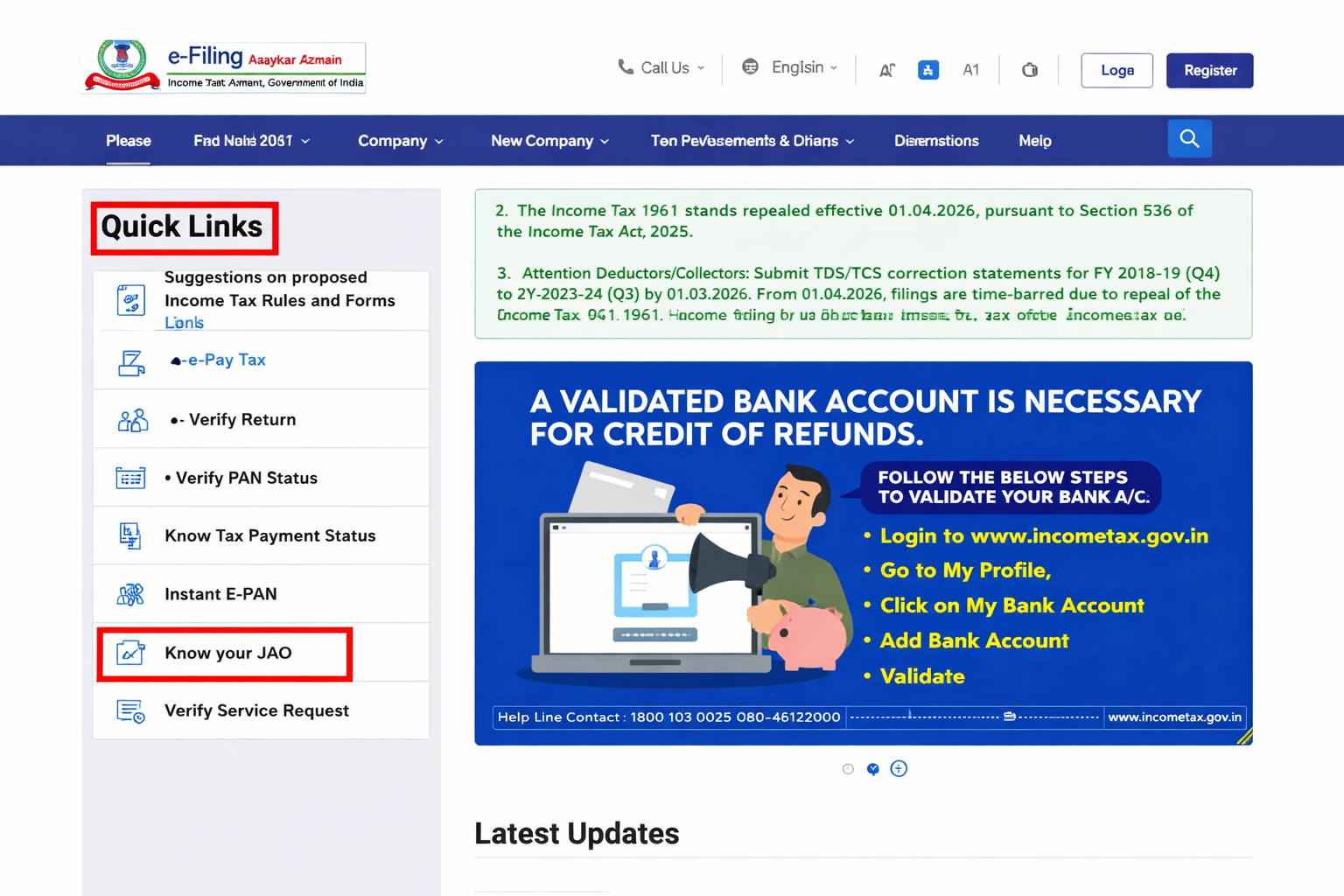
- File an e-Nivaran Grievance :
- Log in to the e-Filing portal, go to the Grievances tab, and select Submit Grievance.
- Choose CPC-TDS.
- Select Form 16/16A related.
- Form 16 is considered a part of your employment records. You can approach a Labour Commissioner or file a civil suit asking the court to order the employer to hand over your tax documents.
Common Mistakes to Avoid while Filing ITR without Form16
- Reporting only your current employer's income or claiming the Standard Deduction twice.
- Claiming TDS that isn't in Form 26AS
- Claiming deductions not allowed under the chosen tax regime
- Not Reporting Exempt Allowances Properly like the HRA exemption.
- Using the wrong ITR form can make your return defective.
How DigiLawyer Can Help
Checking months of salary slips and matching them with government records like the AIS can feel confusing and time-consuming.DigiLawyer makes it a simple process by turning your documents into an accurate and notice-free tax filing.
- Regime Optimization: We run a side-by-side comparison of your data under both the Old and New Tax Regimes to pinpoint exactly which one saves you the most money.
- Seamless Remote Consultation: You don't need to visit a physical office. Through our Online CA Consultation, you can upload your bank statements and payslips securely, getting your taxes filed by experts from the comfort of your home.
- Manual HRA & Deduction Support: If you’re filing without Form 16, our experts help you accurately calculate HRA exemptions and verify your 80C/80D proofs. To ensure your HRA claims are legally valid, we assist you in drafting a formal Residential Rent Agreement Online that meets the latest tax department requirements.
- Notice Protection: By performing a pre-filing audit, we catch discrepancies that usually trigger Section 143(1) notices before you hit submit.
- Employer Liaison: If your employer has deducted tax but hasn’t deposited it, DigiLawyer’s legal team can help you draft formal notices to ensure your tax credits are secured.
FAQs
Form 16 shows your gross salary (April–March), while your bank shows only the net salary after deductions like TDS, PF, and professional tax, so a mismatch is common. Compare only April–March credits, add back deductions, and verify TDS in Form 26AS on the Income Tax Department portal; if the difference is still large, ask HR for a reconciliation.
No. It is not compulsory. It is only a summary of your salary and TDS details provided by your employer.
You must collect salary slips from all employers and include total income from each job. Also verify TDS through Form 26AS.
No. Form 16 is issued only for salary income. Freelancers may receive Form 16A if TDS was deducted.
If income shown in AIS or Form 26AS is not reported, you may receive a notice from the Income Tax Department. Always cross-check before filing.
Yes, Form 16 (Form 130) is merely a certificate issued by your employer summarizing your salary and tax deducted. It is not a mandatory attachment for filing your return. The Income Tax Department only requires you to report your income accurately and pay the correct taxes.
This is a serious issue. If your payslip shows a deduction but it's not on the portal, your employer may not have deposited the tax.
- First request your employer to file their TDS return (Form 24Q / Form 138).
- Under Section 205, the tax department cannot recover tax from you if it has already been deducted by the employer. You can file your ITR using your payslips as evidence, though you may receive a notice to provide proof
Waiting for a missing document is not a valid excuse for late filing. If your income is above ₹5 Lakh, the late fee is ₹5,000. If below ₹5 Lakh, it is ₹1,000.You will also owe 1% interest per month on any unpaid tax under Section 234A.
You can send a legal notice to your employer. Under Section 203 of the Income Tax Act, an employer is legally mandated to issue Form 16 (now being renumbered as Form 130 in the 2026 rules) if they have deducted TDS from your salary.
To file your ITR without a Form 16, you must reconstruct your financial profile using your monthly salary slips, bank statements, and the government’s Annual Information Statement (AIS) or Form 26AS (Form 168). You are legally required to report your total gross salary and can manually claim the Standard Deduction, you must remember to explicitly Opt-Out of the default New Regime if you wish to claim deductions like 80C or HRA.
Not serving your notice period is a contractual issue, but issuing Form 16 is a statutory obligation. Your employer cannot legally withhold your tax certificate as a penalty for not serving notice. Under Section 203 of the Income Tax Act, if an employer has deducted TDS from your salary, they are legally mandated to issue the certificate.
- Why is it Important to File ITR?
- What are the Cases in which Form-16 is Not Issued?
- Step-by-Step Guide to File ITR Without Form16
- Step 1 Gather Your Alternate Income Proof
- Step 2: Calculate Your Gross Taxable Income
- Step 3: Claim Tax-Saving Deductions
- Step 4: File and E-Verify
- Documents Required to File ITR without Form 16
- 1.Salary Slips
- 2. Form 26AS
- 3. Annual Information Statement (AIS)
- 4. Bank Statements
- 5. Interest Certificates
- 6. Investment Proofs (For Deductions)
- 7. PAN and Aadhaar
- Legal Remedies if Form 16 is Not Available
- Common Mistakes to Avoid while Filing ITR without Form16
- How DigiLawyer Can Help
- FAQs
Which ITR Form Should You Choose? Types & Eligibility Based on Income Type
This blog explains the different ITR forms in India, who should file each one, common mistakes to avoid, and how to choose the correct form for smooth, compliant tax filing.
Income Tax Notices to Salaried Employees: Types, Reasons & How to Respond
Received an income tax notice? Learn the common types, reasons, how to respond, and ways salaried employees can avoid tax notices altogether.




Disclaimer: DigiLawyer is not a law firm, a substitute for a lawyer or law firm, a chartered accountancy firm, or a company secretary firm. We act solely as an intermediary between users and registered professionals, and also offer AI-powered legal assistance, consultation, and document drafting tools to improve access to legal support. Use of our website, services, or AI tools is at the sole risk of the user and does not create any lawyer-client or professional relationship. All consultations and interactions facilitated through our platform are strictly between the user and independent professionals. DigiLawyer is not liable for any actions, decisions, or outcomes arising from the use of our platform, AI tools, or reliance on any advice, consultation, or content provided by us or third-party professionals.
Use of our products and services is subject to our Privacy Policy & Terms of Service

