


How to Create a Rent Agreement Online in India

60-Second Summary
- Renting property in India requires a legally valid agreement to protect both landlords and tenants.
- Landlords worry about unpaid rent, property damage, and weak contracts.
- Tenants fear unfair clauses, deposit disputes, and sudden eviction.
- First, decide the type (residential/commercial) and duration (11 months or more).
- Draft the agreement with proper clauses - rent, deposit, notice period, maintenance, termination, etc.
- Fill in accurate property and party details.
- Pay the correct stamp duty and complete e-stamping.
- Register the agreement if the tenure exceeds 11 months.
Renting a property in India is simple until the paperwork problems arise. Owners worry about the unpaid rent, property misuse, and poorly drafted agreements that won’t hold up in court if any issues arise in the future. Tenants fear unfair clauses, sudden eviction, or disputes over security deposits.
Many still rely on local agents, outdated templates, or incomplete stamp paper documentation, which can create serious legal risks. This is where online rent agreement services simplify the process. With step-by-step digital drafting, proper stamp duty calculation, and legally compliant documentation, platforms like Digilawyer help both landlords and tenants create secure, valid rental agreements quickly and hassle-free without unnecessary delays or legal confusion.
Complete Step-by–Step Process to Create a Rent Agreement Online
Let’s understand how to draft a legally valid rental agreement, along with the essential steps involved.
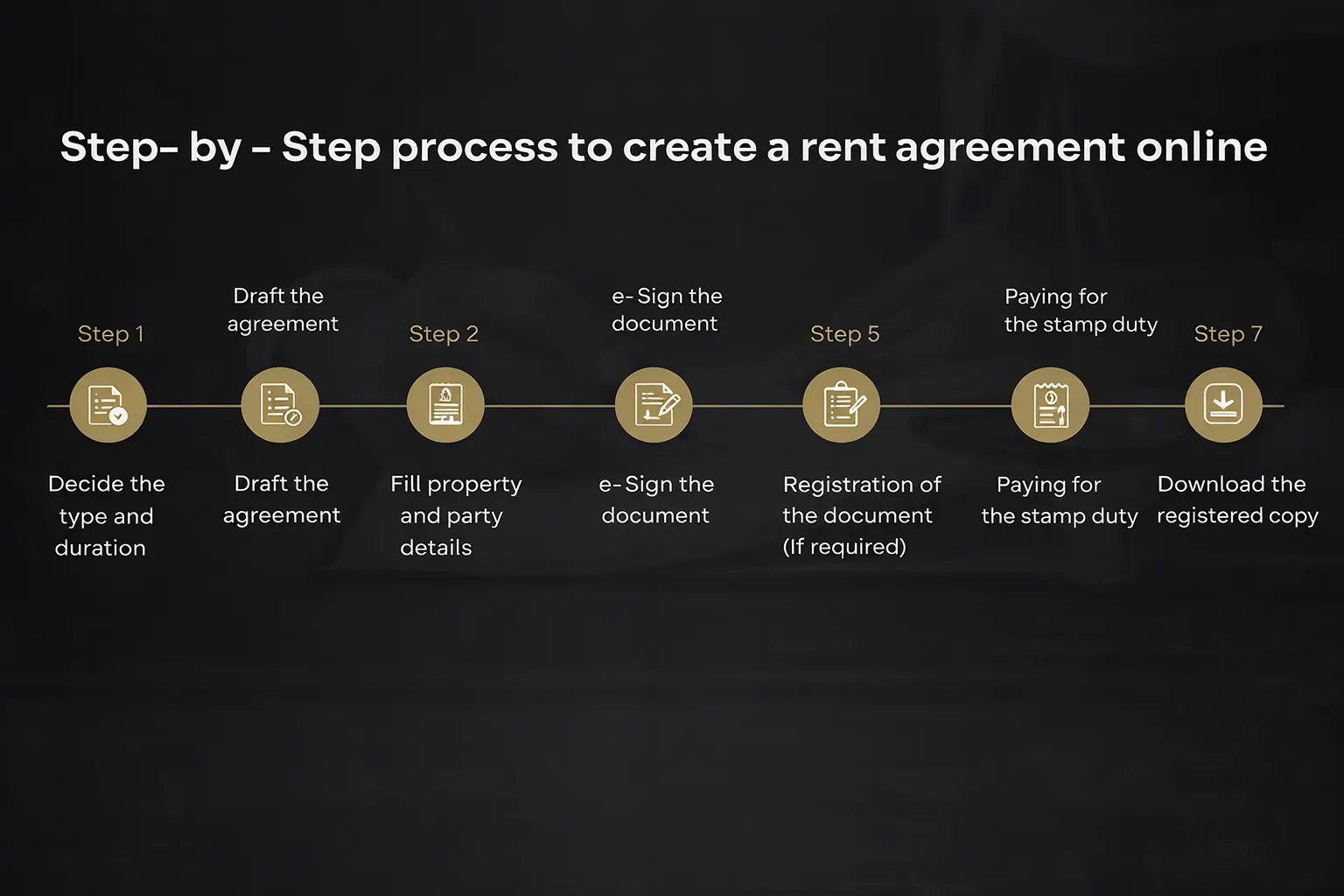
Step 1- Decide the Type and Duration
First, decide the type of agreement that best suits your needs, whether residential or commercial. And how much duration do you want, 11 months or more than that? Each type will have its benefits and needs. If the agreement is for a longer duration that is, 11 months or more, it is mandatory to register according to the Registration Act, 1908.
If you're unsure, check out our complete guide on 11-month rent agreements to see why it is one of the most commonly preferred options.
Step 2– Draft the Agreement
The next step is to draft the agreement from a reliable website. A good template will include all the necessary clauses. This includes the rent amount, the security deposit, the notice period for leaving, and who is responsible for maintenance and utility bills. Using a trusted template from a portal like Digilawyer is important, as it will already have all the necessary information added in the legal document between the parties.
Note- It is important to do police verification of the tenant for safety and legal compliance.
Step 3- Fill in Property and Party Details
Fill in the details in the agreement, like the landlord and tenant names, their Aadhaar or PAN numbers, the complete property address, the monthly rent, the security deposit amount, and the lease term. Properly check every detail.
Step 4- E- Sign the document
Once the agreement is ready, it’s time to sign the document. Both the landlord and tenant must sign, and you can use Aadhaar-based e-Sign, which is legally valid for completing an e-rent agreement. There should also be two witnesses who must sign the document.
Step 5- Registration of the document (If required)
If the tenure is more than 11 months, it is important to get the agreement registered with the Sub- Registrar which can be booked online via the specific state IGR portal. Visit the office with original ID proof, complete the biometric verification, and pay the registration fees.
Notarization is the process by which a notary validates the signature and identity of the individual for authenticity. It is not a mandatory step and is usually done for affidavits and short-term agreements.
Step 6- Paying for the stamp duty
After the registration is done, it is important to get it stamped. You can get an e-stamp through portals like SHCIL e-stamping. The cost depends on the lease term. For a lease of up to 5 years, it is 2% of the average annual rent. For 5 to 10 years, it is 5%. Digilawyer can help you with calculating the amount of e-stamp you have to pay for your agreement, and also with the e-stamping procedure.
Step 7- Download the registered copy
After the document is approved, you can download the digitally registered copy or collect it from the Sub-Registrar's office.
Documents Required to Create the Rent Agreement in India
Here is a checklist of essential documents required for drafting a rental agreement.
For Both Tenant and Landlord
- Proof of Identity- Aadhar card, Pan card, or driving license
- Proof of address
- Passport-sized photographs
For Landlord
- Proof of ownership- Title deed, latest property tax receipt, or an electricity bill in the owner's name.
For Registration
- Two witnesses, along with their IDs for verification.
- Photocopy of the signed agreement pages.
Specific documents may also be required, depending upon the state where the rental agreement is executed. It’s recommended to consult a lawyer for professional advice.
👉 Also Read: Rent Agreement vs Lease Agreement in India
State-Wise Rental Agreement Costs
1. Delhi
- Stamp duty- Upto 5 years is 2% of the average annual rent + security deposit. For 5-10 years is 5% of the total average annual rent + deposit
- Registration charges-1% of the average annual rent + deposit, or a nominal amount, generally around ₹1,100 for many, though it can vary based on tenure.
- Notarization- Rs. 100-500
Read More About Stamp Duty & Registration Charges for Rent Agreement in Delhi
2. Maharashtra
- Stamp duty- 0.25% of the total rent for the entire tenure.
- Registration charges- ₹1,000 (urban) or ₹500 (rural).
- Notarization- Rs. 100-500
- Online Service charge- ₹300 – ₹1,000 (biometric/home visit charges if applicable)
3. Uttar Pradesh
- Stamp duty- 4% of annual rent (for agreements up to 11months) and 8% for longer terms.
- Registration charges- Usually 2% of the total rent plus security deposit. A flat fee of ₹1,100 may apply for registered agreements.
- Notarization- Rs. 100-500 You can also connect with Digilawyer licensed lawyers to learn more specifically about the costs in your state.
Important Clauses to Include While Drafting a Rent Agreement
While drafting a rental agreement, it is important to include essential clauses to ensure clarity and legal validity. Below are the important clauses to include.
- Rent amount & due date
- Security deposit terms
- Lock-in period clause
- Maintenance responsibilities
- Notice period
- Subletting clause
- Termination clause
- Late payment penalties
- Dispute resolution clause
Common Mistakes to Avoid in a Rent Agreement
Here are some common mistakes people often make while drafting a residential or commercial rental document.
Not Paying the Proper Stamp Duty: Paying insufficient stamp duty can make the agreement legally weak and inadmissible in court. It may also attract penalties during disputes or registration.
Not Registering the Agreement When Required: If the agreement duration exceeds 11 months, registration is mandatory under law. Failure to register can reduce enforceability and create complications during eviction or legal proceedings.
Using copy-paste templates without customization: Generic templates may not reflect the actual rent amount, deposit terms, lock-in period, or state-specific rules. This can create ambiguity and disputes later.
Missing a Clear Termination Clause: Without defined notice periods and exit terms, ending the tenancy can become complicated and lead to conflict.
Skipping Police Verification: Not conducting tenant police verification can expose landlords to safety and security risks.
Not Clearly Defining Maintenance Responsibilities: If it’s not clearly stated who pays for repairs, utility bills, or society charges, disagreements between landlord and tenant are common.
Benefits Of Making a Rental Agreement Online Via Digilawyer
Feature | Digilawyer | Local Agent |
Legally Approved Agreements | Drafted by legal experts in compliance with Indian laws and state regulations | Often uses generic templates; legal accuracy not guaranteed |
Fast & Easy Process | Fully online process — quick drafting and execution without running around | Requires physical visits, coordination, and follow-ups |
E-Stamping & Registration Help | Complete assistance with e-stamping and registration formalities | Usually limited to drafting, registration support may be unclear |
Customizable Agreements | Clauses can be tailored to landlord/tenant needs (lock-in, notice, maintenance, etc.) | Mostly standard format with minimal customization |
Affordable & Transparent Pricing | Clear pricing with no hidden charges | Commission-based pricing; hidden or variable charges are common |
Secure Online Storage | Digital copy stored securely access anytime, anywhere | Physical copy handed over, no digital backup guaranteed |
Conclusion
A properly drafted rental agreement protects your money, property, and peace of mind. Whether you're a landlord worried about unpaid rent or a tenant concerned about unfair eviction, legal clarity is essential. From calculating stamp duty to assisting with registration and adding customized clauses, Digilawyer makes the entire process smooth and legally sound.
Instead of risking errors with agents or outdated templates, choose a trusted digital rent agreement service. Create your rental agreement online with Digilawyer — fast, secure, and legally compliant.
FAQ
Is an online rent agreement legally valid in India?
Yes, if proper stamp duty is paid and registration is completed (if required), an online rent agreement is legally valid.
Is registration mandatory for all rent agreements?
Registration is mandatory if the agreement duration is more than 11 months.
Is notarization required to make a rent agreement legally valid?
No. Notarization is optional and generally used for short-term agreements. Registration is more legally strong.
What happens if I don’t pay correct stamp duty?
The agreement may become legally weak and can attract penalties during disputes.
Can Digilawyer help with state-specific stamp duty calculations?
Yes. Digilawyer assists in calculating accurate stamp duty and guides you through the e-stamping process.
Is stamp duty mandatory for a rent agreement?
Yes. Paying proper stamp duty is compulsory. An agreement without adequate stamp duty may not be legally admissible in court.
Is notarization enough instead of paying stamp duty?
No. Notarization does not replace stamp duty. Stamp duty must be paid first. Notarization only verifies signatures.
Who should pay the stamp duty — landlord or tenant?
There is no fixed rule under central law. Usually, it is decided mutually between landlord and tenant, but in many cases, the tenant pays.
Is stamp duty different for commercial and residential properties?
Yes. Commercial lease agreements often attract higher stamp duty compared to residential agreements.
What is the difference between a lease agreement and a rent agreement?
- Lease Agreement: Usually long-term (more than 12 months), offers more stability, and often requires registration.
- Rent Agreement: Typically, short-term (commonly 11 months in India) and easier to renew or terminate.
Both outline rights and responsibilities, but leases generally provide stronger legal protection for tenants.


- Complete Step-by–Step Process to Create a Rent Agreement Online
- Documents Required to Create the Rent Agreement in India
- State-Wise Rental Agreement Costs
- 1. Delhi
- 2. Maharashtra
- 3. Uttar Pradesh
- Important Clauses to Include While Drafting a Rent Agreement
- Common Mistakes to Avoid in a Rent Agreement
- Benefits Of Making a Rental Agreement Online Via Digilawyer
- Conclusion
- FAQ

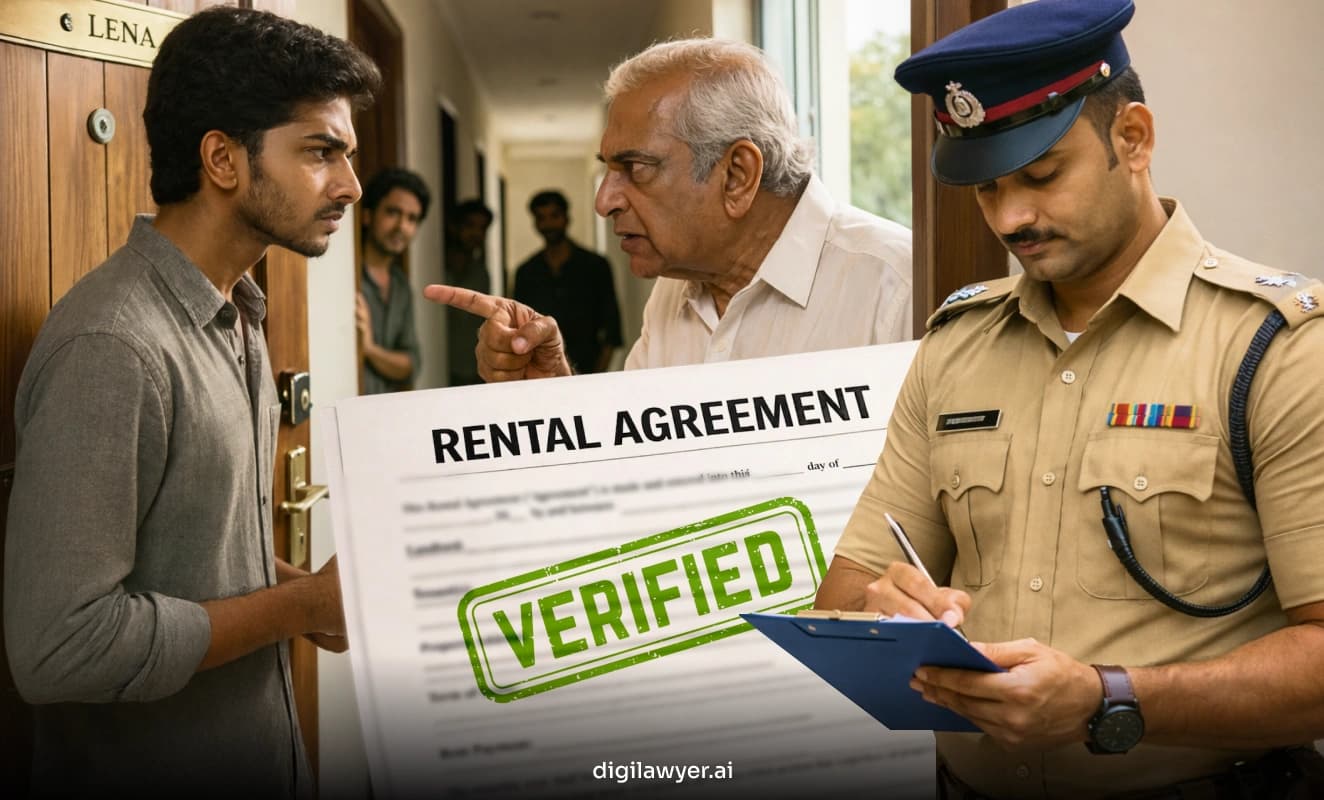
Why Police Verification Is Required for Rent Agreement: Why Landlords Should Do It?
Police verification for tenants helps landlords confirm tenant identity, prevent fraud, and reduce legal risks. This guide explains the process, required documents, applicable legal rules, and how to complete tenant verification easily in India.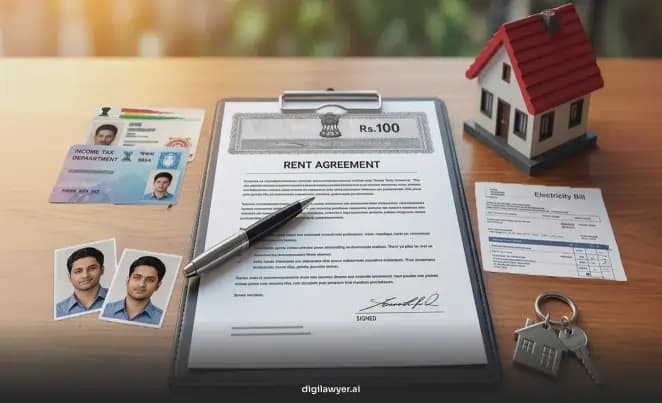
What are the Documents Required for Residential and Commercial Rent Agreement
Discover rent agreement documents required in India. Complete checklist for residential & commercial tenants and landlords with legal guidance and document tips.
Why 11-Month Rent Agreements Are Common in India?
Signing a rent agreement? Understand 11-month agreements in India with legal rules, registration, stamp duty, key clauses, validity & tips to avoid disputes.
Rent vs Lease Agreement in India: Key Legal Differences Explained
Understand the legal difference between rent and lease agreements in India. Compare duration, flexibility, stamp duty, tenant rights, and registration rules to choose the right property agreement.
Rent Agreement Vs Leave & License in India | Key Differences Explained
Don't sign the wrong paper. We break down the rent agreement vs leave and license agreement so you know exactly who holds the rights. Learn the key differences and draft your agreement online today.
All You Need to Know About Society Conveyance Deed
Secure your housing society's legal ownership with a Society Conveyance Deed. Learn its importance, process, and required documents in this essential guide!
DigiLawyer, A 80, A Block, Sector 2, Noida, Uttar Pradesh 201301
Phone: +918178704343
justice@digilawyer.ai





Disclaimer: DigiLawyer is not a law firm, a substitute for a lawyer or law firm, a chartered accountancy firm, or a company secretary firm. We act solely as an intermediary between users and registered professionals, and also offer AI-powered legal assistance, consultation, and document drafting tools to improve access to legal support. Use of our website, services, or AI tools is at the sole risk of the user and does not create any lawyer-client or professional relationship. All consultations and interactions facilitated through our platform are strictly between the user and independent professionals. DigiLawyer is not liable for any actions, decisions, or outcomes arising from the use of our platform, AI tools, or reliance on any advice, consultation, or content provided by us or third-party professionals.
Use of our products and services is subject to our Privacy Policy & Terms of Service

