


Ways to Recover Money from a Friend or Someone Else

60-Second Summary
You helped someone when they needed money, and now they’ve stopped replying. Inside this blog, you’ll learn:
- Why nearly 90% of money recovery cases get resolved just by sending a proper legal notice, without going to court.
- What proof actually works when the loan was informal or based on trust?
- How to turn WhatsApp messages, UPI payments, and conversations into usable evidence.
- When to stay polite, when to escalate, and how to avoid making mistakes that weaken your case.
- The exact sequence to follow so you don’t waste time, money, or relationships unnecessarily.
Do you want your money back? This is a short, step-by-step legal and practical guide for people in India who lent money to someone they trust, friend, family, buyer, lender, and now need it back. Read it, act fast (there’s a time limit), and follow the checklist below. Just see what works best for you.
7 Easy & Practical Ways to Recover Money
Before diving into the legal options, it’s important to understand these five practical things you can try first.
1. Try to Get Control Over the Situation
If you keep saying “whenever you can, please pay it to me”, payment drops to zero priority.
Do this instead:
- Give one clear amount + one firm date
- Speak in statements, not requests
“I need ₹25,000 by Friday evening. Please confirm.”
In most cases, people aren’t refusing to pay—they’re delaying it.
Expert Insight:
A clear deadline often changes the outcome.
2. Break the Amount down
Large amounts feel impossible & easy to postpone. Smaller ones feel doable.
Instead of Saying:
“Return ₹50,000”
Say:
“Send ₹10,000 today. We’ll close the balance in parts.”
Once the first payment happens, there’s a good chance you’ll get something, which is better than nothing.
Expert Insights:
There is a famous saying for recovery of Debt “When an elephant is standing on you, the goal isn’t to remove it instantly, it’s to reduce the pressure. If it moves from your body to just your hand, you can survive and regain control. The same logic applies to debt recovery: reduce the burden first, then resolve the rest”
3. Public-but-Polite Pressure (Carefully)
Make sure what you say doesn’t come across as insulting or shaming them. Keep it casual, not accusatory.
- Ask about money in group settings (friends / family chats)
- Casually bring it up when others are present
“You were going to clear my amount this week, right?”
Most People hate looking unreliable in front of others, especially if you bring this in front of someone they care about. While this may lightly touch their ego, social accountability often prompts action and helps in recovering the money.
Expert Insights:
Mediation has long been part of Indian culture. Involving a respected elder, family member, village sarpanch, or a well-regarded person in the community can be highly effective in money recovery. The presence of a neutral and respected mediator often resolves matters faster than repeated personal follow-ups.
4. Tie It to Their Reputation
Works especially well with professionals.
Example:
“I’ve always spoken well about you. Let’s not make this awkward.”
You’re reminding them what they lose, trust, not money. Usually, people with good principles are going to clear their debts, but they can also delay sometimes, this is the way to butter them up.
Expert Insights:
People with strong principles usually intend to clear their dues, but delays happen due to convenience, not dishonesty. Appealing to their reputation “softly” reactivates their sense of responsibility without creating confrontation. This approach builds pressure while keeping the relationship intact often making it more effective than repeated payment reminders
5. If Reputation Doesn’t Work, Re-Route the Pressure
If someone still hasn’t paid, it usually means their own reputation is no longer a concern.
At that point, identify whose reputation does matter to them- a spouse, parent, business partner, investor, or senior family member and bring the conversation closer to that circle.
The objective isn’t to threaten or shame. It’s to shift accountability to a space they care about and can’t easily ignore.
Expert Insights:
This is why, in professional and corporate recoveries, communication often extends beyond one individual to include partners, directors, or stakeholders. Responsibility moves faster when it’s shared.
6. Offer a Face-Saving Exit
Sometimes people delay payment because they’re embarrassed. Giving them a dignified way out can unlock honesty and sometimes money
Say:
- “If you’re stuck, tell me honestly. We’ll fix a plan.”
- This often unlocks truth + partial payment.
Expert Insight:
- If someone blocks you or avoids your calls, visit them at their home or workplace. Many people pay simply to avoid the discomfort of a direct encounter.
- Even unanswered calls create pressure-consistent follow-ups matter, even when ignored.
- If they answer calls but don’t act, it’s time to shift to a formal warning email or legal notice. Informal patience should always have a clear end point.
7. Use a Formal Warning Before Escalation
If reminders and deadlines don’t work, introduce seriousness into the conversation.
Get a warning letter drafted by DigiLawyer with:
- A clear outstanding amount
- Firm payment dates
- A final opportunity to settle
This warning letter acts as a last, formal nudge before issuing a legal notice. Many people respond at this stage because it signals that the matter is moving from informal follow-ups to formal action-without yet escalating to court.
Think of it as a controlled step: firm, documented, and often enough to trigger payment before the actual legal notice is sent.
However, it’s important to be realistic-these methods are not guaranteed solutions. At the end of the day, you need recovery of debt, not conversations.
Legal Ways to Recover Your Money
If someone owes you money and refuses to pay, you may be able to recover it legally. In certain situations, the law allows you to force repayment. Below are the legal ways you can recover your money.
1. When a Legal Notice Gives You Back Your Money?
Sending a Legal Notice for money recovery is the single most effective step in money recovery.
It is a formal letter sent by an advocate on your behalf. It is not a court case yet. It is a warning shot. It effectively says: "You owe my client ₹X amount. If you do not pay within 15 days, we will drag you to court, and you will have to pay the debt plus interest plus my legal fees."
Why It Works?
Most people are terrified of courts.
- They don't want police at their door.
- They don't want a "Court Case" status on their background check when applying for jobs or visas.
- They don't want their family to know they are being sued.
A legal notice on an advocate's letterhead breaks their denial. It makes the problem "real."
💡 Did You Know? In our experience at Digilawyer, roughly 70-80% of money recovery cases are settled immediately after the Legal Notice is sent. The borrower usually calls up, panicking, and arranges a payment plan.
2. Next Steps When a Legal Notice Fails
If the legal notice is ignored (which happens with hardened defaulters), you have to file a suit. These are your options.
Option A: Summary Suit (Order 37 of CPC)
The Fastest Method.
This is the best option if you have written proof (Cheques, Promissory Notes, Written Agreements).
- How it works: In a normal case, the borrower can drag things on for years by filing random defenses. In a Summary Suit, the borrower is not allowed to defend themselves automatically. They have to ask the judge for permission to speak.
- The Judge asks: "Do you have a solid reason why you shouldn't pay?"
- If their excuse is weak ("I don't have money right now"), the judge refuses permission and passes a judgment in your favor immediately.
- Timeline: Much faster than regular suits (6 months to 1.5 years).
Option B: Ordinary Money Recovery Suit
The Standard Route.
Use this if your proof is weak (e.g., only WhatsApp chats, no formal agreement).
- Here, the borrower has the full right to defend themselves.
- Witnesses will be called. Evidence will be examined.
- Timeline: Slower (2–4 years).
- Tip: You can also ask for interest (usually 9% to 12%) for the delay period.
Option C: Commercial Courts (For Big Amounts)
If the transaction can be classified as "commercial" (e.g., a business loan between friends) and is above a certain value (usually ₹3 Lakhs+), you can approach the Commercial Courts.
- These courts have strict timelines.
- Mandatory Mediation: Before the case starts, the court forces both parties to sit with a mediator to try and settle. This is excellent for resolving disputes without a trial.
Note: For those dealing with NRI relatives or overseas assets, the process involves additional steps of serving notice through the Ministry of Home Affairs, ensuring that geographical boundaries do not stop the RECOVERY OF MONEY.
In metro cities like Bengaluru, Hyderabad, and Pune, courts now allow e-filing through state judicial portals, making it easier for a lawyer to recover money on your behalf without physical court visits for every small date.
“Law doesn’t help those who sleep on their rights. If you have lent money, stay awake, stay documented, and when necessary, get legal help.”
Abhishek Manu Singhvi
”3. When Should You Go for Criminal Cases?
Civil law is about getting money back. Criminal law is about punishment. Usually, money recovery is a civil matter. The police will tell you, "Go to court, this is a civil dispute."
However, there are two exceptions where you can file a criminal complaint (FIR).
Option A: Cheque Bounce (Section 138, NI Act)
If the borrower gave you a cheque to repay the loan, and it bounced due to "Insufficient Funds,"
- This is a criminal offence.
- You must send a legal notice within 30 days of the cheque bouncing.
- If they don't pay within 15 days of the notice, you file a case.
- Consequence: They face up to 2 years in jail or a fine of double the cheque amount.
- Note: Most people pay up instantly once a Section 138 summons reaches their house. No one wants to go to jail for a bounced cheque.
Option B: Cheating (Section 420 IPC / Section 318 BNS)
For a criminal case under Section 420 IPC (or equivalent BNS provisions, read about IPC vs BNS differences here) for cheating,
- If they took the money promising to invest it in a business that didn't exist? That’s cheating.
- If they used a fake name or forged documents? That’s cheating.
- But if they genuinely borrowed it and just can't pay it back now? That is not cheating. That is a breach of contract (Civil).
Warning: Don't file a fake criminal case just to pressure them. Courts hate this and it can backfire. Use criminal law only if there was actual fraud.
Where to File Your Recovery Suit
Understanding jurisdiction is crucial for your recovery suit under CPC. Under Section 20 of the Code of Civil Procedure, you can file a suit for recovery of money at:
- Where the defendant resides (the borrower's current address)
- Where the defendant carries on business (if applicable)
- Where the cause of action arose (where the loan was given or was to be repaid)
For amounts up to ₹20 lakhs: District Courts or Civil Courts have jurisdiction (varies by state)
Above ₹20 lakhs: May be filed in District Court or High Court depending on state rules
If you need to move your case due to inconvenience or other valid reasons, here's how to transfer a case from one court to another.
What Proof Do You Need to Recover Your Money?
1. Bank Statements (The Gold Standard) If you transferred via UPI (GooglePay, PhonePe), NEFT, RTGS, or Cheque, you are safe. The bank entry proves the money moved. The onus shifts to them to prove why you gave it to them. Was it a gift? Did they sell you a car? If they can't prove that, the court assumes it’s a debt to be repaid.
2. WhatsApp and SMS Yes, WhatsApp chats are valid evidence in Indian courts.
- Context matters: Screenshots showing you asking for money and them making excuses ("Next week pakka," "Salary didn't come") are proof they admit they owe you.
- Export the chat: Don’t just take screenshots. Export the chat history via email to yourself so you have the metadata.
3. Voice Recordings Is it legal to record calls in India? Generally, recording a conversation you are a part of is admissible in civil proceedings if it’s relevant to the case.
- The trick: Get them to say the amount.
- You: "I am really stressed about the 5 Lakhs."
- Them: "I know, I know, I will give the 5 Lakhs back in March."
- That recording is pure gold for your lawyer.
4. Witnesses Did anyone else see you give the money? Or did the borrower mention the loan to a mutual friend? Witness statements can support your case, though they are weaker than digital proof.
The Section 65B Certificate
Here is a slightly technical but important point. Electronic evidence (chats, emails) needs a certificate under Section 65B of the Indian Evidence Act. Don't worry you don't need this now. But when you file a case, your lawyer will draft an affidavit stating that the device (your phone/laptop) was working properly and the prints are authentic. It’s a standard legal procedure.
Cost of Filing a Money Recovery Suit in India
Understanding the costs involved is important before starting any money recovery process. Understanding the financial commitment helps you decide whether to pursue a recovery suit under CPC. Here’s a clear breakdown to help you plan better.
Court Fees (Approximate)
Claim Amount | Court Fee | State Variations |
Up to ₹1 lakh | ₹1,500-3,000 | Delhi, Mumbai, Bangalore |
₹1-5 lakhs | ₹3,000-10,000 | Most states |
₹5-20 lakhs | ₹10,000-40,000 | Commercial courts may charge more |
Above ₹20 lakhs | Ad valorem (percentage-based) | 2-5% of claim amount |
Lawyer Fees for Money Recovery
Service | Cost Range | Notes |
Legal Notice Drafting | ₹999-5,000 | Digilawyer: ₹999 |
Summary Suit | ₹15,000-40,000 | Includes drafting + filing |
Regular Recovery Suit | ₹25,000-1,00,000 | Depends on complexity |
Court Appearances | ₹3,000-10,000 per hearing | 5-20 hearings typical |
Execution Petition | ₹10,000-30,000 | After decree |
Total Estimated Cost for Money Recovery
For a ₹5 lakh claim (summary suit):
- Court fees: ₹5,000
- Lawyer fees: ₹20,000
- Miscellaneous (stamps, copies): ₹2,000
- Total: ₹27,000 (5.4% of claim)
Cost-Benefit Analysis: If you're trying to recover ₹50,000 through court, legal costs might consume 40-50% of recovery. Consider negotiated settlement or Lok Adalat first.
How Long Do You Have to Recover Your Money?
Under the Limitation Act, 1963 in India, the "limitation period" for money recovery is 3 years from the date the debt became due.
- If you lent money on 1st Jan 2020, and they were supposed to pay back on 1st Jan 2021.
- You must file the case by 1st Jan 2024.
If you wait until 2nd Jan 2024, your money is gone legally. The court will dismiss your case instantly, no matter how much proof you have.
When Is It Hard to Recover Your Money Legally?
This is where things get tricky.
The Cash Problem If you lent a large amount (over ₹20,000) entirely in cash with no witnesses and no written acknowledgment, recovery is very difficult. The borrower can simply deny ever receiving it.
Furthermore, under Section 269SS of the Income Tax Act, accepting a loan or deposit in cash of ₹20,000 or more is actually a penalty-attracting offence for the borrower, and repayment in cash of ₹20,000 or more is an offence for you (Section 269T).
Note: This is a tax law, not a recovery law. You can still sue for cash recovery, but you might face questions from the Tax Department if the amount is huge.
The most common lie borrowers tell in court is: "He gave it to me as a gift because he is my uncle/friend." This is why your WhatsApp messages are crucial.
If a message says "When will you return the money?", and they reply, "Soon," that proves it was not a gift. Gifts are not "returned."
WhatsApp messages are valid proof only if the phone number is clearly visible. Chats that show only saved names or nicknames weaken your case. Always keep screenshots or chat exports where the sender and receiver numbers are clearly identifiable.
Practical Rules for the Future
If you eventually get your money back (or even if you don't), you need to change how you operate. You don't have to stop helping people, but you must stop being naive.
Treat your personal lending like a Personal Credit Score.
Rule 1: The Loss Limit Only lend an amount you are mentally prepared to lose. If losing that ₹50,000 will mean you can't pay your rent, do not lend it.
Rule 2: No Cash, Ever Always use UPI or Bank Transfer. In the "Remarks" section of the transfer, write: "Loan for [Name] - Repay by [Date]”. This remark on your bank statement is strong evidence.
Rule 3: The Promissory Note You don't need a 20-page agreement. Buy a simple revenue stamp, take a plain paper, and write: "I, [Name], acknowledge receiving ₹X from [Your Name] as a loan. I promise to repay it by [Date]. Signed." Have them sign it. Keep it safe. This tiny piece of paper makes the legal process 10x faster.
Rule 4: Stop the Chain If someone borrows money and you have to remind them twice to return it, never lend to them again. They have shown you their financial character. Believe them.
How Digilawyer Can Help?
Don't let another day pass while your money sits with someone who refuses to repay. Take the first step toward your money recovery today.
What Digilawyer Offers:
Free Case Evaluation: Understand your legal options in 10 minutes
Legal Notice Drafting: Lawyer drafted+ attested at just ₹1000 delivered in 24-48 hours
Recovery Suit Filing: Summary, regular, or commercial, we handle everything
Success-Oriented Approach: We focus on settlement first, litigation only when necessary
Digital Convenience: Track your case online, communicate via WhatsApp
Frequently Asked Questions (FAQs)
The borrower is in a different city. Where do I file the case?
You have an advantage here. You can generally file the case in the city where you reside (since the "cause of action" partly arises where the money was supposed to be returned) or where the transaction took place. You don't necessarily have to travel to their city.
Can I recover money if I gave it in cash?
Yes, but it is harder. You will need witnesses, WhatsApp chats acknowledging the cash, or recordings. Without any supporting proof, cash recovery is nearly impossible in court.
How much does a lawyer cost for this?
It varies. But at Digilawyer, we believe in transparent, fixed pricing. A legal notice costs a fraction of the loan amount, and it’s usually an investment that pays for itself when the money is recovered.
What if they declare bankruptcy (Insolvency)?
If an individual files for insolvency, a court-appointed officer takes over their assets to pay off creditors. You will have to file a claim with the officer. You might not get 100% back, but you will receive a share of any remaining assets.
Can I file a suit if I'm not an Indian citizen?
Yes, foreign nationals can file recovery suits in India if the loan was given in India or the defendant resides in India. You'll need proper documentation, possibly apostilled, and may need to appear through a power of attorney holder.
Read about Power of Attorney requirements in India
What if the borrower dies before repayment?
The debt becomes a claim against the deceased's estate. You can file a suit for recovery of money against the legal heirs or estate representatives. However, heirs are liable only to the extent of assets inherited, not from their personal assets.


- 7 Easy & Practical Ways to Recover Money
- 1. Try to Get Control Over the Situation
- 2. Break the Amount down
- 3. Public-but-Polite Pressure (Carefully)
- 4. Tie It to Their Reputation
- 5. If Reputation Doesn’t Work, Re-Route the Pressure
- 6. Offer a Face-Saving Exit
- 7. Use a Formal Warning Before Escalation
- Legal Ways to Recover Your Money
- 1. When a Legal Notice Gives You Back Your Money?
- 2. Next Steps When a Legal Notice Fails
- Option A: Summary Suit (Order 37 of CPC)
- Option B: Ordinary Money Recovery Suit
- Option C: Commercial Courts (For Big Amounts)
- 3. When Should You Go for Criminal Cases?
- Option A: Cheque Bounce (Section 138, NI Act)
- Option B: Cheating (Section 420 IPC / Section 318 BNS)
- Where to File Your Recovery Suit
- What Proof Do You Need to Recover Your Money?
- Cost of Filing a Money Recovery Suit in India
- Court Fees (Approximate)
- Lawyer Fees for Money Recovery
- Total Estimated Cost for Money Recovery
- How Long Do You Have to Recover Your Money?
- When Is It Hard to Recover Your Money Legally?
- Practical Rules for the Future
- How Digilawyer Can Help?
- What Digilawyer Offers:
- Frequently Asked Questions (FAQs)

How to Check if a Legal Notice Is Original or Fake
Learn how to identify fake legal notices, warning signs, scams & verification steps to protect yourself from fraud, extortion and fake court threats.
When and How to File a Suit for Recovery of Money: A Complete Legal Guide
A simple guide to filing a money recovery suit in India, covering when to take legal action, required documents, and the step-by-step process to recover your money.
What to Do After Receiving a Legal Notice - How to Reply Properly
A practical guide on what to do after receiving a legal notice, including steps to respond, common mistakes to avoid, and how to protect your legal position.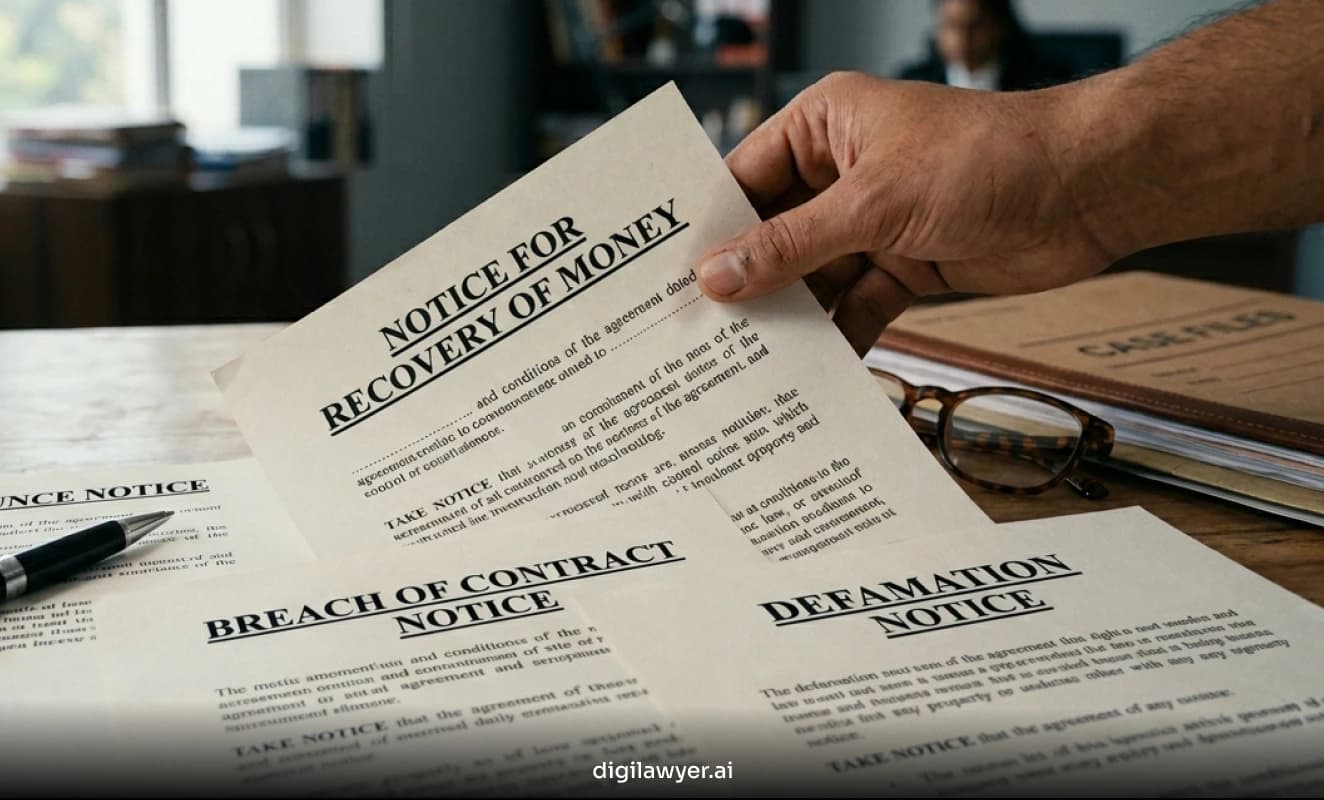
Types of Legal Notices and How to Choose the Right One
Learn the different types of legal notices in India, when to send them, and how they help resolve disputes without going to court. Simple guide with examples and tips.
DigiLawyer, A 80, A Block, Sector 2, Noida, Uttar Pradesh 201301
Phone: +918178704343
justice@digilawyer.ai





Disclaimer: DigiLawyer is not a law firm, a substitute for a lawyer or law firm, a chartered accountancy firm, or a company secretary firm. We act solely as an intermediary between users and registered professionals, and also offer AI-powered legal assistance, consultation, and document drafting tools to improve access to legal support. Use of our website, services, or AI tools is at the sole risk of the user and does not create any lawyer-client or professional relationship. All consultations and interactions facilitated through our platform are strictly between the user and independent professionals. DigiLawyer is not liable for any actions, decisions, or outcomes arising from the use of our platform, AI tools, or reliance on any advice, consultation, or content provided by us or third-party professionals.
Use of our products and services is subject to our Privacy Policy & Terms of Service

