


57th GST Council Meeting 2026: Key Highlights on Next-Gen GST Reforms
60-Second Summary
- Meeting Date: Thursday, 8 October 2026
- Venue: New Delhi
- Chaired By: Union Finance and Corporate Affairs Minister Nirmala Sitharaman
- Organized Under: GST Council
- Key Focus: Next-Generation GST reforms to simplify tax procedures, reduce compliance burdens, improve ITC availability, speed up refunds, and make GST administration more taxpayer-friendly.
57th GST Council Meeting Updates: What Was Announced?
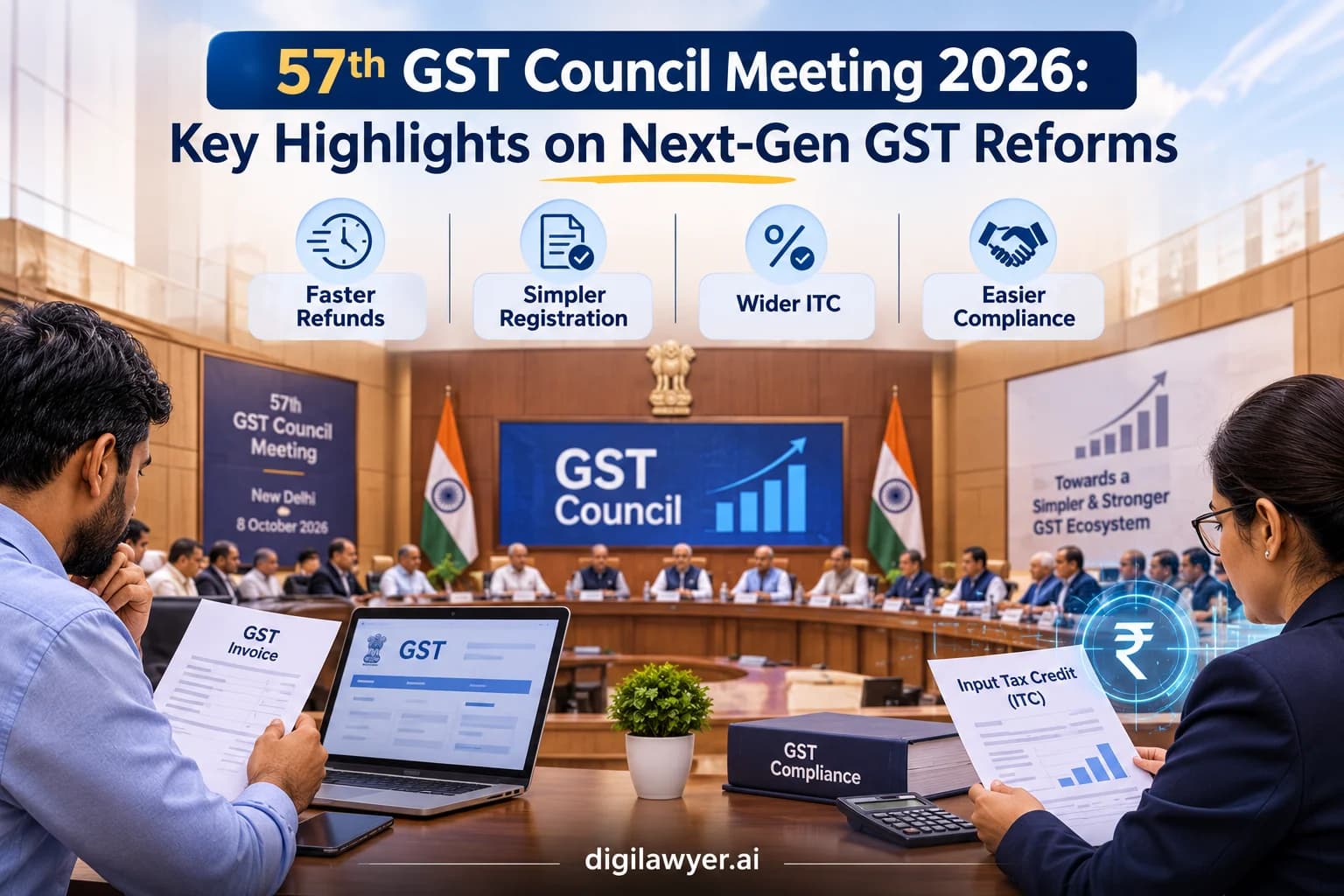
The 57th GST Council Meeting 2026 was held on 8 October 2026 in New Delhi chaired by the Union Finance Minister and Corporate Affairs Minister Nirmala Sitharaman. [1]
The Council recommended major Next-Generation GST reforms to simplify GST procedures, reduce compliance requirements, improve ITC availability, speed up refunds, and make tax enforcement more taxpayer-friendly.
It was attended by the Chief Ministers of Delhi, Goa, Haryana, Jammu & Kashmir, Karnataka, Kerala, Maharashtra and Meghalaya, the Deputy Chief Ministers of Manipur and Telangana, State and UT finance ministers, the Revenue Secretary and CBIC members.
57th GST Council Meeting: Quick Summary
Particulars | Details |
Event | 57th GST Council Meeting 2026 |
Date | Thursday, 8 October 2026 |
Venue | New Delhi |
Chaired By | Union Finance Minister and Corporate Affairs Minister Nirmala Sitharaman |
Focus | Next-Generation GST reforms to simplify GST procedures, reduce compliance requirements, improve ITC availability, speed up refunds and make tax enforcement more taxpayer-friendly |
Attended By | Chief Ministers of Delhi, Goa, Haryana, Jammu & Kashmir, Karnataka, Kerala, Maharashtra and Meghalaya; Deputy Chief Ministers of Manipur and Telangana; State and UT Finance Ministers, Revenue Secretary and CBIC members |
Organized Under | GST Council |
Key Recommendations of the 57th GST Council Meeting
1. Input Tax Credit Reforms
The GST Input Tax Credit reforms recommended allowing businesses to claim ITC on catering, insurance, telecom towers, pipelines outside factories, free samples and goods they can no longer use or sell because they have expired.
For example, if shop buys goods worth Rs 10,000 and pays Rs 1,800 as GST. If those goods expire and can no longer be sold, the shop may still be allowed to keep the Rs 1,800 GST credit instead of paying that amount back to the government.
2. GST Registration Reforms: Faster and Simplified Registration Process
GST registration updates and cancellations may become easier. Most changes to your GST registration updates and cancellations will become easier, with automatic approval of most changes and a two-phase cancellation process based on ITC limits, pending returns and dues.
Small e-commerce sellers who transfer up to Rs 2.5 lakh in ITC per month may register in other states using the platform's warehouse address, without setting up a physical office.
In 2025, the GST Council recommended faster automatic registration and simpler documentation for eligible businesses, while in 2026 it proposed easier registration, automatic approvals for changes, simpler cancellations and easier registration for small online sellers.
3. Faster GST Refunds: Automated Processing and Reduced Timelines
The GST refund reforms 2026 has recommended automating GST refunds to reduce delays, limit officer intervention, and help businesses receive their eligible refunds faster.
The Council has recommended a two-phase automated refund mechanism to reduce business cash flow:
Phase 1: You’ll get excess cash balances refunded automatically, faster refund approvals and 90% of eligible low-risk refunds while your claim is being processed.
Phase 2: Your eligible refund applications will be accepted automatically, and low risk claims for zero-rated supplies will get the full refund after pending dues are deducted.
From 1 November 2026, businesses can also claim refunds on services input services under the inverted duty structure.
4. GST Arrest Power and Prosecution
The GST Council has proposed removing GST officers' power to arrest by omitting Section 69 of the CGST Act. However, investigations, searches, seizures, penalties, and prosecution will continue through the legal process. Other important changes include:
- Minimum Amount for Prosecution: Increased from Rs 1 crore to Rs 5 crore.
- Fewer Offences: Offences such as fake ITC claims, unpaid taxes, illegal goods and services that break GST rules will no longer lead to prosecution.
- Lower jail terms: Reduced from five to two years for Rs 5–10 crore offences remain five years above ₹10 crore.
- Flexible punishment: Courts can give jail time, a fine or both, without a six-month minimum.
- Minimum SCN Amount: Minimum SCN amount: No show-cause notice will be issued for amounts below Rs 10,000, including pending cases and appeals.
- Voluntary Payments: If you pay the tax, interest and penalty within the allowed time, the penalty will be treated as a charge you have paid.
- Appeal pre-deposit limit: It means you won't have to deposit more than Rs 40 crore to appeal against a GST penalty.
- Lower Penalties: In non-fraud cases, the penalty will reduce from 10% to 5% if paid within 30 days.
- Lower General Penalties: The maximum penalty under Section 125 will be reduced from Rs 25,000 to Rs 10,000.
5. Annual Return Quarterly Payment (ARQP) Scheme
Small businesses with a turnover of up to Rs 5 crore that sell only to unregistered customers may get an easier GST filing option. They can pay GST every three months and file just one return a year.
Who Is Affected by the 57th GST Council Recommendations?
- Regular taxpayers filing GSTR-1, GSTR-3B and claiming ITC
- Exporters and businesses with an inverted duty structure
- MSMEs and small taxpayers with up to Rs 5 crore turnover
- Small sellers on e-commerce platforms
- Transporters and businesses moving goods across States
- Banks, NBFCs, insurers and financial institutions
- Anyone with a pending GST notice, appeal or penalty
- Businesses buying health or life insurance for employees
Are the 57th GST Council Recommendations in Force?
Some changes will start from 1 November 2026, including the new ITC refund benefit on input services under the inverted duty structure.
Other changes, such as ITC refunds on capital goods and changes to GST return filing, are expected from 1 April 2027.
The Council has also proposed changes to GST arrest provisions, prosecution limits and ITC eligibility. These will apply only after the government makes the necessary legal changes.
Important Dates to Remember
Date | What starts |
|---|---|
1 November 2026 | Refund of accumulated ITC on input services (inverted duty structure) for ITC availed from this date |
1 April 2027 | Refund of ITC on capital goods (zero-rated and inverted duty), spread over 60 months. |
What Businesses Must Know?
- More ITC benefits: Businesses may be able to claim ITC on expenses such as catering, insurance, telecom towers,etc reducing their overall tax burden.
- Easier GST registration: Automatic approval of eligible registration changes and simpler cancellation procedures will reduce paperwork, delays, and the need to interact with tax officers.
- Relief from prosecution and penalties: Higher prosecution thresholds, reduced general penalties and lower pre-deposit requirements for penalty-only appeals will reduce the financial and legal burden on businesses.
- Simpler GST return filing: Under the proposed ARQP scheme, eligible small businesses with turnover up to ₹5 crore that sell only to unregistered customers can pay GST quarterly and file one annual return, reducing compliance work.
What Business Must Do?
- Review ITC claims: Check expenses such as catering, insurance, telecom towers, pipelines and expired goods to identify potential ITC benefits.
- Update GST records: Keep registration details, business addresses, pending returns, and tax dues updated.
- Prepare refund documents: Maintain invoices and ITC records, especially for input services under the inverted duty structure.
- Review pending GST cases: Check existing show cause notices, tax demands and appeals. Continue to meet all current deadlines.
- Check ARQP eligibility: Small businesses with turnover up to ₹5 crore should monitor the scheme's final conditions.
Conclusion
The 57th GST Council Meeting has recommended several changes to make GST compliance easier for businesses and taxpayers.
However, not all recommendations are in force yet. The ITC refund benefit on input services under the inverted duty structure will apply to eligible credit availed from 1 November 2026.
What businesses should do: Review your ITC claims, keep GST registration details updated, maintain refund documents, and check your eligibility for the proposed ARQP scheme.
Need help with a GST notice, ITC dispute, or refund issue? Get legal guidance through DigiLawyer before taking your next step.
FAQ's
What is the 57th GST Council meeting about?
Held on 8 October 2026, the meeting recommended changes to GST registration, returns, refunds, ITC, penalties and enforcement.
Has GST arrest power been removed?
The Council has recommended omitting Section 69 of the CGST Act. The powers governed by the existing law until the required amendment takes effect.
What is the proposed GST prosecution threshold?
The Council recommended increasing it from Rs 1 crore to Rs 5 crore, alongside changes to certain offences under Section 132.
Will small GST demands attract a show cause notice?
The recommendation is not to issue SCNs for disputed tax below Rs 10,000, including specified pending matters. Taxpayers should continue responding to existing notices until the relevant legal change takes effect.
When will the new GST refund provisions apply?
The proposed refund of ITC on input services in inverted duty cases covers credit availed on or after 1 November 2026. The proposed refund of ITC on capital goods in specified cases covers credit availed on or after 1 April 2027.


- 57th GST Council Meeting: Quick Summary
- Key Recommendations of the 57th GST Council Meeting
- 1. Input Tax Credit Reforms
- 2. GST Registration Reforms: Faster and Simplified Registration Process
- 3. Faster GST Refunds: Automated Processing and Reduced Timelines
- 4. GST Arrest Power and Prosecution
- 5. Annual Return Quarterly Payment (ARQP) Scheme
- Who Is Affected by the 57th GST Council Recommendations?
- Important Dates to Remember
- What Businesses Must Know?
- What Business Must Do?
- Conclusion
- FAQ's



DigiLawyer, A 80, A Block, Sector 2, Noida, Uttar Pradesh 201301
Phone: +918178704343
justice@digilawyer.ai





Disclaimer: DigiLawyer is not a law firm, a substitute for a lawyer or law firm, a chartered accountancy firm, or a company secretary firm. We act solely as an intermediary between users and registered professionals, and also offer AI-powered legal assistance, consultation, and document drafting tools to improve access to legal support. Use of our website, services, or AI tools is at the sole risk of the user and does not create any lawyer-client or professional relationship. All consultations and interactions facilitated through our platform are strictly between the user and independent professionals. DigiLawyer is not liable for any actions, decisions, or outcomes arising from the use of our platform, AI tools, or reliance on any advice, consultation, or content provided by us or third-party professionals.
Use of our products and services is subject to our Privacy Policy & Terms of Service

