


Haryana EV Policy 2026: Motor Vehicle Tax Exemption on EVs
👉 Join 1,00,000+ people who have consulted with experienced CAs through DigiLawyer for trusted tax, accounting & compliance guidance. Book Session with CA Expert.
Haryana EV Policy 2026: Road Tax Exemption (Live since 21 Aug 2026)
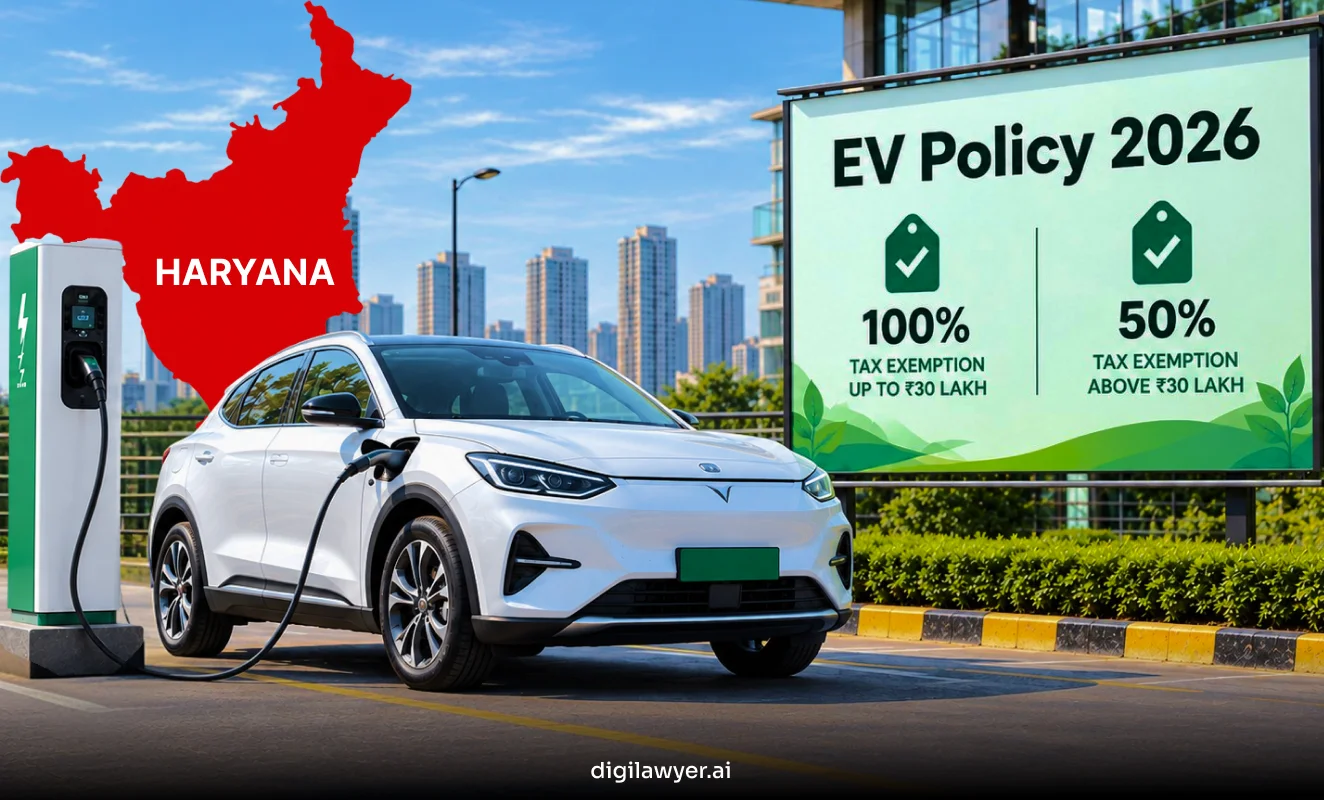
- EVs up to ₹30 lakh (ex-showroom): 100% motor vehicle tax exemption
- EVs above ₹30 lakh: 50% tax exemption
- Vehicles covered: Two-wheelers, three-wheelers (autos, e-rickshaws), four-wheelers
- Eligibility: Vehicle must be bought and registered in Haryana
- Price cap based on: Ex-showroom price, not on-road price
- CNG vehicles: Unchanged, 20% one-time rebate continues
- Women buyers: Extra 1% rebate on vehicles up to ₹20 lakh
- Replaces: Old flat 20% rebate on EVs
New Haryana EV Tax Exemption
Haryana's electric vehicle tax exemption isn't new, it's been in effect since Saturday, 21 August 2026. But with the festive car-buying season approaching, it's worth revisiting exactly what it offers before you finalise a booking.
Under a notification issued by the Haryana Transport Department, new EVs priced up to ₹30 lakh get a 100% motor vehicle tax exemption at registration. [1] The change was cleared by the Haryana Cabinet, chaired by Chief Minister Nayab Singh Saini, and it replaces the state's older flat 20% rebate on EVs.
However, if your EV crosses that ₹30 lakh ex-showroom mark, you don't lose the benefit entirely, you get a 50% exemption instead of the full waiver. And regardless of price bracket, the exemption only applies if your vehicle is both purchased and registered within Haryana.
Note: An EV bought elsewhere and brought in for registration won't qualify.
It's easy to assume this only covers four-wheelers, it doesn't. The revised structure applies to electric two-wheelers, three-wheelers (including autos and e-rickshaws), and four-wheelers alike, all under the same price-based rule. CNG vehicles continue on their existing, separate 20% rebate, nothing has changed there. In fact, there's a further 1% rebate for vehicles registered in a woman's name, priced up to ₹20 lakh, approved in the same Cabinet decision.
The state has quietly rewritten its EV tax rulebook and depending on what you're buying, your motor vehicle tax bill at registration could drop to zero.
Key Highlights of Haryana's EV Tax Exemption
Particulars | Details |
Policy | Haryana EV Motor Vehicle Tax Exemption 2026 |
Approved by | Haryana Cabinet, chaired by CM Nayab Singh Saini |
Cabinet approval date | 28–29 July 2026 |
Came into effect | 21 August 2026 |
What changed | Motor vehicle tax on new EVs revised from a flat 20% rebate to a tiered exemption |
Exemption (EVs up to ₹30 lakh) | 100% road tax waiver |
Exemption (EVs above ₹30 lakh) | 50% road tax waiver |
Vehicle types covered | Two-wheelers, three-wheelers, four-wheelers (BEVs) |
Eligibility condition | Vehicle must be purchased and registered in Haryana |
Previous benefit | 20% one-time exemption (now replaced) |
CNG vehicle benefit | Unchanged, 20% one-time exemption continues |
Women buyers (separate rebate) | Additional 1% MVT rebate, non-transport vehicles up to ₹20 lakh |
Haryana EV Road Tax Exemption: What's Actually New Here?
Haryana's EV buyers used to get a flat 20% cut on motor vehicle tax, regardless of what the vehicle cost. The Cabinet has now approved a full exemption from motor vehicle tax on new battery-operated vehicles priced up to ₹30 lakh, which is a considerably larger jump than the old flat-rate discount.
Anything priced above that threshold still gets a 50% cut rather than the full waiver.
This isn't a scheme with a vehicle cap or a "first X buyers" limit either.
Earlier EV incentives in the state (like the 2022 policy) came with unit caps for each vehicle category. [2] This one doesn't appear to carry that same first-come-first-served ceiling; it's a straightforward price-slab structure that applies as long as you meet the purchase-and-registration condition.
Two-wheelers, three-wheelers, including autos, e-rickshaws and four-wheelers are all covered under the same rule. So, whether you're eyeing an electric scooter for the daily commute or a family EV, the same 30-lakh cutoff decides how much tax relief you get.
When Did This Actually Start Working on the Ground?
There's a gap worth knowing about between "Cabinet approved it" and "you can actually use it."
The Cabinet cleared the change in late July 2026, but the revised tax structure didn't become operational for registrations until 21 August 2026, when the new system went live and the first vehicles were registered under it in Gurugram and Badshahpur.
For a sense of what this looks like in rupees rather than percentages: the first EV registered under the new rule in Gurugram: a Mahindra electric vehicle carried a motor vehicle tax liability of roughly ₹2.45 lakh, and that entire amount was waived at registration. [3]
That's the kind of number that makes the difference between "nice policy" and "actually changes my purchase decision."
Who Qualifies for Haryana's EV Policy 2026?
Eligibility criteria are simple. If you have purchased and registered your vehicle in Haryana, you qualify for tax exemption. What sounded simple has a bit more to consider.
Here are the details that matter:
- The vehicle has to be both bought and registered in Haryana. EVs purchased in a neighbouring state and brought in for registration don't qualify, this was specifically written in to stop dealers losing sales to Delhi and Chandigarh, where EV registration was already cheaper.
- The price that matters is ex-showroom price, not on-road price. If your EV sits right around the ₹30 lakh mark, get the exact ex-showroom figure from your dealer before assuming which slab you fall into.
- The exemption covers motor vehicle tax specifically, not necessarily every line item on your registration invoice. Number plate charges, hypothecation endorsement fees (if you're financing), and smart-card RC charges are separate costs that may still apply. Ask your dealer for a full on-road price break-up rather than assuming a zero bill across the board.
- Don't confuse this with the older 2022 EV manufacturing/purchase-incentive scheme. That one dealt with capital subsidies, SGST reimbursement, and stamp duty relief for manufacturers and had its own vehicle-count caps, it's a different track from this 2026 buyer-facing tax notification. If you see numbers about "15% cashback" or "SGST reimbursement to buyers" floating around online, verify which scheme they're actually describing before counting on it.
How This Changes the Math for New Buyers
- Mass-market EVs (which is most of what's sold in India today) register at zero motor vehicle tax. For a vehicle that would've otherwise attracted a tax running into lakhs, that's real money back in your pocket at the point of purchase, not a rebate you claim later.
- Premium EVs above ₹30 lakh still save half of what they'd otherwise owe a smaller percentage cut, but often a larger absolute number given the price bracket.
- Petrol, diesel, and CNG buyers see no change. CNG keeps its existing 20% one-time rebate; nothing has moved for conventional fuel vehicles.
- If a woman is registering the vehicle, there's a separate 1% additional rebate on non-transport vehicles priced up to ₹20 lakh, worth checking if that changes who the registration should go under.
Before you finalise numbers on a specific model, it's worth getting a second pair of eyes on how the exemption, any loan-related charges, and other on-road costs stack up for your exact case.
Find a CA Consultant who can walk through the actual figures with you before you sign the booking form.
Buying an EV in Haryana? The Tax Exemption Doesn't Touch Your Traffic Record
This is the part that quietly catches new EV owners off guard: getting a tax waiver at registration has zero bearing on how your vehicle is treated on the road afterward.
An EV runs through the exact same enforcement system as any other vehicle. It can still land an e-challan for:
- Overspeeding or camera-detected violations
- Jumping a red light
- Driving on the wrong side or in the wrong lane
- Parking in a no-parking zone
- Missing or invalid RC, insurance, or PUC documents
- Any other standard traffic offence
Zero road tax doesn't mean zero visibility to enforcement cameras and an unpaid challan sitting against your vehicle number can hold up RC transfers, insurance renewals, and fitness certificate renewals later, regardless of how much you saved at registration.
Before You Drive Your New EV Off the Lot: Confirm This
- Lock in your Haryana registration: purchase and registration both need to happen within the state, or the exemption doesn't apply at all.
- Keep your paperwork current: valid RC, insurance, and PUC-equivalent certificate, even for an EV.
- Drive like the tax break doesn't exist: enforcement rules apply identically to electric and non-electric vehicles.
- Check your vehicle number for pending e-challans periodically: clearing them early avoids compounding fines and paperwork headaches down the line.
Frequently Asked Questions (FAQ)
Does the exemption apply if I bought my EV in Delhi but want to register it in Haryana, or vice versa?
No. The benefit is conditional on both the purchase and the registration happening within Haryana. An EV bought elsewhere and registered in Haryana or bought in Haryana but registered outside, won't qualify.
Is the ₹30 lakh limit based on on-road price or ex-showroom price?
Ex-showroom price. Get this exact figure from your dealer, since on-road price (which includes insurance, registration, and other charges) can push a vehicle's total cost well past ₹30 lakh even if its ex-showroom price is lower.
Are hybrid vehicles covered under this exemption?
No, this notification is specific to battery electric vehicles (BEVs). Hybrids fall under a separate, older tax treatment.
I registered my EV in Haryana before 21 August 2026. Can I claim the new exemption retroactively?
This isn't clearly addressed in available reporting, check directly with your local RTO or the Transport Department's circular notifications page for guidance on registrations that fall right around the transition date.


- Key Highlights of Haryana's EV Tax Exemption
- Haryana EV Road Tax Exemption: What's Actually New Here?
- When Did This Actually Start Working on the Ground?
- Who Qualifies for Haryana's EV Policy 2026?
- How This Changes the Math for New Buyers
- Buying an EV in Haryana? The Tax Exemption Doesn't Touch Your Traffic Record
- Before You Drive Your New EV Off the Lot: Confirm This
- Frequently Asked Questions (FAQ)

DigiLawyer, A 80, A Block, Sector 2, Noida, Uttar Pradesh 201301
Phone: +918178704343
justice@digilawyer.ai





Disclaimer: DigiLawyer is not a law firm, a substitute for a lawyer or law firm, a chartered accountancy firm, or a company secretary firm. We act solely as an intermediary between users and registered professionals, and also offer AI-powered legal assistance, consultation, and document drafting tools to improve access to legal support. Use of our website, services, or AI tools is at the sole risk of the user and does not create any lawyer-client or professional relationship. All consultations and interactions facilitated through our platform are strictly between the user and independent professionals. DigiLawyer is not liable for any actions, decisions, or outcomes arising from the use of our platform, AI tools, or reliance on any advice, consultation, or content provided by us or third-party professionals.
Use of our products and services is subject to our Privacy Policy & Terms of Service

