


Supreme Court Proposes Strict Measures for Unpaid Traffic Challans
Over 1 lakh+ challan cases have already been settled through DigiLawyer. If you're not sure whether yours qualifies, enter your vehicle number and we'll check for you.
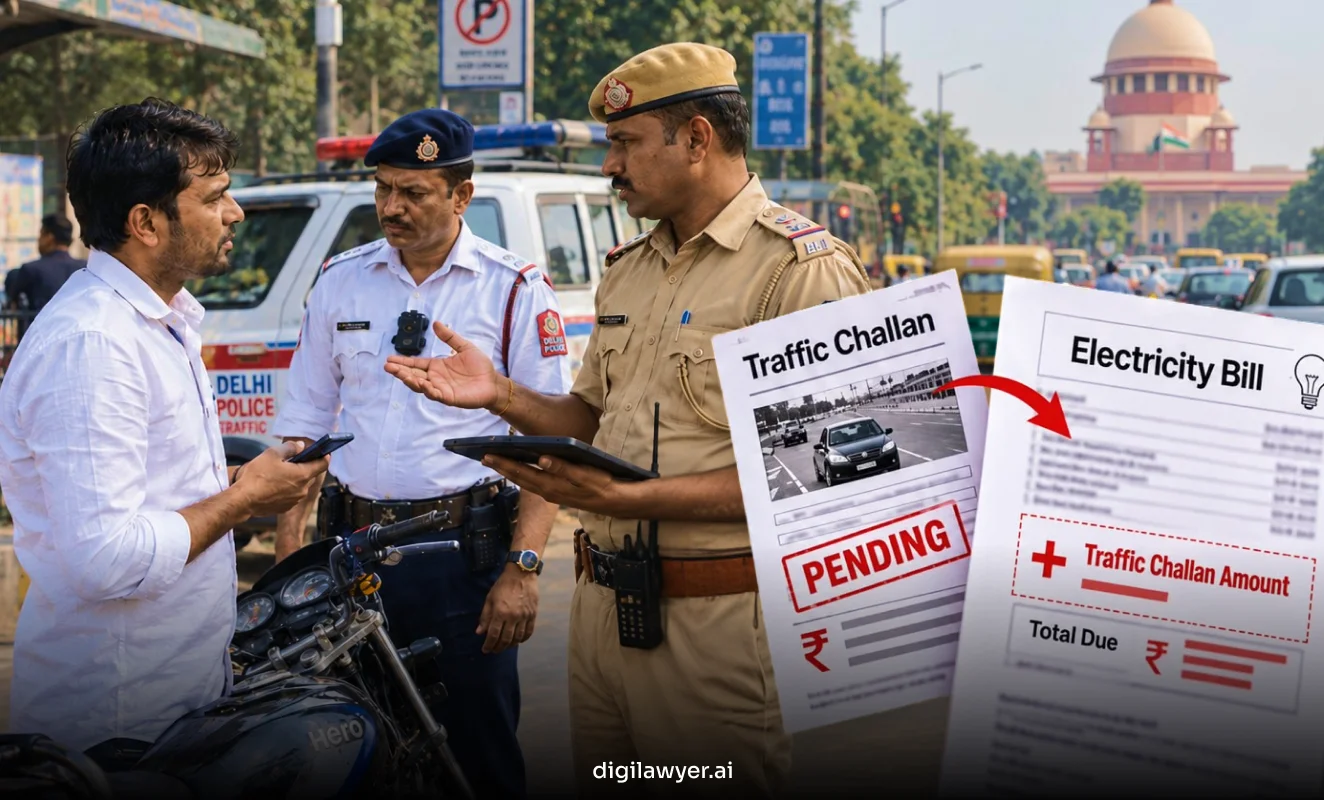
Supreme Court Proposes to Link Unpaid Traffic Challans to Electricity Bill
- The Supreme Court has expressed concern over more than ₹20,000 crore worth of unpaid traffic challans across India.
- States and Union Territories have issued traffic challans worth approximately ₹45,000 crore, of which only around ₹25,000 crore has been recovered so far.
- The Court suggested exploring stricter recovery mechanisms, including linking unpaid challans to electricity bills, blocking vehicle transfers, restricting RC renewals, and suspending driving licence-related services.
- These are currently suggestions under consideration and not yet nationwide rules.
- Vehicle owners with pending challans may face stricter enforcement in the future if governments implement these recommendations.
Supreme Court BIG UPDATE on Unpaid Traffic Challans
The Supreme Court has suggested that States and Union Territories consider linking unpaid traffic challans to electricity bills to recover outstanding e-challan fines. The suggestion came on Monday, 28 September 2026, during a hearing in S Rajaseekaran v. Union of India & Ors.
The matter was heard by a Bench of Justice JB Pardiwala and Justice KV Viswanathan. It arose from an application seeking directions to implement electronic enforcement under Section 136A of the Motor Vehicles Act, 1988, read with Rule 167A of the Central Motor Vehicles Rules, 1989.
The Court was told that States and UTs have to recover around ₹45,000 crore in e-challan fines, of which about ₹25,000 crore has been recovered. That leaves roughly ₹20,000 crore pending. Justice Pardiwala observed that it is not enough to keep issuing e-challans, and that the real question is recovering the fines.
The Court discussed and suggested stricter measures, involving adding unpaid challans to electricity dues, RC restrictions, Blacklisting and transfers, etc. This is not a final direction.
Key Highlights
Particulars | Details |
Matter | Electronic enforcement of traffic violations and recovery of fines |
Forum | Supreme Court of India |
Total challans issued (States/UTs) | Approx. ₹45,000 crore |
Amount recovered | Approx. ₹25,000 crore |
Amount pending | ₹20,000+ crore |
Nature of Court's remarks | Suggestions and observations, not a final direction |
Nationwide rule in force? | No |
Implementing authorities | Central Government, State Governments, Transport Departments |
Why Is the Supreme Court Concerned About Unpaid Traffic Challans?
India has significantly expanded camera-based traffic enforcement, automated number plate recognition (ANPR) systems, and electronic challan generation over the last few years. While authorities are issuing millions of challans, recovery of penalties remains a major challenge.
During a hearing on electronic enforcement of traffic violations and recovery of fines, the Supreme Court was informed that traffic authorities across India still have more than ₹20,000 crore in unpaid traffic penalties pending recovery.
The Bench observed that merely issuing e-challans is not enough if violators do not ultimately pay the penalties imposed on them.
What Did the Supreme Court Suggest?
The Court discussed several measures that governments may consider to improve traffic challan recovery.
1. Link Unpaid Challans with Electricity Bills
One of the strongest suggestions discussed during the hearing was linking unpaid traffic challans with electricity bills.
The Court observed that utility payments generally have high compliance rates and suggested exploring whether pending traffic fines could be recovered through electricity billing systems.
If implemented in the future, vehicle owners may need to clear pending challans before settling certain utility dues.
2. Block Vehicle Ownership Transfers
The Court also discussed restricting vehicle ownership transfers where outstanding traffic challans remain unpaid.
This could mean that buyers and sellers may need to ensure all traffic violations are cleared before completing vehicle sale transactions.
3. Restrict RC Renewal and Duplicate Vehicle Documents
Another proposal discussed was:
- Blocking renewal of Registration Certificates (RC)
- Preventing issuance of duplicate registration documents
- Restricting other vehicle-related services until challans are cleared
These measures are intended to improve compliance among habitual violators.
4. Blacklist Vehicles with Pending Challans
The Court also discussed blacklisting vehicles with unpaid challans through the Parivahan ecosystem.
Such a system could prevent vehicle owners from accessing certain transport-related services until dues are settled.
5. Restrict PUC, Fitness Certificate and Driving Licence Services
Additional measures discussed include:
- Withholding Pollution Under Control (PUC) Certificates
- Withholding Fitness Certificates
- Restricting Driving Licence Renewals
- Exploring suspension of licences in cases of continued non-payment
These suggestions aim to create stronger incentives for traffic rule compliance.
Are These Rules Applicable Right Now?
The Supreme Court has only discussed and suggested possible recovery mechanisms.
There is currently no nationwide rule that automatically:
- Adds traffic challans to electricity bills
- Blocks licence renewals for all unpaid challans
- Prevents RC renewal nationwide
- Suspends licences automatically
Any implementation would require separate action by the Central Government, State Governments, Transport Departments, or other regulatory authorities.
Vehicle owners should therefore treat these as potential future enforcement measures rather than currently enforceable rules.
What Does This Mean for Delhi-NCR Vehicle Owners?
This development is particularly relevant for drivers in Delhi, Noida, Ghaziabad, Gurgaon and Faridabad, where millions of traffic challans are generated every year through:
- ANPR Cameras
- Red-Light Violation Cameras
- Speed Detection Systems
- Automated Enforcement Networks
Delhi has already introduced several initiatives aimed at reducing traffic challan pendency, including Weekend Traffic Courts and Virtual Traffic Court systems. These measures were introduced to help dispose of large volumes of pending traffic violation cases.
If stricter recovery mechanisms are eventually adopted, vehicle owners with pending challans may encounter difficulties while:
- Selling vehicles
- Transferring ownership
- Renewing RCs
- Renewing driving licences
- Obtaining PUC Certificates
- Obtaining Fitness Certificates
Why You Should Act Now
- Pending challans do not expire. Fines can accumulate and may lead to court summons.
- Unresolved challans can already cause problems in some vehicle-related processes, depending on the state.
- Eligible compoundable challans can currently be settled at a reduced amount through Lok Adalat. The Delhi Lok Adalat sitting is on 25 October 2026 (token and eligibility details).
- Settling early avoids being caught out if recovery rules tighten.
DigiLawyer's Take On the Proposal
The Supreme Court's observations signal a shift from traffic violation detection to traffic penalty recovery.
India's digital traffic enforcement infrastructure has matured significantly over the last decade.
In Fact, UP has been proposing incorporation of new AI-powered Digital Traffic Enforcement System recently. Cameras, AI-based monitoring systems, and e-challan platforms are now making it easier than ever to identify violations. The next challenge for regulators is ensuring that penalties are actually recovered.
While the Court's suggestions may improve compliance and road safety, any future implementation will need to balance enforcement objectives with due process safeguards and citizen rights.
For now, vehicle owners should regularly check and pay pending challans and resolve outstanding violations before they escalate into court proceedings or future compliance restrictions.
FAQs
Can unpaid traffic challans affect my driving licence?
Currently, there is no nationwide rule automatically blocking licence renewals due to unpaid challans. However, the Supreme Court discussed this as a possible future enforcement measure.
Can I transfer ownership of my vehicle if challans are pending?
At present, rules vary by jurisdiction. The Court discussed restricting ownership transfers until pending challans are cleared.
Can traffic challans be added to electricity bills?
The Supreme Court suggested exploring this mechanism to improve recovery rates, but no nationwide implementation currently exists.
How can I check my pending traffic challans?
You can check pending challans through the Parivahan portal, State Traffic Police portals, Delhi Virtual Court systems, or DigiLawyer's traffic challan assistance platform.


- Key Highlights
- Why Is the Supreme Court Concerned About Unpaid Traffic Challans?
- What Did the Supreme Court Suggest?
- 1. Link Unpaid Challans with Electricity Bills
- 2. Block Vehicle Ownership Transfers
- 3. Restrict RC Renewal and Duplicate Vehicle Documents
- 4. Blacklist Vehicles with Pending Challans
- 5. Restrict PUC, Fitness Certificate and Driving Licence Services
- What Does This Mean for Delhi-NCR Vehicle Owners?
- Why You Should Act Now
- DigiLawyer's Take On the Proposal
- FAQs
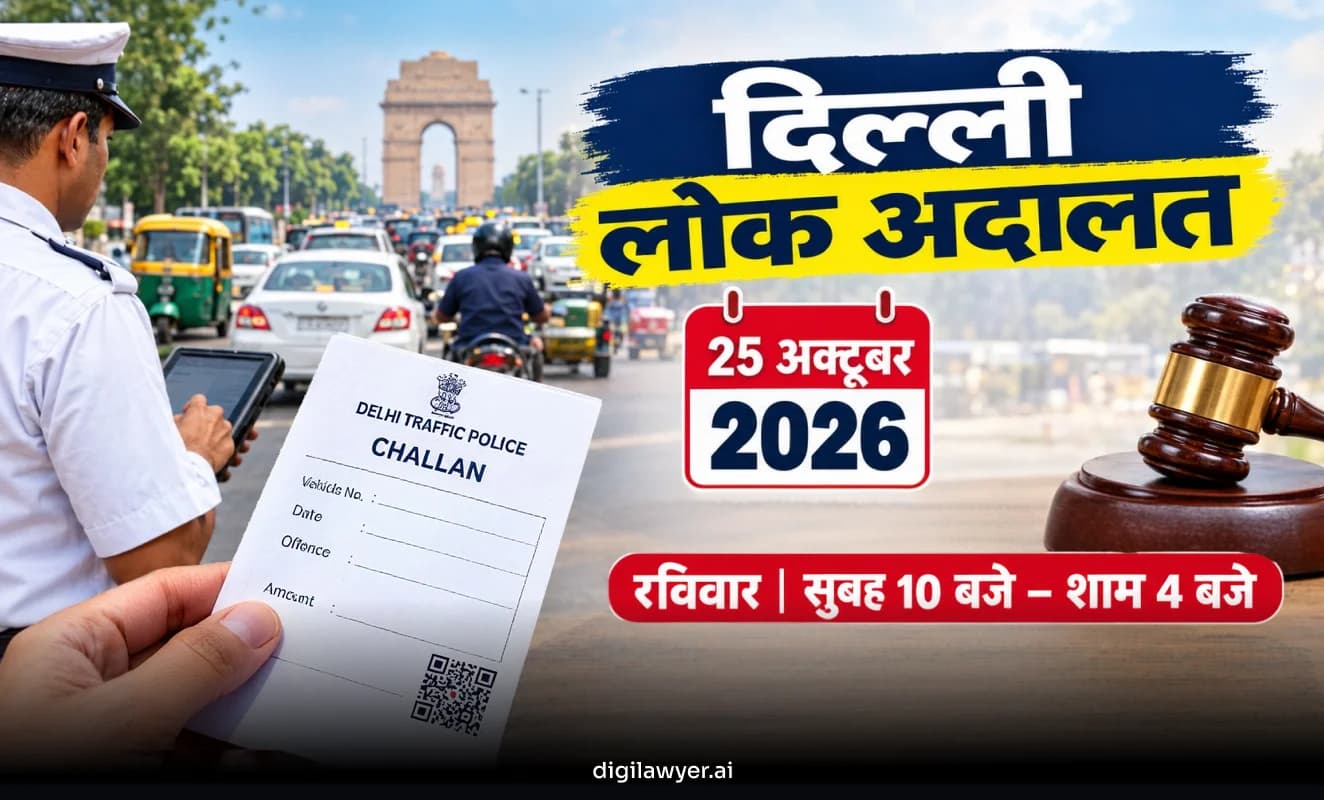
दिल्ली ट्रैफिक लोक अदालत 2026: लंबित चालानों के निपटारे की पूरी जानकारी
दिल्ली में ट्रैफिक चालानों के निपटारे के लिए राष्ट्रीय लोक अदालत रविवार, 25 अक्टूबर 2026 को आयोजित होगी। इसके लिए दिल्ली ट्रैफिक पुलिस के पोर्टल पर पहले से ऑनलाइन टोकन बुक करना जरूरी है। बिना टोकन पहुँचने वालों के चालान नहीं लिए जाएँगे। निर्धारित शर्तें पूरी करने वाले चालानों के निपटारे के लिए समय रहते तैयारी करें।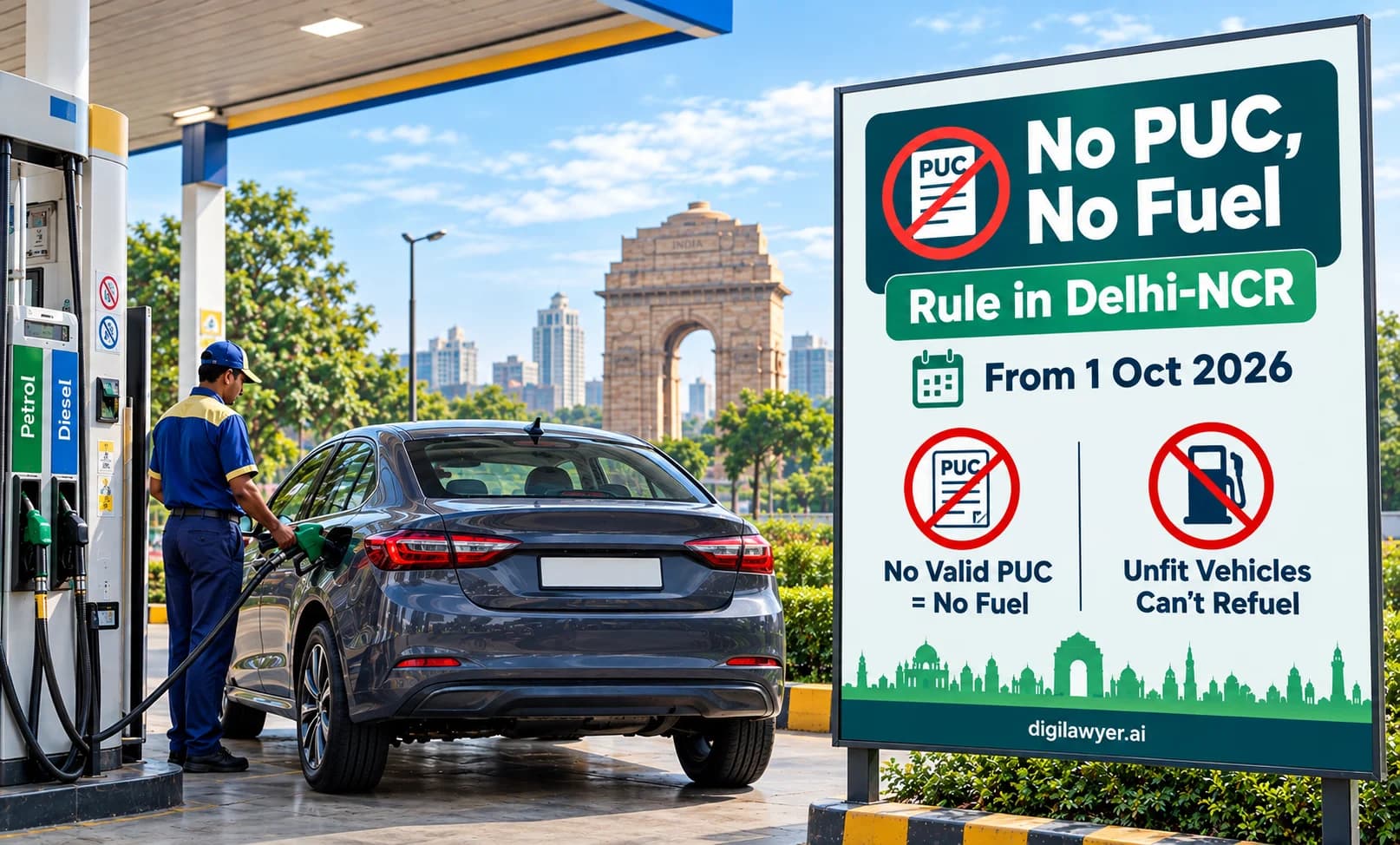
'No PUC, No Fuel' Rule Applies From 1st Oct Across Delhi-NCR
What is the "No PUC, No Fuel" rule? From 1 Oct, no valid Pollution Under Control (PUC) certificate means you lose access to fuel across Delhi-NCR. Learn who is affected and what Delhi vehicle owners should do now.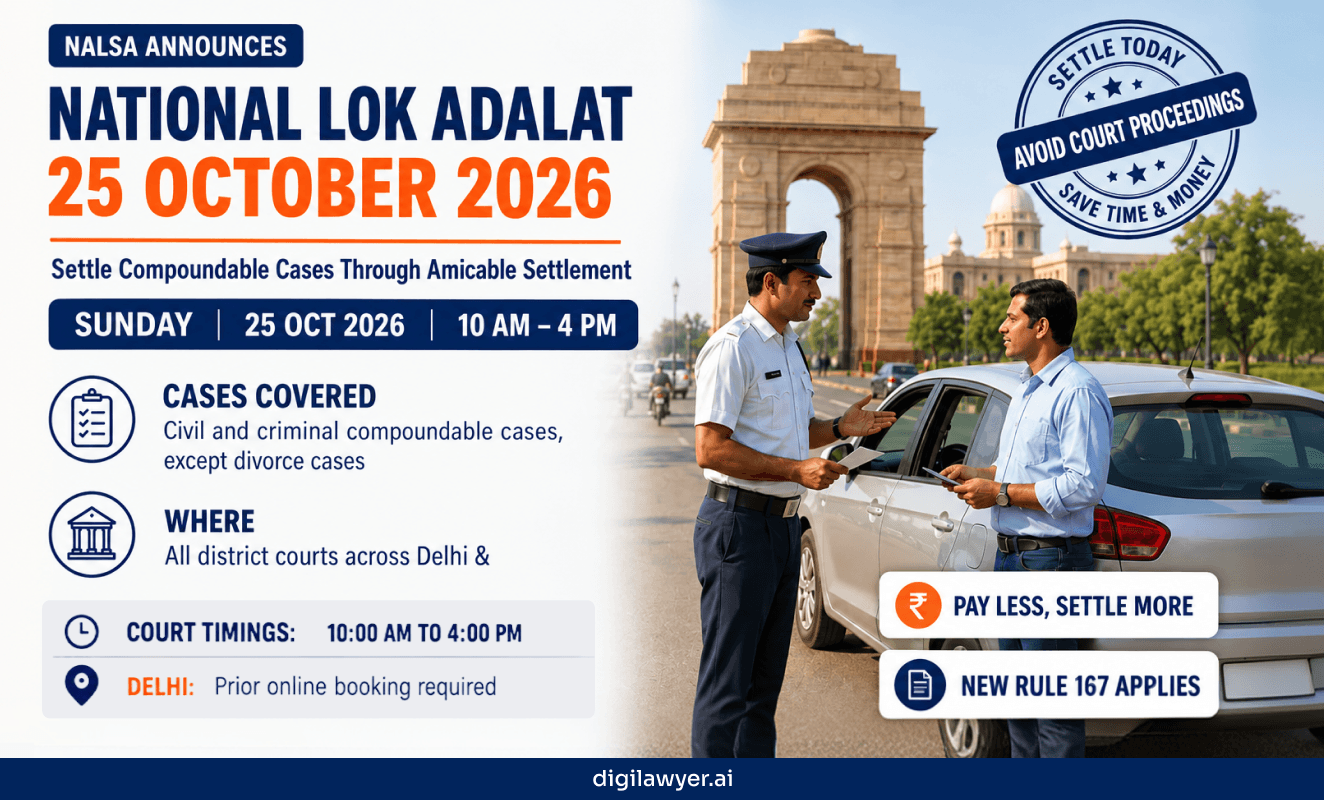
National Lok Adalat in Delhi 25 October 2026: Token & Registration Process
The 3rd National Lok Adalat of 2026 is scheduled for September 12, 2026 (Saturday), across every state and union territory in India, except Delhi. For motorists or vehicle owners, this is the next real opportunity to clear pending compoundable traffic challans at a reduced amount.
DigiLawyer, A 80, A Block, Sector 2, Noida, Uttar Pradesh 201301
Phone: +918178704343
justice@digilawyer.ai





Disclaimer: DigiLawyer is not a law firm, a substitute for a lawyer or law firm, a chartered accountancy firm, or a company secretary firm. We act solely as an intermediary between users and registered professionals, and also offer AI-powered legal assistance, consultation, and document drafting tools to improve access to legal support. Use of our website, services, or AI tools is at the sole risk of the user and does not create any lawyer-client or professional relationship. All consultations and interactions facilitated through our platform are strictly between the user and independent professionals. DigiLawyer is not liable for any actions, decisions, or outcomes arising from the use of our platform, AI tools, or reliance on any advice, consultation, or content provided by us or third-party professionals.
Use of our products and services is subject to our Privacy Policy & Terms of Service

