


Revocation Notice
Starting at
₹1
₹100






Revocation Notice Format
18+
States Covered
5-10 Minutes
Average Self-Draft Time
200+
Active Lawyers
118+
Verified Revocation Notice Buyers
5
Governing Laws Covered
₹1
₹100
99% off
Other Highlights
₹1499
₹1999
Flat ₹500
Other Highlights
Received a Revocation Notice and Want to Respond?
If your power of attorney, offer, license, or consent has been revoked and you want to contest or reply formally, our advocates draft a clear, factual response, reviewed and stamped, delivered within 24-48 hours.What Is a Revocation Notice?
A Revocation Notice is a formal written communication that withdraws or cancels a previously granted right, offer, license, authority, or consent. It serves as an official declaration that the earlier permission or agreement is no longer valid or binding, effective from the date mentioned in the notice. These notices are used in both personal and professional contexts and are important to legally record the termination of a right or obligation.What is a Revocation Notice?
A Revocation Notice is a formal written communication that withdraws or cancels a previously granted right, offer, license, authority, or consent. It serves as an official declaration that the earlier permission or agreement is no longer valid or binding, effective from the date mentioned in the notice. These notices are used in both personal and professional contexts and are important to legally record the termination of a right or obligation.
It can be issued under contract law, agency relationships, power of attorney, employment contracts, licensing arrangements, and other scenarios where one party granted rights or consent that now needs to be withdrawn.
Why Choose DigiLawyer for Revocation Notices?
Need to send a legal notice? We make it simple - With DigiLawyer, you get help from real lawyers, strong legal documents, and quick delivery - all without leaving your home.


How Can DigiLawyer Help You?
Easy Drafting: No legal jargon. No confusion. Just a clean, guided process that helps you draft your notice in minutes. Whether you do it yourself or get a little help from our legal experts, we make sure it’s clear, confident, and to the point.
Legal Validation: Every notice is reviewed, signed, and stamped by a licensed advocate ensuring it meets legal standards, increases enforceability, and stands strong in any legal scrutiny.
Convenient Delivery: Choose how your notice is delivered: via WhatsApp, email, speed post, or registered courier. We ensure your notice is sent securely, professionally, and with proper documentation of delivery and proof.
When Should You Send a Revocation Notice?
Timing is critical in revocation. The notice should be sent:
- Immediately after decision to revoke is made, especially if the other party might rely on the existing permission.
- Before the offer is accepted, in case of revoking a contractual offer.
- As per agreement or legal deadlines, to avoid waiver or estoppel claims.
- Upon breach or misuse of the original rights or obligations.
- Upon change of intent, such as ending representation or agency.
Sending the notice early helps prevent misuse, confusion, or legal liability for continuing acts under revoked authority.
What Does a Revocation Notice Include?
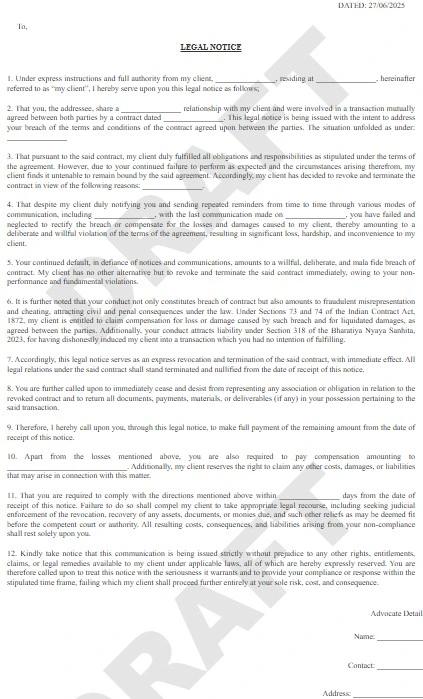
A valid revocation notice should be clear, direct, and legally compliant. Key contents include:
- Name and details of the sender and recipient
- Reference to the original agreement, license, offer, or authorization
- Clear statement of revocation and the effective date
- Reason for revocation (optional but recommended for legal clarity)
- Instructions for post-revocation conduct e.g., stop using IP, return documents, cease representation etc.
- Signature of the authorized person issuing the notice
- Mode of delivery (email, registered post, hand-delivery) for proof of communication
Supporting documents like a copy of the original agreement or power of attorney may also be attached, if applicable.
Common Reasons for Sending a Revocation Notice
Revocation notices may be issued for various lawful reasons, depending on the relationship and agreement between parties. Common reasons include:
- Termination of Power of Attorney- When the principal wants to cancel the authority given to an agent.
- Revocation of Offer- If the offeror wants to withdraw an offer before acceptance under contract law.
- Revocation of License or Authorization- In case of breach, misuse, or policy violation (e.g., software license, dealership).
- End of Consent- Withdrawal of prior consent for use of intellectual property, personal data, or representation.
- Employment or Appointment Termination- Revoking a letter of appointment, mandate, or delegated authority.
- Violation of Terms- If the other party breaches agreed-upon terms, justify cancellation of permissions.
- Change of Circumstances- If the original basis of the agreement or authorization no longer exists or is no longer needed.
Consequences of Ignoring a Revocation Notice
If the recipient ignores a valid revocation notice and continues to act under the revoked authority or agreement, it may lead to:
- Legal liability for unauthorized use or representation
- Civil suits for damages or injunction
- Criminal action in cases involving fraud, impersonation, or unauthorized access
- Breach of contract claims and penalties
- Loss of trust or professional consequences, especially in employment or agency contexts
It is essential to cease all actions related to the revoked authority immediately after receiving such notice.
Governing Laws
Revocation notices are governed under various laws depending on the context:
- Indian Contract Act, 1872- Governs revocation of offers and agency.
- Power of Attorney Act, 1882- Covers revocation of Power of Attorney.
- Information Technology Act, 2000- If electronic consent or license is revoked.
- Intellectual Property laws- For revocation of license or consent to use.
- Employment and Service Laws- When revoking appointments or delegation.
Failing to comply with revocation can lead to civil damages, legal costs, or even criminal consequences if fraud or impersonation is involved.
FAQs Related to Revocation Notice
Is a revocation notice legally binding?
Yes, if sent by a person legally empowered to do so and in accordance with relevant laws and agreements.
Can a revocation notice be sent electronically?
Yes, revocation can be communicated through email or WhatsApp, but it is advisable to also send a signed hard copy for proof and formal record.
Do I need to give a reason in the revocation notice?
While not always mandatory, stating the reason strengthens the legal validity and helps avoid disputes.
Can an offer be revoked after acceptance?
No, once accepted, an offer becomes a binding contract and cannot be revoked unilaterally without facing consequences.
What if someone continues to act after revocation?
You may initiate civil or criminal action depending on the nature of the breach.
Is there a format or template for revocation notice?
Yes, a proper legal format is recommended. You can consult a lawyer or use automated legal tools to generate one.
What are you revoking?

Why a revocation legal notice works
How It Works
Need a Custom Revocation Notice?
Withdrawing authority or consent needs precise wording. Draft a custom revocation notice online with DigiLawyer. Advocate review and stamp, typically within 24-48 hours.Frequently Asked Questions
Can a revocation notice be sent electronically?
Yes. It can be sent by email or WhatsApp, and electronic communication is recognised for this purpose. A signed hard copy is still advisable, so you have clear proof of delivery and a formal record.
Is my information kept confidential when sending a revocation notice?
Yes. Your details and documents are kept private and are used only to prepare and review your notice. DigiLawyer is a platform that connects you with registered advocates, not a public directory of your matter.
Should I pick the self-draft or lawyer-drafted plan?
The ₹1 self-draft is suited to simpler withdrawals you are comfortable handling yourself. The ₹900 lawyer-drafted and attested plan suits more complex or high-stakes revocations where you want an advocate to review and stamp the notice.
Is a reason required to revoke?
A reason is not always mandatory, but stating one strengthens the validity of your revocation and helps avoid disputes later. It shows the withdrawal was deliberate rather than arbitrary.
Is there a standard format or template for a revocation notice?
There is a common structure: your details, a reference to the original grant, a clear revocation statement, the effective date, and any post-revocation instructions. Our AI drafts this for you and an advocate reviews it, so the wording fits your situation.
Do any obligations continue after revocation?
Some may. Revocation ends the grant going forward, but acts already done, or obligations already accrued, can still stand. The notice should be clear about what stops now and what the other party must do next.
Is a revocation notice legally binding?
Yes. A properly drafted and served revocation notice is a formal legal communication that withdraws the right, offer, license, or consent you had granted, effective from the date stated in it. Serving it correctly is what makes it hold up.
Can you revoke an offer after the other party has accepted it?
Generally no. Once an offer is accepted it becomes a binding contract and cannot be revoked unilaterally without facing consequences. Revoke before acceptance, and have a lawyer review the timing if you are unsure where you stand.
Related Blogs
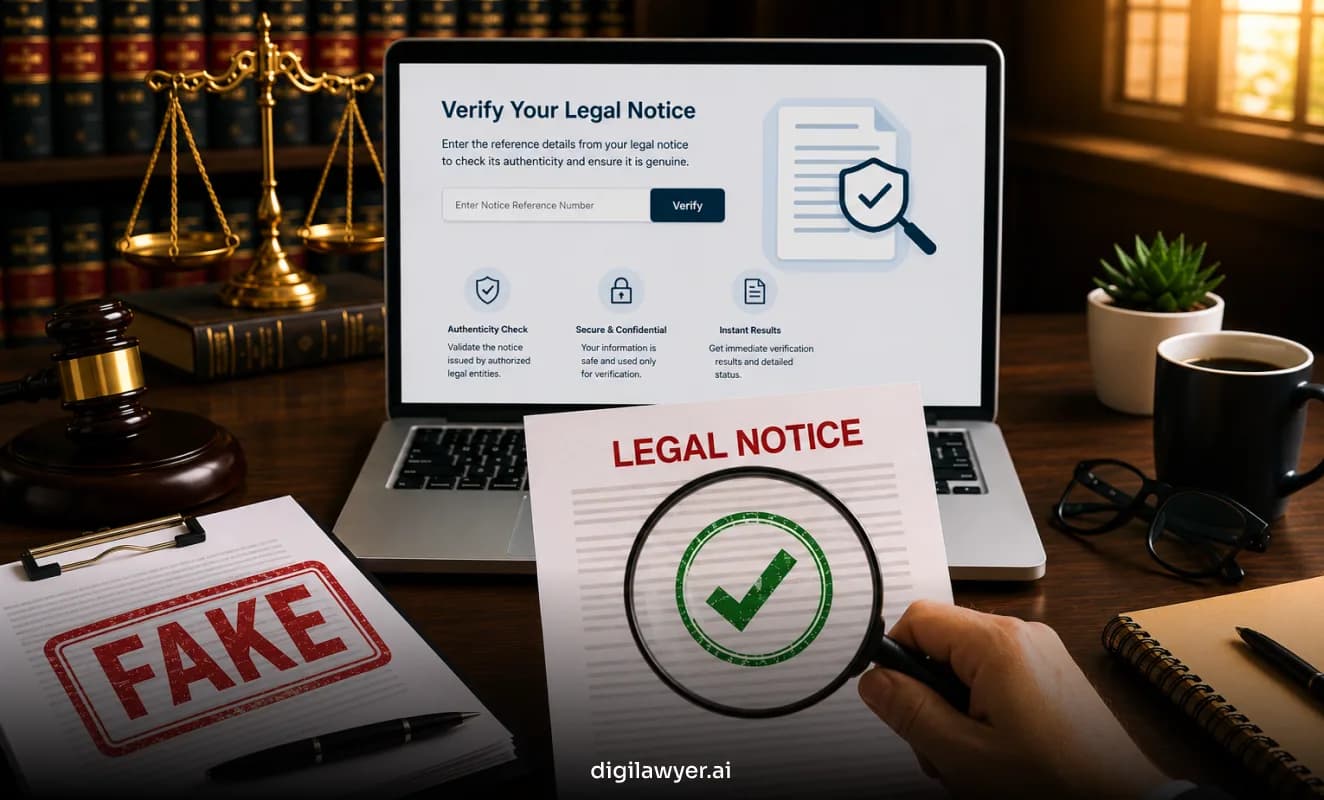
How to Check if a Legal Notice Is Original or Fake
Learn how to identify fake legal notices, warning signs, scams & verification steps to protect yourself from fraud, extortion and fake court threats.
When and How to File a Suit for Recovery of Money: A Complete Legal Guide
A simple guide to filing a money recovery suit in India, covering when to take legal action, required documents, and the step-by-step process to recover your money.
What to Do After Receiving a Legal Notice - How to Reply Properly
A practical guide on what to do after receiving a legal notice, including steps to respond, common mistakes to avoid, and how to protect your legal position.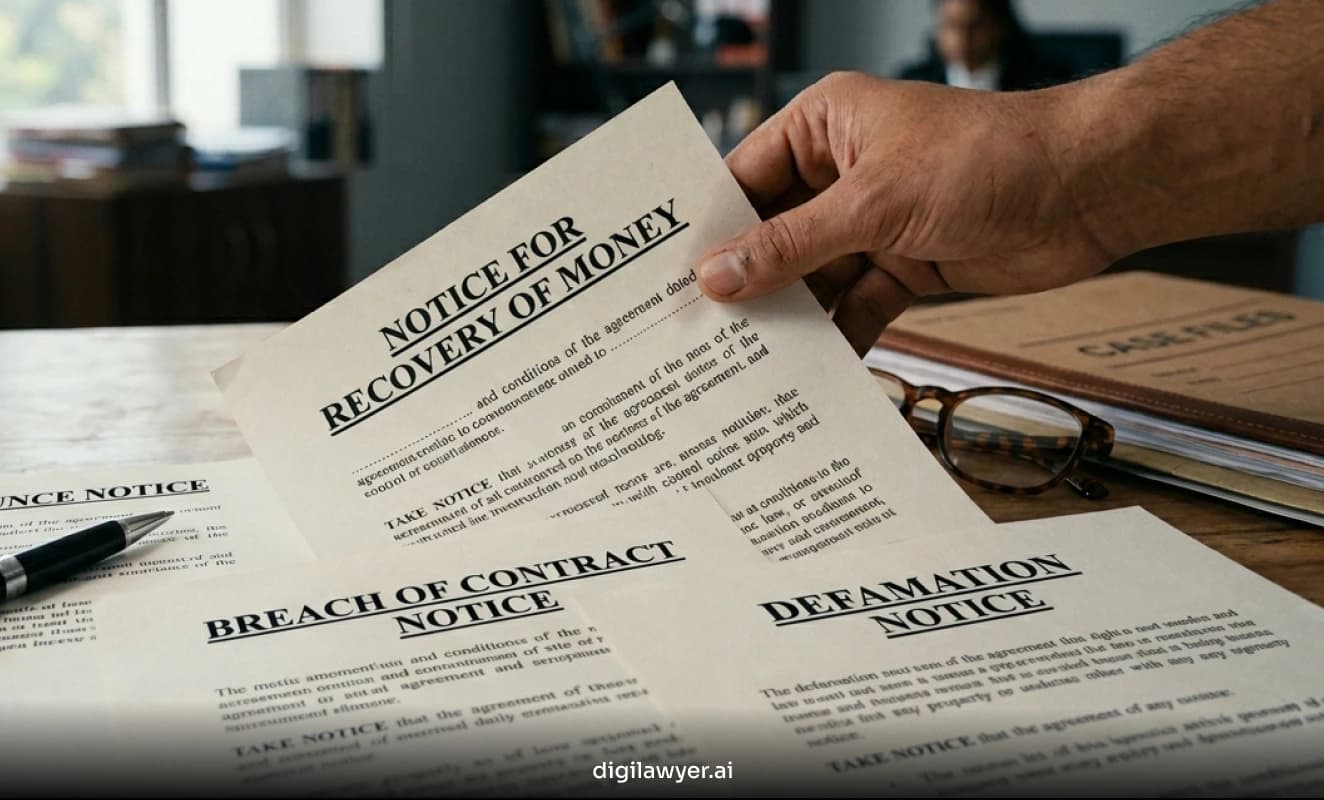
Types of Legal Notices and How to Choose the Right One
Learn the different types of legal notices in India, when to send them, and how they help resolve disputes without going to court. Simple guide with examples and tips.
Ways to Recover Money from a Friend or Someone Else
Explore how to get your money back from friends practically and legally, with clear steps, requirements, and practical approaches
How To File Mutual Divorce? Know the Complete Process
Learn how to file mutual divorce in India. Understand the process, required documents, conditions, and timelines with guidance from our experts



DigiLawyer, A 80, A Block, Sector 2, Noida, Uttar Pradesh 201301
Phone: +918178704343
justice@digilawyer.ai




Disclaimer: DigiLawyer is not a law firm, a substitute for a lawyer or law firm, a chartered accountancy firm, or a company secretary firm. We act solely as an intermediary between users and registered professionals, and also offer AI-powered legal assistance, consultation, and document drafting tools to improve access to legal support. Use of our website, services, or AI tools is at the sole risk of the user and does not create any lawyer-client or professional relationship. All consultations and interactions facilitated through our platform are strictly between the user and independent professionals. DigiLawyer is not liable for any actions, decisions, or outcomes arising from the use of our platform, AI tools, or reliance on any advice, consultation, or content provided by us or third-party professionals.
Use of our products and services is subject to our Privacy Policy & Terms of Service

