


Tenant Won't Vacate? Send a Legally Valid Eviction Notice
Starting at
₹1
₹100






Eviction Notice Format
Pan-India
Eviction Notice Coverage
5-10 Min
Average Self-Draft Time
200+
Active Lawyers
122+
Verified Eviction Notice Buyers
15-30 Days
Typical Notice Period
₹1
₹100
99% off
Other Highlights
₹1499
₹1999
Flat ₹500
Other Highlights
Have You Received an Eviction Notice?
Got an eviction notice from your landlord instead of sending one? Our advocates draft a clear, legally sound reply from your version of the facts, reviewed, stamped, and delivered in 24-48 hours.What is an Eviction Notice?
An eviction notice is a formal written communication sent by a property owner (landlord) to a tenant, requesting them to vacate the rented premises within a specified time. It is typically the first legal step taken before initiating eviction proceedings in court. This notice outlines the reason for eviction and gives the tenant a fair chance to respond or resolve the issue before further legal action is taken.What is an Eviction Notice?
An eviction notice is a formal written communication sent by a property owner (landlord) to a tenant, requesting them to vacate the rented premises within a specified time. It is typically the first legal step taken before initiating eviction proceedings in court. This notice outlines the reason for eviction and gives the tenant a fair chance to respond or resolve the issue before further legal action is taken.
👉 Dealing with a Rental Dispute? Begin the process to vacate your premises by downloading a compliant eviction notice format or getting it drafted by a qualified lawyer.
Steps for Downloading or Sending an Eviction Notice to a Tenant
Simply download your Eviction Notice PDF, securely send it to your tenant online, or have the physical copy delivered right to your doorstep - all with professional handling and proof of receipt. Follow these easy steps to ensure your legal notice for eviction is prepared or sent fast and safely.
Why Choose DigiLawyer to Draft Notice of Eviction?
Need to send a legal notice to evict a tenant over a rental dispute? We make it simple - With DigiLawyer, you get help from real lawyers, strong legal documents, and quick delivery - all without leaving your home.


How Can DigiLawyer Help You?
Easy Drafting: No legal jargon. No confusion. Just a clean, guided process that helps you draft a well-formatted legal eviction notice in minutes. Whether you do it yourself or get a little help from our legal experts, we make sure it’s clear, confident, and to the point.
Legal Validation: Every notice is reviewed, signed, and stamped by a licensed advocate ensuring it meets legal standards, increases enforceability, and stands strong in any legal scrutiny.
Downloadable Format: Your finalized notice is available for instant download in PDF format - ready to print, share, or archive for your records.
Convenient Delivery: Choose how your notice is delivered: via WhatsApp, email, speed post, or registered courier. We ensure your notice is sent securely, professionally, and with proper documentation of delivery and proof.
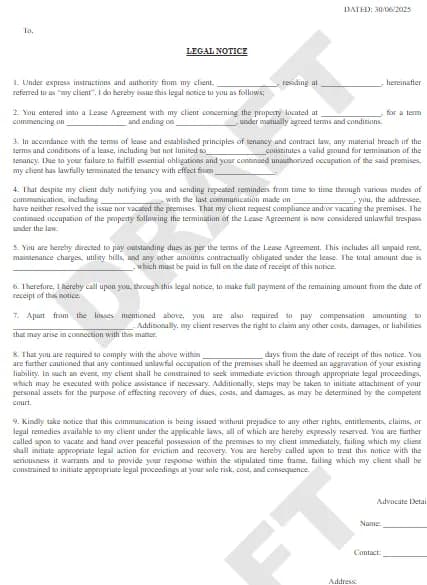
What Does an Eviction Notice Include?
A properly or well-drafted legal notice to vacate a property should contain the following elements:
- Names and addresses of both the landlord and tenant
- Description of the property under dispute
- Mention the reason(s) for eviction
- Notice period granted for vacating (as per agreement or local rent laws or usually 15 to 30 days)
- Reference to any lease terms or rental laws
- Signature of the landlord or authorized representative
When Should you Send an Eviction Notice?
- Upon Valid Legal Reason: Send the notice as soon as there's a valid reason like non-payment of rent, lease violation, property damage, or unauthorized occupation.
- After Identifying the Issue: Act promptly once the default or breach is noticed to avoid complications.
- Before Legal Action: Most laws require an eviction notice before initiating formal eviction proceedings.
- As Per Legal Timelines: The time to send the notice depends on the type of default and local/state-specific eviction laws.
- Avoid Delay: Delaying the notice may result in extended unlawful occupation and increased financial loss.
Common Reasons to Send Legal Notice to Evict Tenant?
Property owners may send an eviction notice for several lawful reasons, including:
- Non-payment of rent over an extended period
- Violation of lease terms such as subletting without permission, performing illegal activities, or property damage
- Unauthorized occupancy or overstay after lease expiry without renewal
- Creating nuisance or harassment to neighbors or landlord
- Property required for landlord’s personal use (in case of bonafide requirement)
- Illegal construction or alterations without permission within the rented premises
Consequences of Ignoring an Eviction Notice
If a tenant does not comply with the notice, it could lead to serious legal consequences:
- The landlord can initiate eviction proceedings in the appropriate rent control tribunal or civil court
- The tenant may be ordered to pay outstanding rent, penalties, or damages and the litigation costs
- Forced eviction through court orders can affect the tenant’s credit and rental history
- Continued occupation may attract charges of illegal possession or trespassing
- It may also cause reputational and financial consequences
Governing Laws
Eviction-related matters in India are governed by:
- State-specific Rent Control Acts (e.g., Maharashtra Rent Control Act, Delhi Rent Control Act)
- Transfer of Property Act, 1882
- Code of Civil Procedure, 1908 for civil enforcement through courts
- Bharatiya Nagarik Suraksha Sanhita, 2023 (BNSS)- only if criminal elements are involved, such as unlawful force, intimidation, or trespass.
Non-compliance with legal procedures can lead to dismissal of eviction petitions or penalties for landlords. Hence, it is vital to follow legal routes and timelines strictly.
FAQ’s Related to Eviction Notice
How can I ensure my eviction notice is legally valid?
Ensure it includes all legal and factual details, is signed by the landlord or lawyer, and refers to relevant clauses and laws.
Can a notice to evict tenant be sent via email or WhatsApp?
While hard copy notices are preferable, courts have accepted electronic communication in certain cases if delivery is provable.
How long is the notice period?
Typically, 15 to 30 days, or as per the lease or applicable rent law.
What if the tenant refuses to vacate?
The landlord must file an eviction suit in the appropriate court or tribunal.
Can harassment be grounds for eviction?
Yes, if the tenant engages in mental, physical, or social harassment, it may justify issuing a legal notice for the tenant to vacate the rental property.
When Can You Send an Eviction Notice to Your Tenant?

Why sending an eviction notice works
How It Works
Need a Custom Eviction Notice?
Leave-and-license or rent default facts vary. Draft a custom eviction notice online when you need bespoke terms. An advocate reviews and stamps your draft, typically within 24-48 hours.Frequently Asked Questions
What if the tenant refuses to vacate after receiving the notice?
If the tenant does not vacate after the notice period, your next step is usually to file an eviction petition in the Rent Control Tribunal or civil court. The notice you sent becomes part of your record showing you followed due process.
Can police help me remove a tenant from my property?
No. Police cannot evict a tenant without a court order, except in limited criminal situations. Eviction is a civil process, so you generally need a court order before police can assist with enforcement.
Can I evict a tenant for creating nuisance or harassment?
Yes. Nuisance, harassment, or unlawful activity on the premises is a recognised ground for eviction under most state Rent Control Acts. Your notice should clearly state the specific conduct and the ground you are relying on.
How can I ensure my eviction notice is legally valid?
Name both parties, describe the property, state the grounds for eviction, give a valid notice period, and sign it. A lawyer-reviewed notice on official letterhead adds weight. AI drafts it fast; an advocate checks it for validity.
How much does it cost to send a legal eviction notice in India?
A self-drafted eviction notice on DigiLawyer starts at ₹1. A lawyer-drafted and attested notice costs ₹1,499. Traditional legal drafting through a local advocate typically costs far more. You see the plan price before you pay.
Can I send an eviction notice via email or WhatsApp?
Yes, email or WhatsApp can be used, but a signed hard copy sent by registered post or courier gives stronger proof of delivery. Many landlords use both, so there is a clear record that the notice reached the tenant.
Can I lock the property or disconnect utilities to force the tenant to vacate?
No. Locking the property, cutting electricity or water, or using force to remove a tenant can expose you to legal action. The safe route is a formal notice followed by a court order if the tenant does not leave.
Can I evict a tenant even if there is no written rental agreement?
Yes. A written agreement helps, but you can still send an eviction notice based on rent receipts, bank records, messages, or other proof of tenancy. An advocate can help you frame the notice when there is no formal agreement.
How long is the notice period for eviction?
It is usually 15 to 30 days, depending on your tenancy agreement and applicable state rent law. Under the Transfer of Property Act 1882, a month-to-month tenancy generally needs 15 days notice. Check your agreement for the exact period.
Is sending an eviction notice mandatory before filing an eviction suit in court?
Not always, but it is strongly advised. Most tribunals and civil courts expect a prior written notice before admitting an eviction petition, and it protects your position. The exact requirement depends on your state law and the grounds.
Related Blogs

How to Check if a Legal Notice Is Original or Fake
Learn how to identify fake legal notices, warning signs, scams & verification steps to protect yourself from fraud, extortion and fake court threats.
When and How to File a Suit for Recovery of Money: A Complete Legal Guide
A simple guide to filing a money recovery suit in India, covering when to take legal action, required documents, and the step-by-step process to recover your money.
What to Do After Receiving a Legal Notice - How to Reply Properly
A practical guide on what to do after receiving a legal notice, including steps to respond, common mistakes to avoid, and how to protect your legal position.
Types of Legal Notices and How to Choose the Right One
Learn the different types of legal notices in India, when to send them, and how they help resolve disputes without going to court. Simple guide with examples and tips.
Ways to Recover Money from a Friend or Someone Else
Explore how to get your money back from friends practically and legally, with clear steps, requirements, and practical approaches
How To File Mutual Divorce? Know the Complete Process
Learn how to file mutual divorce in India. Understand the process, required documents, conditions, and timelines with guidance from our experts



DigiLawyer, A 80, A Block, Sector 2, Noida, Uttar Pradesh 201301
Phone: +918178704343
justice@digilawyer.ai




Disclaimer: DigiLawyer is not a law firm, a substitute for a lawyer or law firm, a chartered accountancy firm, or a company secretary firm. We act solely as an intermediary between users and registered professionals, and also offer AI-powered legal assistance, consultation, and document drafting tools to improve access to legal support. Use of our website, services, or AI tools is at the sole risk of the user and does not create any lawyer-client or professional relationship. All consultations and interactions facilitated through our platform are strictly between the user and independent professionals. DigiLawyer is not liable for any actions, decisions, or outcomes arising from the use of our platform, AI tools, or reliance on any advice, consultation, or content provided by us or third-party professionals.
Use of our products and services is subject to our Privacy Policy & Terms of Service

