


E-Stamping for Rent & Lease Agreements in India

60-Second Summary
- E-Stamping proves stamp duty payment and makes your rent or lease agreement legally valid.
- Unstamped or under-stamped agreements can be rejected in court or attract penalties up to 10× the stamp duty.
- Rules vary by state, so the correct stamp duty depends on where the property is located.
- 11-month agreements: usually lower stamp duty and notarisation.
- 12+ month agreements: registration and percentage-based stamp duty are usually mandatory.
- E-stamps carry a Unique Identification Number (UIN) that can be verified on government servers.
- Details cannot be edited after purchase, so errors may require buying a new stamp.
- Digital platforms like DigiLawyer can handle drafting, stamping, signing, and delivery in one process.
If you are creating a rent or lease agreement and wondering whether you need e-stamp paper, the short answer is Yes. But the actual stamp duty, registration requirement, and total cost depend on factors like your state, monthly rent, security deposit, and agreement duration. In many states, you can complete e-stamping online.
In this guide, we will help you understand why e-stamping is essential, why proper e-stamping is required, how to obtain one, and documents required.
Why is Proper E-stamping Needed?
If you own a property, rental income is one of your most valuable assets. However, in India, collecting rent regularly can sometimes become difficult. One reason is that landlords may use a rent or lease agreement that is missing important terms or does not meet legal requirements (such as proper stamping), which can make it harder to enforce payments or resolve disputes.
Under the law, an agreement without proper stamp duty has limited legal value. Even if both parties have signed it, an improperly stamped document can be questioned in court, delayed in proceedings, or require heavy penalties (sometimes up to 10 times the actual value) before it can be enforced, which is why understanding e-stamp legal validity in India and how it helps prevent fraud is essential.
Remember, landlords will often face unnecessary disputes, delayed payments, and expensive legal processes because their agreement was not legally compliant from the start. Hence, it is important to understand how to buy and use an e-Stamp for your rent/lease agreement. Further, how to avoid common documentation mistakes that can put your rental income at risk.
Apart from standard rent and lease agreements, arrangements like a sublease agreement in India may also require proper documentation and e-stamping.
The Legal Significance of E-Stamping Explained
An E-Stamp is official proof that stamp duty has been paid to the government. It is issued digitally, carries a Unique Identification Number (UIN), and is recorded on the central server.
Stamp duty is calculated based on the total transaction value of the agreement. Paying less than the required amount can make the agreement unenforceable and may attract penalties.
In India, stamp duty is governed by state laws. Each state has its own Stamp Act and rate schedule. An agreement that is valid in one state may be under-stamped in another. As per applicable Rent Control Acts and State Stamp Laws, all property-related agreements, whether Rent or Lease, must be properly stamped to be legally valid.
An unstamped or under-stamped agreement has limited legal value and enforceability, even if both parties have signed it, which is why understanding the difference between e-stamp paper and traditional stamp paper is important.
For a Rent and Lease agreement, an e-Stamp:
- Confirms legal compliance
- Makes the document admissible in court
- Protects both parties from future disputes
- Enables smooth registration, verification, and enforcement
This rule applies equally to:
- Residential Rent Agreements
- Long-Term Lease Agreements
If any of these documents are not stamped correctly, the court may refuse to accept them as evidence until the required stamp duty and penalty are paid. In many states, this penalty can be up to 10 times the original stamp duty.
Types of Property Agreements Covered Under E-Stamping
Before proceeding, it is important to understand which type of agreement applies to you.
- Usually for short-term rentals (up to 11 months)
- Often notarised
- Lower stamp duty
👉 Read more: How to Make a Rent Agreement Online
- Long-term agreement (12 months or more)
- Mandatory registration
- Higher stamp duty
Note: The e-stamping process remains the same regardless of the document, with only state rules, stamp duty, and registration requirements changing, which is why property document verification plays a crucial role in avoiding legal risks.
👉 Read More: Difference between Rent and Lease agreement
Benefits of an E-Stamped Property (Rent or Lease) Agreement
Valid in court: The agreement is accepted as legal evidence without fines or delays.
Protects both parties: Clear, enforceable terms help prevent misunderstandings and false claims.
Required for tenant verification and maintenance apps: Many states require a stamped agreement for tenant verification, and in some cases, police verification of tenants is also necessary.
Accepted by banks and offices: Used as address proof for KYC and government work.
No risk of fake stamp paper: E-stamping is recorded by the government and can be verified anytime.
Fast and simple: Stamping and signing are completed online through DigiLawyer. Both parties can sign digitally (using Aadhaar eSign or eSign) or choose to get a physical stamp copy delivered, download their copies, and avoid paperwork.
Secure digital record: The entire rent agreement is stored digitally and can be downloaded anytime by both parties when needed.
Highly enforceable in disputes: Highly enforceable in disputes: Agreements stamped and signed digitally using Aadhaar eSign/eSign are more reliable, easier to enforce in legal proceedings, and can help prevent issues such as illegal possession of property.
How to Get the E-Stamp (Assisted vs Manual Process)
Obtaining an E-Stamp for rent agreement or lease agreement can be done in two ways - through assisted DigiLawyer (which ensures legal compliance and fraud protection) or government portal (where you complete the process manually).
Option 1: End-to-End E-Stamping Process for a Rent or Lease Agreement via DigiLawyer (Secure & Error-Free)
DigiLawyer can handle the complete process, including drafting, stamping, signing, and doorstep delivery, while managing all technical requirements to prevent errors and fraud.
Step 1: Visit Digilawyer.ai and search for the correct property agreement type
- Select your state and document type
- Choose the correct stamp duty and select the purpose as “Rent Agreement” or “Lease Agreement”
- Enter party and transaction details
- Pay online via UPI, net banking, or card
- Download the digitally generated e-Stamp certificate (PDF)
Step 2: Drafting and Verification
Instead of providing blank stamp paper, let experts draft your agreement. You only need to enter basic rental details such as the rent amount and dates.
Step 3: Anti-Fraud Document Merging
Digitally merge rent agreement with the e-Stamp certificate.
Why this matters: In manual methods, stamps are attached to loose pages that can be replaced or altered. Our process creates a single, unified document that reduces the risk of tampering, which is why legal document review is essential before finalizing any agreement.
Step 4: Government Procurement
We procure the e-Stamp directly from the authorised SHCIL or State Treasury Centre on your behalf.
Step 5: Delivery or Digital Signing
You can choose either:
- Doorstep delivery of the physical copy, or
- Aadhaar e-Sign to digitally lock the document
Both options ensure the agreement remains secure and tamper-resistant.
Option 2: Step-by-Step: How to Obtain E-Stamp Online through Government Portals (Manual Process)
If you prefer to complete the entire process manually, you must use your state’s official portal for stamping. After downloading the e-Stamp, you need to print it, attach it to the agreement, get both parties to sign, and store the copies safely.
Tip: Always keep two signed and notarized copies of the rent/lease agreement. These may be required in case of a dispute.
Step 1: Identify Your State Portal
- Delhi, Uttar Pradesh, Karnataka, Punjab: SHCIL (Stock Holding Corporation of India)
- Maharashtra: GRAS / e-SBTR
- West Bengal: GRIPS
Step 2: Registration
Create an account using your mobile number and email address.
Step 3: Data Entry
Select “Non-Judicial Stamp Duty” and enter the landlord and tenant details exactly as per their ID proofs.
Step 4: Payment
Pay online using net banking or UPI.
Step 5: Download and Print
Download the e-Stamp certificate and print it on A4 paper using a high-quality printer.
Step 6: Signing and Storage
Attach the printed stamp to the agreement, get both parties to sign, notarise if required, and store two copies safely.
Important Note: Once the certificate is generated and printed, errors cannot be corrected. Any mistake requires purchasing a new stamp.
Documents Required for All Property Agreements
To execute a legally enforceable rent/lease agreement, you generally need the following documents. Ensure that all details are clear and valid.
- Landlord’s ID Proof: Original and photocopy of Aadhaar Card, Passport, or Voter ID.
- Tenant’s ID Proof: Original and photocopy of Aadhaar Card, Passport, or Voter ID. Always verify the permanent address on these documents.
- Ownership Proof: A copy of the latest electricity bill, property tax receipt, and Sale Deed Index II. This proves to the tenant and authorities that you own the premises.
- Photographs: Two recent passport-sized photographs of both the landlord and tenant.
- Witness Information: Two witnesses are required. You will need their ID proofs and photographs as well.
Important Note: One witness should be from the landlord’s side and one from the tenant’s side. A broker should not act as a witness.
- PAN Card: PAN Card is Mandatory for both parties if the annual rent exceeds ₹1,00,000 or if you plan to register the agreement.
- Company Documents (for Commercial Tenants): If the tenant is a company, a valid board resolution letter and relevant board meeting minutes are required.
How Stamp Duty Is Calculated for Rent and Lease Agreements
Stamp duty is decided based on four standard factors:
- State Law: Each state has its own rules and rates.
- Type of Document: Rent agreements, Leave & License and Lease Agreement are charged differently.
- Transaction Value: Higher rent or consideration leads to higher stamp duty.
- Agreement Duration: Longer agreements usually attract higher duties and mandatory registration.
These four inputs form the base of all stamp duty calculations.
This section explains how stamp duty for Rent and Lease agreements is calculated using standard, rule-based logic.
👉 Read More: Rent Agreement Vs Leave & License in India
➤ State-Specific Rules
- State
- State
- Agreement Duration
- Rent and Deposit Amount
- Additional (if any)
- Applicable stamp duty rates
- Registration or notarisation requirements
These inputs determine the final stamp duty, registration requirement, and legal strength.
➤ State-Based Rules
Stamp duty rates vary by state. The same agreement may attract different duty depending on where the property is located.
1. Registered Agreements (12 Months or More)
For long-term Rent and Lease agreements, most states apply percentage-based duty.
- Maharashtra: ~0.25% of total rent + deposit
- Uttar Pradesh: ~4% of total rent
These agreements must be registered with the Sub-Registrar.
2. Notarised Agreements (Up to 11 Months)
For short-term Rent Agreements, many states apply fixed government fees.
State | Typical Fixed Fee |
Delhi | ₹100 may suffice for an 11-month agreement |
Uttar Pradesh | ₹100 may suffice for an 11-month agreement |
Maharashtra | the minimum may be ₹500 or a percentage of annual rent |
These are government-notified flat rates
3. Standard State-Based Calculation Formula:
For most states, stamp duty is calculated as follows:
Monthly Rent/+or Deposit × Duration (months) → Apply state-specific slab or percentage For long-term agreements: (Total Rent + Deposit) × State Percentage Rate
➤ Tenure-Based Rules (Agreement Duration )
Agreement duration directly affects stamp duty and registration requirements.
1. Agreements Up to 11 Months
Rule | Applicability |
Registration | Usually Not Mandatory |
Stamp Duty | Fixed Low Fee (₹100 / ₹500) |
Verification | Generally Notarised unless registration of the agreement is required for tenant Verification in some states. |
Legal Strength | Moderate |
These agreements are commonly used for short-term residential rentals.
👉Read More: 11-month rental agreement rules in India
2. Agreements of 12 Months or More
Rule | Applicability |
Registration at Sub-Registrar | Mandatory |
Stamp Duty | Percentage- Based |
Verification | Strong |
Legal Strength | Strong |
Long-term Rent and Lease agreements without registration may have less legal enforceability in court
➤ Deposit Rule
Stamp duty may be calculated on:
- Only rent: In some states (for example, Uttar Pradesh)
- Rent + deposit: In some states (for example, Maharashtra)
This depends entirely on state-specific Stamp Acts.
Why ₹100 or ₹500 for 11-Month Agreements?
For agreements up to 11 months, many states apply fixed stamp duty under their Stamp Acts.
This means Flat fee instead of percentage, No mandatory registration & Simplified compliance
This system is designed to:
- Encourage written agreements
- Reduce informal rentals
- Minimise disputes
Important: Once the agreement exceeds 12 months, the flat rate does not apply. Registration and percentage-based duty become compulsory.
Registration vs Notarisation
Agreement Duration | Registration | Notarisation | Legal Strength |
Up to 11 months | Usually No | Allowed | Moderate |
12+months | Mandatory | Not enough | Strong |
- Notarisation only verifies signatures.
- Registration records the agreement with the government and gives full legal validity.
How Duration Affects Stamp Duty?
Stamp duty is calculated based on the total duration of the agreement, not on the minimum stay commitment.
1. Lease Period / Rent Period
This refers to the full validity period of the agreement:
- For a Lease Agreement → Total lease duration (for example, 5 years)
- For a Rent Agreement → Total rent period (for example, 11 months or 2 years)
This is the primary period used for stamp duty calculation.
2. Lock-in Period
The lock-in period is the minimum time both parties agree to stay bound to the agreement.
For example:
- Tenant must stay for at least 3 years
- Early exit attracts a penalty
The lock-in period only affects exit terms. It does not affect stamp duty.
3 Stamp Duty Calculation Rule
Stamp duty is always calculated on the full agreement period, not on the lock-in period.
Key Takeaways
- Stamp duty depends on the total agreement duration
- Lock-in period does not reduce duty
- Always calculate duty on the full lease/rent period
- Ignoring this rule can lead to under-stamping and legal penalties.
System Rule: Stamp Duty = State Rate × Full Agreement Transaction Value × Total Duration
Information Required Before Buying an E-Stamp for a Rent/Lease Agreement
1. Before Buying Checklist
A correctly issued e-Stamp depends entirely on the details you provide at the time of purchase. Even a small mistake can make the certificate unusable and force you to buy a new one.
Before proceeding, ensure you have the following details ready:
First Party and Second Party details (Exactly as they will appear on the ID proofs)
Clear specify the document type (Rent Agreement, Lease Agreement, Affidavit, Declaration, etc.)
Correct stamp duty amount (As prescribed under the applicable state stamp law)
Based on duration, rent, and deposit
- Property Details
- Complete address
- Flat number, building name, area, and PIN code
- Financial Details
- Monthly rent
- Security deposit
- Lock-in period (if applicable).
Important Note: Once generated, an e-Stamp cannot be edited, reused, transferred, or corrected. Errors require cancellation (if allowed) and repurchase.
How to use an E-stamp for a Rent Agreement once the E-stamp is Purchased?
After the e-Stamp is generated based on the details you provide, it must be used correctly to ensure legal validity.
Each e-Stamp is linked to a unique identification number (UIN) and recorded on the government server. Any misuse or incomplete execution can weaken its legal value.
1. Document Integration
- Merge the e-Stamp certificate with the agreement
- Ensure the UIN appears on every page
2. Signing Procedure
- Witnesses must sign where required
- Both parties must sign all pages
3. Notarisation or Registration
- Up to 11 months → Notarisation (usually)
- 12 months or more → Mandatory registration
Follow the correct process based on duration and state rules.
4. State-Based Cost Awareness
Stamp duty depends on:
- State
- Agreement duration
- Rent amount
- Security deposit
Examples:
- Delhi / UP (11 months): ₹100
- Maharashtra (11 months): ₹500
- Long-term agreements: Percentage-based
Always verify rates before purchase.
For stronger legal protection:
- Purchase the stamp in the tenant’s name (preferred)
- Share the stamp duty between both parties (recommended)
- Store both physical and digital copies securely
👉 Understand the benefits of property document verification
Key Mistakes to Avoid When Buying an E-Stamp for a Rent Agreement
If you buy an E-Stamp manually, accuracy is critical.
Exact Names: Ensure the names match the ID proofs exactly. Ramesh Kumar is not the same as Ramesh S. Kumar in legal terms.
First Party vs. Second Party: Traditionally, the Landlord is the First Party, and the Tenant is the Second Party. Ensure consistency.
Stamp Duty Amount: Double-check the state rates. If you attach a ₹100 stamp where ₹500 is required (Ex. Maharastra, the agreement is technically invalid until the deficit (plus penalty) is paid.
Consideration Price: This usually can refer to the total rent payable or the security deposit involved. Enter the correct consideration value (rent and/or deposit)
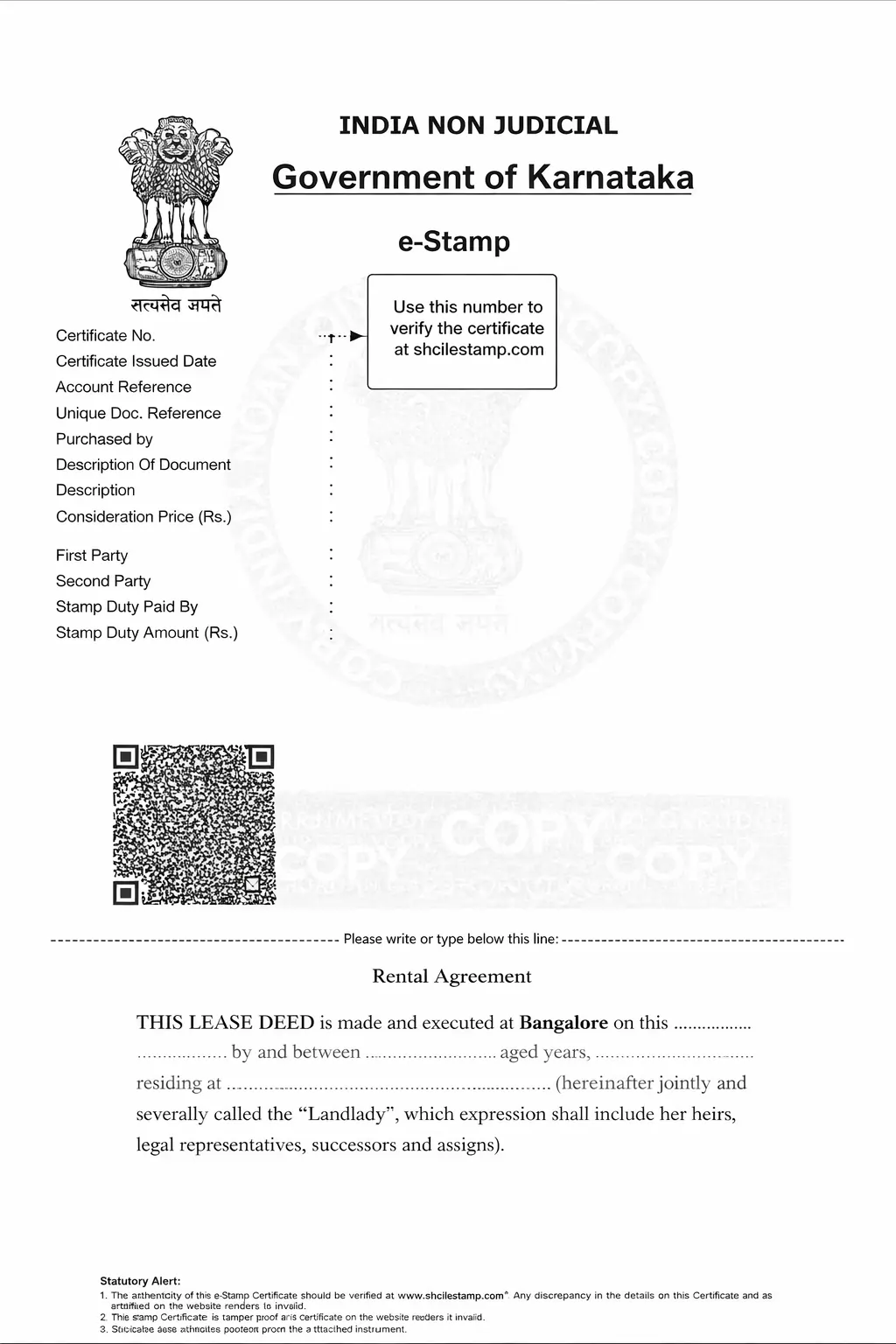
E-Stamped Rent Agreement Sample
Below is a Format/Sample of a valid E-Stamp certificate used for a rent/Lease Agreement.
How DigiLawyer Helps You With E-Stamp Rent or Lease Agreements?
Creates Legally Compliant Agreements: DigiLawyer drafts your rent or lease agreement following all state laws, ensuring it is enforceable in court.
Handles E-Stamping Smoothly: We manage the entire e-Stamp purchase process online, preventing errors and ensuring the stamp duty is correct.
Merges Documents Securely: Your agreement is digitally merged with the e-Stamp certificate to prevent tampering or fraud.
Offers Digital Signing or Delivery: Sign with Aadhaar e-Sign or get a printed copy delivered to your doorstep, making it fast and convenient.
Prevents Costly Mistakes: Ensures all names, rent details, and duration are accurate, so your document is legally valid from the start.
FAQ's
Is a black-and-white e-Stamp valid for rent and lease agreements?
Yes. A black-and-white printout of an e-Stamp certificate is legally valid. Its authenticity can be verified using the Unique Identification Number (UIN) and QR code. Legal validity comes from the government database, not the paper colour.
Is e-Stamping enough, or is registration also required?
E-Stamping is proof of stamp duty payment, but registration is mandatory for agreements longer than 11 months. Without registration, long-term agreements may not be legally enforceable.
What is the total cost of a rent or lease agreement?
The total cost includes stamp duty, registration fees (if applicable), drafting charges, service fees, and delivery or digital signing costs. The final amount is usually higher than just the stamp paper value.
Can I use one state’s e-Stamp for property in another state?
No. Stamp duty must be paid in the state where the property is located. Using a different state’s stamp makes the agreement legally invalid.
Where should parties sign a rent or lease agreement?
All parties must sign on the e-Stamp sheet and on every page of the agreement. Witness signatures are also required to prevent tampering.
What happens if stamp duty is underpaid?
An under-stamped agreement becomes legally weak. Courts may reject it, demand the deficit duty, and impose penalties up to ten times the original amount.
Can landlords and tenants share stamp duty costs?
Yes. Stamp duty costs can be shared mutually. While tenants commonly pay, the law allows flexible cost-sharing agreements.
What is the validity period of an e-Stamp certificate?
An e-Stamp does not expire once properly executed. If unused, cancellation may be allowed within six months depending on state rules.
Can details be corrected after an e-Stamp is issued?
No. Once issued, an e-Stamp cannot be edited. Errors require applying for a refund and purchasing a new stamp.
Is notarization enough without paying stamp duty?
No. Notarization only verifies signatures. Proper stamp duty payment is mandatory for legal validity.
Who pays the stamp duty — landlord or tenant?
There is no strict legal rule. Usually, tenants pay the stamp duty, but both parties can mutually decide cost sharing.
How long does it take to complete a rent or lease agreement online?
Online agreements usually take 24–48 hours for e-stamping and e-signing. If registration is required, it may take 3–5 working days.
Can rent or lease agreements be completed fully online?
Yes. Drafting, e-stamping, digital signing, and registration can be completed online without physical visits in most cases.
Can stamped and registered agreements be delivered at home?
Yes. Physical copies can be delivered to your home, and digital copies are also provided for secure storage.
Why is the total payment higher than the stamp paper value?
The printed stamp value covers government tax only. Additional costs may include drafting, service fees, processing charges, and delivery expenses.


- Why is Proper E-stamping Needed?
- The Legal Significance of E-Stamping Explained
- Types of Property Agreements Covered Under E-Stamping
- Benefits of an E-Stamped Property (Rent or Lease) Agreement
- How to Get the E-Stamp (Assisted vs Manual Process)
- Documents Required for All Property Agreements
- How Stamp Duty Is Calculated for Rent and Lease Agreements
- ➤ State-Specific Rules
- ➤ State-Based Rules
- 1. Registered Agreements (12 Months or More)
- 2. Notarised Agreements (Up to 11 Months)
- 3. Standard State-Based Calculation Formula:
- ➤ Tenure-Based Rules (Agreement Duration )
- 1. Agreements Up to 11 Months
- 2. Agreements of 12 Months or More
- ➤ Deposit Rule
- Why ₹100 or ₹500 for 11-Month Agreements?
- Registration vs Notarisation
- How Duration Affects Stamp Duty?
- 1. Lease Period / Rent Period
- 2. Lock-in Period
- 3 Stamp Duty Calculation Rule
- Information Required Before Buying an E-Stamp for a Rent/Lease Agreement
- 1. Before Buying Checklist
- Based on duration, rent, and deposit
- How to use an E-stamp for a Rent Agreement once the E-stamp is Purchased?
- 1. Document Integration
- 2. Signing Procedure
- 3. Notarisation or Registration
- 4. State-Based Cost Awareness
- Key Mistakes to Avoid When Buying an E-Stamp for a Rent Agreement
- E-Stamped Rent Agreement Sample
- How DigiLawyer Helps You With E-Stamp Rent or Lease Agreements?
- FAQ's


DigiLawyer, A 80, A Block, Sector 2, Noida, Uttar Pradesh 201301
Phone: +918178704343
justice@digilawyer.ai





Disclaimer: DigiLawyer is not a law firm, a substitute for a lawyer or law firm, a chartered accountancy firm, or a company secretary firm. We act solely as an intermediary between users and registered professionals, and also offer AI-powered legal assistance, consultation, and document drafting tools to improve access to legal support. Use of our website, services, or AI tools is at the sole risk of the user and does not create any lawyer-client or professional relationship. All consultations and interactions facilitated through our platform are strictly between the user and independent professionals. DigiLawyer is not liable for any actions, decisions, or outcomes arising from the use of our platform, AI tools, or reliance on any advice, consultation, or content provided by us or third-party professionals.
Use of our products and services is subject to our Privacy Policy & Terms of Service

